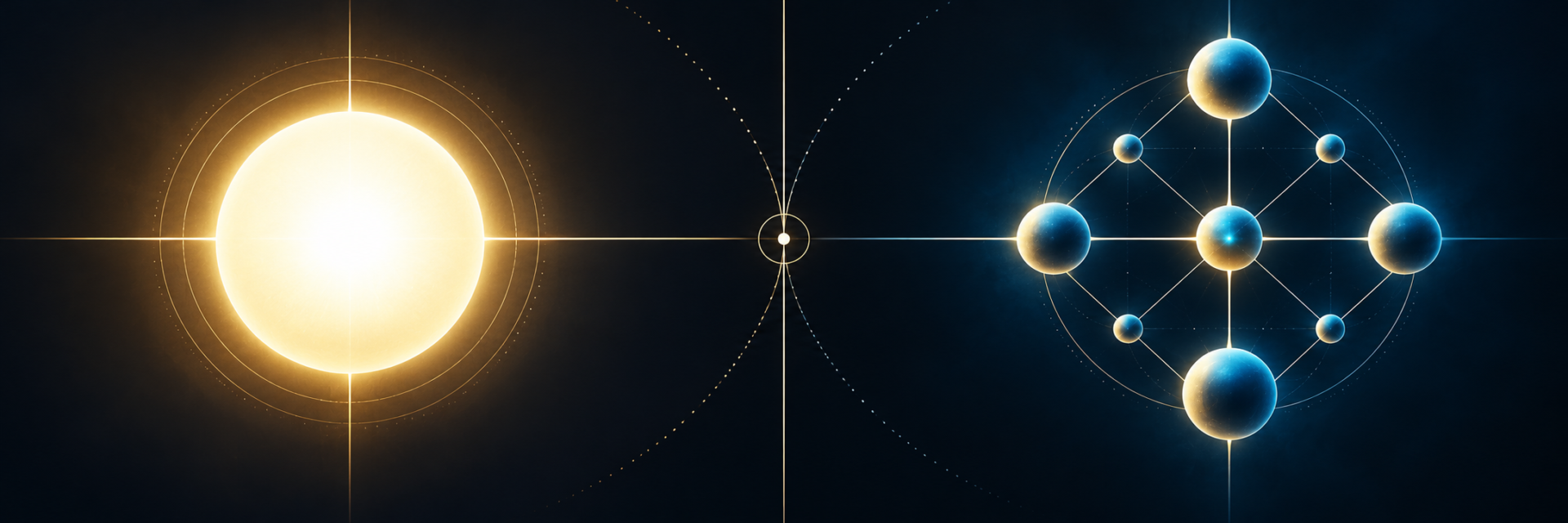
Divine Complexism
Can Divine Complexism Find Parity with the Divine Simplicity Tradition?
A Comparative Viability Audit of Constituent Models, Whole-Priority Complexism, and Catholic Doctrinal Constraints
Introduction
Divine simplicity is not merely the claim that God is unusually unified. In the classical tradition it belongs to a larger account of divine ultimacy: the first source of reality does not receive actuality, unity, existence, determination, or perfection from principles more basic than itself. God is not actual because some constituent actualizes him, one because distinct factors are combined into a unity, existent because an essence receives being, or perfect because numerically distinct perfection-parts jointly make him what he is. The force of the doctrine therefore depends on a metaphysical question about sourcehood: can the ultimate reality contain numerically distinct intrinsic constituents without thereby receiving from them something required for its own actuality or identity?
This study examines the strongest surviving forms of divine constituent complexism against that question. By constituent complexism, the primary target is not every real distinction in God, every use of mereological language, or every theory on which divine attributes have irreducibly different formal content. The target is the stronger thesis that the divine reality includes numerically distinct intrinsic items that are in some substantive sense proper constituents of God. That distinction matters because contemporary proposals range from ordinary part-whole models to truthmaker theories, constitution accounts, improper or symmetric parthood, primitive structure, grounding pluralism, and whole-priority theories. These models cannot be assessed merely by counting how often the word “part” appears.
The benchmark on the simplicity side is a six-route simple-source account, not the bare negative thesis that God has no parts. Its stronger intellectual claim is constructive: pure actuality, nonderivative unity, anti-composition, transcendence of genus or common measure, underived existence, and attribute simplicity converge upon a single account of the ultimate source as intrinsically actual, one, existent, determinate, and perfect without receiving completion from a numerically distinct intrinsic principle. The routes overlap and should not be treated as six wholly independent proofs. Their cumulative force lies in showing why sourcehood, perfection, unity, transcendence, and underived existence are expected to coincide in one noncomposite actuality. Simplicity, on this stronger account, is therefore an explanatory achievement rather than a mere subtraction of parts. The audit does not define ultimacy as simplicity in advance; it asks whether that richer convergence can be earned and whether any complexist rival can preserve the same explanatory work at comparable metaphysical cost.
That qualification is crucial because the hardest complexist countermodel reverses the ordinary explanatory direction. Instead of claiming that divine parts constitute or ground God, the model proposes a necessary and fundamental divine whole that grounds its alleged essential parts. Gregory Fowler develops this strategy as a Doctrine of Divine Priority, drawing on the general-metaphysical precedent of whole-to-part priority associated with Jonathan Schaffer. [1] [2] If the whole is already necessary, fundamental, fully actual, unified, and perfect, the bare fact that it has downstream constituents does not by itself contradict a minimal notion of ultimacy. The universal inference from “has proper parts” to “depends constitutively on proper parts” therefore requires argument rather than stipulation.
The central issue of the paper is consequently comparative rather than merely eliminative. A theory can survive an exclusion proof without becoming an equally warranted theory of God. Formal consistency, metaphysical intelligibility, explanatory adequacy, comparative adequacy, and theological admissibility are different achievements. The decisive question is not simply whether a surviving complexist ontology can be described coherently, but what explanatory work its proposed constituents perform, why that work requires proper constituency, and whether the gain is sufficient to justify the added ontology.
This produces a qualified robustness pressure. If numerically distinct constituents supply divine actuality, unity, existence, determination, or perfection, the classical dependence arguments reactivate: the constituents function as intrinsic principles through which the ultimate source is what it is. If the constituents are instead wholly downstream from an already complete God, the dependence problem is weakened, but the explanatory burden changes. Derivative constituents may still explain derivative effects, differentiated causal roles, truthmaking relations, or other downstream facts. Their being proper parts of God, however, needs a surplus payoff. The relevant challenge is to show what proper constituency explains that a grounded feature, formal distinction, relation, intentional specification, or other noncomposite differentiation could not preserve equally well.
The comparison must be symmetrical. A defender of simplicity cannot merely delete the rival’s constituents, rename them “formal distinctions,” and count the result as a victory. A noncomposite alternative earns comparative superiority only if it preserves the explanatory work that made the complexist model attractive in the first place: objective differences among divine perfections, modal structure, causal and truthmaking roles, genuine cognition and free agency, and, within Christian theology, the real personal distinction of Father, Son, and Spirit. The subtraction test therefore establishes domination only when the relevant truths, modal implications, causal and intentional roles, agency structure, and theological commitments are genuinely preserved.
A second and independent issue concerns Catholic admissibility. The philosophical audit asks whether constituent complexity is compatible with the stipulated conditions of absolute ultimacy and whether it offers sufficient explanatory benefit. Catholic theology adds a further boundary: Vatican I confesses God as absolutely simple, simplex omnino, and the broader conciliar tradition joins that simplicity to an indivisible divine substance and real Trinitarian distinction. [35] [7] This does not make every Thomistic account of identity, predication, or formal distinction dogmatically mandatory, nor does it allow unusual technical mereologies to be rejected by vocabulary alone. It does mean that a theory which literally composes the divine substance from numerically distinct constituent realities is not an equally admissible Catholic alternative merely because those constituents are necessary, inseparable, or grounded by the whole.
The argument proceeds by first fixing a deliberately weak account of ultimacy and identifying the disputed bridge from ultimacy to anti-composition. It then maps the surviving model space, tests the models against the six classical routes, applies robustness, subtraction, enrichment, and independent-motivation tests, examines knowledge and freedom where complexity may appear to offer its strongest intuitive advantage, and finally subjects Trinitarian models to a distinct theological viability filter. The aim is not to manufacture a universal contradiction where none has been shown, but to determine which models remain live, which are excluded by the starting metaphysics, which fail Catholic doctrinal conditions, and whether any surviving constituent model has actually earned parity with simplicity.
Standards of comparative judgment
The audit distinguishes five questions that are easily conflated. Defeating a universal exclusion argument answers only the first kind of challenge; it does not automatically answer the remaining four. The simple-source account bears a parallel burden: it cannot claim comparative superiority unless its own resources actually recover the explanatory successes claimed by its rivals.
Logical survival
Does the model avoid contradiction under the logic and premises it actually adopts? A model may pass this test even if it is poorly motivated or theologically unusable.
Metaphysical intelligibility
Are the proposed entities, relations, structures, and directions of dependence sufficiently clear to constitute a genuine metaphysical position rather than a merely formal diagram?
Explanatory adequacy
Does the model account for the features a doctrine of God must explain, including divine unity, attributes, actuality, agency, knowledge, freedom, and dependence?
Comparative adequacy
Does the added ontology purchase explanatory work that a developed rival cannot preserve at equal or lower cost? Conversely, if simplicity proposes to subtract proper parts, does it actually preserve the rival’s relevant explanatory achievements?
Catholic admissibility
Where the inquiry is explicitly Catholic, does the model remain compatible with the doctrinal commitments to absolute simplicity, indivisible divine substance, real personal distinction, and the whole-and-entire deity of each divine person? This theological filter is kept distinct from the philosophical proof so that doctrinal exclusion is not misreported as metaphysical contradiction.
These standards permit a more discriminating result than the binary alternatives “proved impossible” and “fully viable.” Some models fail the stipulated ultimacy directly. Some remain philosophically intelligible but lack a positive reason for proper constituency. Some use revisionary relations that move them outside ordinary constituent complexism. Some may be philosophically possible while failing the Catholic doctrinal filter. The remainder of the paper keeps these verdicts separate.
Framework and formal architecture
The methodological baseline is deliberately weak: absolute ultimacy begins with necessity, independent existence, and explanatory fundamentality; simplicity is not built into the definition. The audit therefore separates that baseline from the stronger proposition that every essential constituent must constitute the whole in an upward explanatory direction.
Let:
G="God/the absolutely ultimate source"x ≺ y = x metaphysically grounds y.PP(x,y) = x is a proper part of y.CP(x,y) = x functions as an intrinsic constitutive principle of y.Actᵢ(G) = the intrinsic actuality of G.Un(G) = the unity of G.Perf(G) = the intrinsic perfection of G.A sufficiently weak initial ultimacy thesis is:
U_0: □E(G)∧Fund(G)together with:
¬∃x≠G[x≺E(G)∨x≺Act_i (G)].That does not entail:
¬∃x PP(x,G).Indeed, inserting that conclusion at the outset would simply beg the question against Fowler.
The stronger six-route master principle should instead be treated as something the tradition is trying to earn:
U_6: ¬∃x≠G CP(x,G),where CP is not secretly defined as “proper part.” Rather:
CP(x,G)means that x is an intrinsic principle through which G has the actuality, unity, being, determination, or perfection belonging to G as absolute source.
That matches the architecture developed in the manuscript: two principal routes—pure actuality and nonderivative unity—converge upon anti-composition, after which genus/common measure, essence–existence, and attributes close more specific modes of reception. Aquinas’s own anti-composition argument explicitly links composition with posteriority to components, need of a cause of unity, and act-potency structure; his adjacent articles exclude accidents, genus-containment, and a real essence–existence distinction in God. [10]
The resulting target should therefore be stated positively. The six-route tradition is not satisfied by showing that no item bears the relation of proper parthood to God. It aims to show that divine actuality has no numerically distinct intrinsic source-principle because every candidate mode of reception—received act, received unity, composition, determination by a common measure, essence receiving existence, or perfection received through an attribute-constituent—conflicts with the explanatory role assigned to the absolute source. The achievement, if successful, is a unified metaphysics of underived actuality: God is not merely without parts but is the intrinsic source in whom actuality, unity, existence, and perfection do not await completion from anything more basic or internally contributory. This is the standard against which complexism must be compared.
The central proof gap can now be represented exactly:
CP(x,G)→Depend(G,x)is comparatively easy to motivate once CP has been established.
But:
PP(x,G)→CP(x,G)is the disputed universal bridge.
Aquinas asserts a strong version when he says that every composite is posterior to and dependent upon its components. [11] Cohoe gives a sophisticated contemporary defense of a related independence principle: if something internal or external “makes you what you are,” then you are ontologically dependent upon it; he argues that moderate independence is too weak because priority-monistic wholes can satisfy it. [12] Fowler’s strategy is to deny that all proper parts of God make God what God is in that explanatory direction. [1]
That locates the dispute more sharply than either slogan:
“composition always depends on parts”
or:
“parthood and grounding are simply unrelated.”
The research sequence should therefore be understood as follows:
There is also a methodological reason not to make everything depend upon a single formal grounding relation. Contemporary grounding theory does not provide a unanimous strict-order logic. Bliss argues that grounding circles need not automatically be vicious; Rodriguez-Pereyra argues against treating grounding as necessarily irreflexive, asymmetric, and transitive; Rettler develops a theory on which different relations can realize the grounding role in different contexts. [13] Consequently, a successful six-route critique should target the metaphysical work performed by a relation, not merely whether a theorist writes the symbol ≺ next to it.
That principle proves crucial throughout the audit.
Taxonomy of the surviving model space
The major models differ along two axes: where fundamentality lies and whether differentiation contributes upward to the divine whole.
Part-priority complexism has the most familiar structure:
PP(a,G)∧PP(b,G)and:
{a,b}≺G.If the grounding target is God’s existence or intrinsic actuality, this model is excluded already by the stipulated minimal ultimacy thesis. Nothing controversial about universal mereology is needed. The conclusion follows from the model’s own upward explanatory direction.
A property-bundle theory belongs here whenever:
G=a⊕b⊕cand the properties jointly constitute what God is. Contemporary discussions of divine simplicity still regularly frame bundle and trope ontologies as relevant alternatives precisely because they offer different accounts of the relation between object and attributes. [14] A bundle-complexist may be perfectly coherent as a theory of an ordinary or even necessary entity, but it does not survive this minimal ultimacy condition if the bundle grounds the divine whole.
Mutual-grounding complexism asserts something like:
G≺a, a≺G.If these are full instances of the same asymmetric relation concerning the same actuality, the model is in obvious trouble under orthodox grounding assumptions. But it would be an overstatement to call all such networks formally contradictory, since contemporary grounding literature contains sustained challenges to strict asymmetry, transitivity, and anti-circularity. [15] The more decisive criticism is simpler: once a grounds the intrinsic actuality of G, minimal ultimacy is already surrendered. If the theorist instead types the two arrows differently, the model becomes a case of grounding pluralism and must be tested relation-by-relation.
Whole-priority complexism reverses the direction:
G≺a, G≺b,with:
¬(a≺G)∧¬(b≺G).This is Fowler’s central maneuver. His DDP is explicitly modeled using contemporary work on monism and dependence and is offered as a viable alternative to DDS that preserves its traditional aseity motivation. [1] Schaffer’s priority monism is the strongest independent metaphysical precedent: wholes may be fundamental even though they have parts, and explanation may run downward from whole to parts. [2] This is the hard case for the six routes.
Primitive structured-whole complexism refuses both directions:
PP(a,G)∧PP(b,G)but neither:
a≺Gnor:
G≺a.The whole-with-this-structure is simply fundamental. Formally, nothing in minimal ultimacy forbids it. The cost has shifted: instead of explaining constituent plurality downward, the model takes internally differentiated primitive structure as part of the explanatory terminus.
Property complexism is importantly different from arbitrary mereology because the differentiated items have obvious candidate work to do. Ramon Harvey’s 2026 model is unusually explicit. He considers both a constituent ontology with a substratum bearing metaphysically distinct inseparable properties and a bundle model in which God consists of mutually distinct essential properties, and develops a paracomplete constructivist logic intended to articulate strict unity without begging the question for simplicity. [8] This is one of the strongest robust complexist models in the current literature.
Intrinsic-state or dynamic complexism adds contingent intrinsic states:
State(G,s_1,w_1), State(G,s_2,w_2), s_1≠s_2.This is formally compatible with minimal fundamentality. If the contingent intrinsic states are received determinations through which God becomes actual in some respect, pure actuality targets them directly. But cross-world intrinsic variation is not by itself temporal change, and it should not be criticized as though a different eternal choice in another possible world were a transition occurring within God. The simple tradition can propose an invariant intrinsic act with terminative or relational specification, but that is a live explanatory proposal rather than a banked victory: it must still explain intentional content, free selection, reflexive knowledge of the creative exercise, and providential control. [26] [37] Thus contingent knowledge or free creation does not by itself generate an explanatory advantage for constituent parts, but neither has simplicity earned the answer merely by naming a terminus distinction.
Grounding-pluralist complexism says, for example:
G≺_E awhile:
a≺_C Structure(G),where ≺_E is existence-grounding and ≺_C is constitution. The logical maneuver is legitimate; contemporary work gives independent reasons not to presume that every metaphysical explanatory relation behaves identically. [16] But its success depends entirely upon what ≺_C does. If a is thereby a principle through which the intrinsic actuality of G is what it is, renaming the relation does not avoid the master principle. If it does not play such a role, the model approaches the thin horn.
Mereological Trinitarian theories form several distinct families rather than one. Molto proposes a deliberately nonstandard “Latin” mereology according to which each divine person is an improper part of God while remaining nonidentical to the others. [17] Brower and Rea instead employ an analogy with material constitution and “numerical sameness without identity”; their model does not simply say that three proper parts fuse into God. [18] Byerly’s truthmaker model puts the persons into the substantial constitution of minimal truthmakers for God-predications, which likewise does not straightforwardly make them proper constituent parts of the divine actuality. [19] These distinctions matter: several sophisticated “constitution” theories survive precisely because they do not assert the simple proper-part ontology under audit.
Scotistic or quasi-Scotistic formal plurality should not, finally, be counted as ordinary constituent complexism. Scotus asks explicitly whether objective distinctions among essential perfections can coexist with divine simplicity, and answers that wisdom and goodness are formally nonidentical in the reality while still really identical through infinity. [20] In the same distinction he explicitly argues for supreme divine simplicity and against composition from essential parts. [21] Paasch’s recent proposal that the formal distinction is best modeled as a mereological fusion is a substantive interpretive development, but its point is to represent Scotistic formal identity/nonidentity relations, not to turn Scotus into a Fowler-style theorist of ordinary divine proper parts. [5]
Two recent boundary cases reinforce this taxonomy. Gan’s 2026 symmetric-parthood account lets distinct attributes be mutual parts without being proper parts and presents the result as DDS. [9] Harvey’s 2026 account goes in the opposite direction and deliberately constructs a genuinely complex divine nature. [22] Together they show why the operative divide is not simply “does the author use the word part?” but:
▭("Does anything numerically distinct perform upstream constitutive work in divine actuality?" )Six-route pressure and the four-level philosophical viability audit
The six routes do not bear equally upon every model. The matrix below distinguishes direct exclusion (X), substantial pressure requiring an additional bridge (△), and no independent exclusion (∘).
| Model | Pure actuality | Nonderivative unity | Anti-composition | No common measure | Essence–existence | Attribute simplicity |
|---|---|---|---|---|---|---|
| Part-priority whole | △/X | △/X | X | ○ | ○ | △ |
| Property bundle | △ | ○ | X | ○ | ○ | X |
| Substratum + essential properties | △ | ○ | △ | ○ | ○ | X |
| Same-type mutual grounding | △ | △ | X | ○ | ○ | △ |
| Typed grounding network | △ | △ | △ | ○ | ○ | △ |
| Whole-priority | ○ | ○ | △ | ○ | ○/△ | ○/△ |
| Primitive structured whole | ○ | △ | △ | ○ | ○/△ | △ |
| Contingent intrinsic-state model | △/X if received determination | ○ | △ | ○ | ○ | △/X |
| Proper-part Trinitarian fusion | ○/△ | X if fusion confers unity | X/△ | ○ | ○ | △ |
| Harvey paracomplete property model | △ | framework-specific | △/X | ○ | ○ | X |
| Scotistic formal richness | Pass | Pass | Pass | Pass | Pass | Pass under formal distinction |
| Gan symmetric-parthood DDS | Pass claim | Pass claim | revisionary | ○ | ○ | revisionary pass |
The classical anti-composition entry remains the central disputed one. Aquinas explicitly gives several grounds: components make a composite posterior and dependent; distinct items require a cause of their union; and composition introduces act-potency relations. [11] Whole-priority blocks the easy generalization: if the whole grounds its alleged components, Aquinas’s ordinary direction of posteriority is precisely what has been denied. The question must therefore be carried by the explanatory role of the constituents, not by the bare word “part.”
The four-level philosophical analysis below distinguishes formal consistency, metaphysical intelligibility, explanatory viability, and comparative adequacy. Catholic admissibility is intentionally kept as a fifth, separate filter in the next section so that theological exclusion is not confused with philosophical contradiction.
| Model | Formal consistency | Metaphysical intelligibility | Explanatory viability | Comparative adequacy |
|---|---|---|---|---|
| Part-priority | ✓ outside ultimacy premise | ✓ | ✓ | ✕ relative to stipulated ultimacy |
| Mutual strict grounding | △ depends on grounding logic | △ | △ | ✕ |
| Typed mutual network | ✓ | △–✓ | △ | △ |
| Whole-priority | ✓ | ✓ | △ | △ |
| Primitive structured whole | ✓ | △–✓ | △ | △ |
| Property/substratum complexism | ✓ | ✓ | ✓ | ✕/△ once six routes imposed |
| Harvey paracomplete model | ✓ in its constructive framework | ✓ as a logical model | △ pending metaphysical realization | △ |
| Downstream property model | ✓ | △ | △ | △ |
| Proper-part Trinity | ✓ under some mereologies | △ | △ | ✕ under Catholic grammar |
| Scotistic formal richness | ✓ | ✓ | ✓ | ✓ as nonconstituent rival |
Formal consistency
Whole-priority clearly passes this stage. Schaffer’s literature independently establishes that “whole prior to parts” is a genuine metaphysical position rather than a syntactic impossibility. [2] Primitive structure does as well. Mutual networks are more conditional because their formal standing varies with one’s grounding logic; Bliss and Rodriguez-Pereyra prevent us from simply treating every circle as a logical contradiction. [15] Harvey’s model requires an important qualification: it yields a consistency result inside a constructive framework in which distinctness is primitive and not equivalent to negated identity. [23] That is a substantive logical achievement, but not yet a direct verdict on the ordinary identity/nonidentity formulation.
Metaphysical intelligibility
Whole-priority again passes at least minimally: circles and regions provide intelligible cases where parts can be understood through a prior whole, and Schaffer develops this into a general theory of fundamentality. [2] But there is an important gap between:
“the whole grounds its parts”
and:
“the whole grounds parts that are essential to it while those parts perform no constitutive work whatsoever.”
Schaffer motivates the first. Fowler applies it to God. Neither independently establishes the second as a general theorem of whole-part metaphysics. Fowler’s proposal is therefore intelligible, but its strongest divine version remains a further posit. [1]
Explanatory viability is where the strongest survivor begins to incur positive-theory debts. Whole-priority by itself tells us what would ground divine parts if there were such parts; it does not establish that there are any. The model must also individuate the proposed constituents, justify why these divisions are essential, explain the difference between God’s being intrinsically wise and the existence of a derivative item called God’s wisdom, and recover the broader profile of a perfect transcendent Creator. None of these demands proves impossibility, but together they prevent formal survival from being mistaken for explanatory adequacy.
This creates a qualified robustness squeeze.
The decisive complexist dilemma can now be made explicit. The most forthright “bite-the-bullet” form of constituent complexism is the robust view on which numerically distinct intrinsic constituents genuinely explain why God is actual or perfect in some respect. On such a model, divine Wisdom is not merely a derivative expression of an already wise God; it is an intrinsic principle through which God is wise, and likewise for power, knowledge, or other perfections. The advantage is substantial: the parts perform genuine metaphysical work. The cost is equally substantial. The complexist must deny the classical principle that absolute ultimacy excludes being intrinsically constituted or completed through something numerically distinct from oneself. Robust constituency is preserved only by allowing the ultimate source to be underived in one sense while nevertheless deriving some intrinsic determination from distinct internal principles. That is not a formal contradiction, but it is a substantive revision of the conception of ultimacy that motivates the six-route account.
Whole-priority complexism avoids that bullet by reversing the explanatory direction. God is already fully actual, unified, existent, and perfect, and the alleged parts are grounded in God rather than constituting him. But that success forces the opposite concession. Proper parthood becomes increasingly difficult to motivate precisely because the parts no longer explain the divine actuality they were introduced to analyze. A downstream constituent may still explain derivative effects, truthmaking facts, or differentiated causal roles; what remains unestablished is the surplus explanatory value of its being a proper part of God. The dilemma is therefore sharp: robust complexism is dependence-vulnerable, while downstream complexism is explanatory-vulnerable. The former gives the parts real metaphysical work by weakening underived sourcehood; the latter preserves underived sourcehood only by making the distinctive payoff of proper constituency increasingly obscure.
Suppose:
PP(Wisdom,G)and divine wisdom explains why:
Wise(G).
If “Wisdom” is an ontological constituent through which G is intrinsically wise, route six has its target:
Wisdom→Perf(G).Suppose instead:
G≺Wisdomand the wisdom constituent contributes nothing to God’s already-complete intrinsic actuality. That does not make the constituent explanatorily inert: a derivative property could still explain derivative effects, mark a causal role, or function within a broader truthmaker theory. The sharper demand is whether its being a proper part of God explains anything that the relevant property, formal differentiation, causal role, or grounded feature could not explain without composing the divine essence. The complexist must identify that surplus payoff.
PP(Wisdom,G)rather than that the one divine actuality possesses a formally irreducible wisdom-content.
Scotus shows that the latter option is not merely a modern rescue maneuver. He insists both that divine essential perfections possess objective formal nonidentity and that infinity accounts for their real identity. [20] His system therefore supplies a powerful competitor to thin property-complexism.
Harvey’s model illustrates the opposite horn beautifully. His account is not thin: the divine substratum and multiple properties—or, on the bundle variant, the multiple properties themselves—are genuine constituents of the complete divine reality. [23] That gives complexism positive content. But this is precisely why the six-route critic can ask whether the divine reality is what it is through those numerically distinct properties. Harvey’s paracomplete solution can show that strict unity and multiplicity need not be logically inconsistent; it does not show that a property-constituted ultimate receives no intrinsic determination through its properties. Thus:
Harvey strengthens complexism against the unity objection while exposing it more fully to the constitution objection.
The distinction is fundamental.
Comparative adequacy then asks not whether the complexist can remain standing but whether the added ontology buys something unavailable to a developed simple theory. No surveyed constituent model currently demonstrates such a net gain. That is a claim of unestablished advantage, not yet a proof of strict theoretical domination.
That conclusion is reinforced by the general-metaphysics background. Schaffer’s priority monism is a serious independent motivation for downward dependence, but his arguments appeal to cosmos-specific considerations such as entanglement and gunk. [2] Morganti argues that the case for priority monism is not compelling, while Miller argues that Schaffer’s case does not establish the universe as uniquely fundamental. [24] Thus Fowler has something much better than an ad hoc grounding reversal—he has an independently developed metaphysical analogy—but that analogy establishes permission, not a compelling reason to populate God with proper constituents.
Cohoe makes exactly the corresponding simplicity-side point: a merely moderate independence requirement is insufficient because a priority-monistic whole can satisfy it just as a complex ultimate can; if absolute ultimacy is supposed to discriminate further, a stronger account of ontological independence is needed. [12] That pressure is real, but an important caution remains: the stronger independence principle must still be defended rather than encoded into “ultimate.”
Robustness, subtraction, enrichment, and independent motivation
The most revealing test is not another direct proof but a sequence of transformations applied to each survivor.
Define a constituent model:
M_C=⟨G,a,PP(a,G),G≺a⟩.Now construct a subtraction model:
M_F=⟨G,F_a,FormalDifference(F_a,G)⟩,or more generally:
M_D=⟨G,d_a,GroundedDifferentiation(d_a,G)⟩.Then ask:
Δ_E=Explananda(M_C)-Explananda(M_F).If:
Δ_E=⌀,and the nonconstituent competitor preserves the same relevant truths, modal profile, causal and intentional roles, agency structure, and theological commitments, while there is no independent evidence for proper parthood, then the constituent model is genuinely dominated. If those preservation conditions have not been shown, the subtraction test has only identified a competitor.
For divine attributes, the subtraction challenge remains strong but should not be overstated. Baddorf’s Power-Knowledge Difference principle is a clear example of the strongest complexist bridge: it says that truths about power and knowledge are grounded in nonidentical parts. [36] That principle gives proper constituency genuine explanatory ambition, but it is also exactly what requires argument. Difference in meaning or formal content does not by itself entail different concrete actualizers. Scotus permits wisdom and goodness to be objectively and intrinsically nonidentical in formal content while rejecting essential-part composition, and Aquinas argues that divine names need not be synonymous despite their one simple referent. [4] [38]
Paasch complicates but does not overturn this result. His argument that Scotus’s formal distinction can be modeled as mereological fusion shows that mereological formalisms can capture far subtler relations than ordinary Boolean proper-parthood. [5] The lesson is not that Scotus secretly conceded Fowler’s thesis. It is that mereology itself is too flexible to decide the theological issue.
Gan’s 2026 symmetric-parthood model drives the same point home from a contemporary direction. Gan allows potentially distinct attributes while saying God is a part of all God’s parts and defines simplicity through the absence of non-symmetric proper parts. He argues that this can preserve the standard motivations from aseity, transcendence, immutability, and unity. [9] Hence a complexist cannot infer robust constituent ontology merely from the availability of a “part” relation. Once parthood is revisionary enough, it may be doing the work of identity or formal containment rather than classical constitution.
The enrichment test then asks what happens once the austere whole-priority model is made theologically useful.
Start with:
G≺a,b,c.Add wisdom:
a=Wisdom_G.Add will:
b=Will_G.Add knowledge:
c=Knowledge_G.If these explain the corresponding intrinsic divine perfections, the model has become robust enough for route six and, depending on its theory of act, route one to bite. Aquinas’s anti-accident argument expressly treats a subject’s relation to accidents as potency to actuality and denies that God can be actualized in this way. [25] A complexist can deny Aquinas’s metaphysics, of course, but then the disagreement is substantive; whole-priority alone has not answered it.
Now add contingent creation. The complexist may say God possesses a contingent intrinsic state:
Created(G,w_1)≠NotCreated(G,w_2).That provides an intuitive representation of alternative divine acts, and this may be a real comparative attraction of complexism: differentiated intentional states are easier to picture when they are intrinsic. But the cost must be stated accurately. Cross-world variation is not temporal change, and contingent determination is not automatically an improvement in perfection. The pressure arises if such states are received actualizations or if their intentional content makes divine actuality depend on something distinct. The simple tradition can instead distinguish intrinsic act from terminus, but that proposal must earn its adequacy by explaining agency, control, and complete intentional content. [26] [37]
The same structure applies to knowledge. Let:
K(G,p)and:
K(G,q)be complete knowledge facts. The simple theorist need not infer:
Act_p (G)≠Act_q (G).A terminative framework can distinguish a numerically invariant intrinsic act from differing termini and hence from differing complete intentional facts. That blocks the immediate inference from “different known worlds” to “different intrinsic acts.” But the framework still owes an account of how the one act is knowingly and freely exercised toward this terminus rather than another. For that reason the audit should treat terminative differentiation as a serious simple-side resource, not as a completed solution. The complexist, however, cannot claim that numerically additional essential parts solve the selection problem merely by being additional.
“different known objects”⇒”different intrinsic cognitive constituents”.
That non sequitur is exactly analogous to the formal-role/realizer mistake exposed in the attribute case.
The primitive-structure model fares somewhat better here. It can say:
Structure(G)=Primitive.No constituent grounds God and God does not ground the structure as though first existing bare. Rather, this structured G is fundamental.
This model deserves serious status because explanatory stopping points exist in every metaphysics. Two versions must nevertheless be distinguished. If the internal constituents are themselves ungrounded, the theory has introduced additional basic realities and thereby abandons any stronger thesis that everything distinct from God is derivative from God. If one fundamental divine reality explains the constituent structure, the view has effectively returned to whole-priority and inherits its unpaid constituency burden. The simple theorist is not entitled to demand an explanation of primitive structure while allowing simple actuality to be primitive without argument; the relevant comparison is between total explanatory commitments.
But burden symmetry does not yield parity. A primitive fact can encode substantial unexplained organization, just as a simple reality can require an elaborate theory of predication and agency. The comparative question is whether primitive numerical differentiation solves a problem that the simple account cannot solve at equal or lower cost. No surveyed primitive-structure model has yet established that indispensable gain.
The whole-priority model faces a similar comparison:
■("Simple model:" &G" is intrinsically rich without proper-part decomposition" ;@"Whole-priority model:" &G" is intrinsically rich and grounds proper parts expressing that richness" .)
The question is then:
What does " PP(a,G)" explain that " GroundedFeature(a,G)" does not?
Fowler shows that the first description can be made coherent enough to take seriously. [1] The literature surveyed does not yet supply a decisive answer to the second question.
Grounding pluralism does not materially improve the situation. Rettler’s work gives strong independent reason to resist crude assumptions that all grounding talk names exactly one relation behaving identically in every context. [16] But pluralizing relations only prevents illegitimate formal inferences. It cannot convert genuine constitutive dependence into nondependence. If:
a≺_C Act_i (G),where ≺_C is constitution rather than “grounding proper,” then the six-route objection is directed at the metaphysical content of ≺_C, not at its label.
This yields a general principle:
▭("Typed relations defeat equivocation arguments; they do not by themselves defeat dependence arguments." )
The newest explicit complexist model, Harvey’s, confirms the need to distinguish logical modeling from metaphysical realization. Harvey’s constituent ontology is intentionally robust, but his formal device is not ordinary nonidentity: identity (=) and distinctness (≠) are primitive predicates, and distinctness is explicitly not equivalent to negated identity. [23] His model can therefore leave the relation between God and a constituent neither identical nor distinct in that technical sense while retaining mutual distinctness among the properties.
“plurality”⇒”logical failure of unity”.
The six-route tradition does not need to contest the model by simply reasserting classical excluded middle. Its better question is whether the constituent properties are principles through which the complete divine reality is intrinsically what it is, and if so whether that constitutive role is compatible with underived actuality and unity.
Is the whole intrinsically actual/perfect through distinct constituents?
Harvey’s positive constituent ontology makes that sourcehood question pressing, but the audit must also respect the paper’s own limits. Harvey states that the consistency of the intensional model does not establish correspondence to God’s factual existence and that wider metaphysical arguments are still required. [23] Accordingly, the model should be credited as a sophisticated unity-consistency proposal, not as a completed metaphysical demonstration of a complex divine nature.
That distinction substantially clarifies what the six-route tradition should and should not claim.
Trinity and the theological viability filter
The Trinity deserves its own test because a metaphysics may be philosophically possible yet unusable within Catholic theology. The standard here must also be precise: Nicaea alone should not be made to settle every later question about mereology, but Catholic doctrine as a whole does impose two nonnegotiable boundaries—real personal distinction and an absolutely simple, indivisible divine substance. Vatican I’s simplex omnino is therefore relevant to every literal essence-composition model, not only to theories of personal parts. [35]
Scriptural and catechetical pressure on sourcehood
The Catholic theological filter is not generated solely by later technical vocabulary. Exodus 3:14 supplies the principal biblical anchor for the divine name, “I AM WHO I AM,” which CCC 213 interprets as revealing God as the fullness of being and every perfection, without origin or end: creatures receive what they are and have from God, whereas God alone is his very being and is “of himself everything that he is.” [39] Psalm 102:27–28 and James 1:17 reinforce the contrast between mutable creatures and the unchanging Creator, while Acts 17:24–25 intensifies the asymmetry of dependence by portraying God not as one who needs completion from another but as the giver of life, breath, and everything. These texts do not, taken by themselves, deductively prove constituent simplicity. Their dialectical force against the strongest whole-priority complexism is narrower and more exact: the model can preserve this scriptural grammar of radical sourcehood only by making its alleged proper parts wholly downstream from an already complete God. Once that move is made, the paper’s central comparative question returns with greater force: what explanatory work is performed specifically by their being proper parts rather than grounded differentiations of a divine actuality already “of himself everything that he is”?
The Catholic dogmatic constraints relevant to mereology are especially strong. A technically unusual “part” vocabulary is not automatically condemned; what matters is whether the ontology really partitions the divine substance, makes divine unity merely collective, or turns the persons into lesser bearers of a deity possessed more fully by a superior whole.
Father≠Son≠Spiritas persons;
yet:
D(Father)=D(Son)=D(Spirit)where D is not a distributed share but the one divine substance.
The Trinitarian side of the same theological grammar is equally important. Matthew 28:19 places Father, Son, and Holy Spirit under the singular divine “name”; 2 Corinthians 13:13–14 joins the grace of Christ, the love of God, and the fellowship of the Holy Spirit in one liturgical confession; and John 14:26 and John 15:26 articulate real personal distinction through mission and procession. CCC 253 gathers this scriptural pattern into the claim that the persons do not divide the one divinity among themselves but that each is God “whole and entire,” while CCC 254–255 locates their real distinction in relations of origin rather than partition of the divine substance. [28] Fourth Lateran likewise rejects a merely collective unity and affirms one supreme divine reality that is each of the three persons; it also excludes a division in which the Father communicates only part of his substance. [7] Again, the biblical texts do not independently furnish a complete mereology. They constrain the kind of complexism that can count as Catholic: real personal distinction must be preserved without partial deity, collective deity, or a superior whole that possesses divinity more fully than the persons.
That creates a powerful theological filter:
| Trinitarian model | Philosophical status | Catholic/Nicene-Lateran fit |
|---|---|---|
| Three proper parts whose fusion constitutes God | Formally specifiable | Catholic-inadmissible if proper parts are less than the whole or partition the one divine substance |
| God as collective/group unity of three divine individuals | Formally specifiable | Collective conception conflicts with Lateran IV's anti-Joachim boundary and the one indivisible divine substance |
| Fowler-style whole prior to three proper personal parts | Philosophically stronger | Still inadmissible if whole-priority makes the persons lesser bearers of deity or the whole a superior divine subject |
| Brower–Rea constitution | Serious analytic model | Designed for orthodoxy; controversial, but not ordinary proper-part fusion and must be judged on its constitution relation |
| Molto improper-part mereology | Formally revisionary | Revisionary and theologically motivated; closer to “each wholly God,” but not evidence for ordinary proper-part composition |
| Byerly truthmaker account | Serious analytic model | Does not straightforwardly compose the divine essence; potentially compatible if truthmaker constitution is not divine-substance composition |
| Scotistic/Latin relational distinction | Historically established simple model | Historically consonant with one simple essence plus real personal distinction; still requires a coherent account of relations of origin |
| Gan-style symmetric parthood | Boundary/simple model | Boundary/simple model; revisionary metaphysics rather than ordinary constituent partialism |
This is where the distinction between formal non-condemnation and theological misordering becomes philosophically useful. There are different kinds of theological failure.
No contemporary model should be called “anathematized” merely because its author uses an unfamiliar mereology. But a model inherits a dogmatic exclusion if its metaphysical commitments entail a proposition the councils reject. A theory whose divine unity is literally only collective runs into Lateran IV’s explicit anti-collective boundary. [29] A theory on which the Son possesses only one-third of divine being conflicts with the requirement that each person is God whole and entire. [28] A theory that merely uses a revisionary word “part” while preserving whole-and-entire deity has a different problem: the question becomes whether “part” is still doing the work ordinary complexism needed it to do.
Brower and Rea illustrate the distinction. Their 2005 model appeals to an Aristotelian-style account of material constitution and numerical sameness without identity, presenting the persons as analogous to entities sharing the same matter rather than simply as thirds fusing into a fourth being. [18] Craig immediately pressed the disanalogy that neither God nor the persons should literally be composed of material stuff and questioned what explanatory illumination the material analogy adds; Hasker later offered a sustained critique of the proposal. [30] Whatever verdict one gives, Brower–Rea cannot simply be entered into the ledger as “God has three proper parts.”
Molto makes the mereological revision even more explicit: the persons are improper parts of God and, under his nonstandard system, God and the persons can be mutual improper parts without numerical identity. [17] That is philosophically interesting precisely because it tries to encode “each is wholly God.” But once ordinary antisymmetric mereology is abandoned and every person is “all” of the whole in the relevant sense, the model ceases to supply evidence for the ordinary complexist thesis:
∃x PP(x,G).Byerly moves farther away from divine constituent complexity. His model says each person can be the sole substantial constituent of a minimal truthmaker for claims about God. [19] Constitution of truthmakers is not automatically constitution of the divine actuality. The six-route framework’s insistence on typed relations therefore becomes an advantage here: a truthmaker relation should not be silently converted into ontological parthood.
The Trinity thus does not provide the whole-priority complexist with the decisive enrichment advantage one might initially expect. Ordinary personal-parts models face at least three further burdens: complete divine qualities are not yet numerically undivided divine being; the primacy of a whole cannot make Father, Son, and Spirit ontologically lesser bearers of deity; and the model must locate divine agency without introducing a collective or superior fourth subject that becomes the primary agent. A revisionary mereology may try to block those implications, but it must show exactly how.
It does establish:
“real intrinsic personal distinction”.
It does not establish:
“proper-part distinction”.
Indeed, under the Catholic grammar, the second thesis incurs a substantial additional burden because each person must still be wholly the one indivisible divine nature. [31]
Scotus is especially instructive at this junction. His essential attributes are formally nonidentical while really identical; his theology does not treat divine wisdom as an added perfection-part. [20] His own simplicity argument explicitly denies composition from essential parts and connects formal giving of being with limitation and dependence. [21] The resulting position is not “Fowler before Fowler.” It is a historically powerful instance of:
▭("objective multiplicity of intelligible content without constituent multiplication of divine actuality" .)That is precisely the alternative that makes the thin complexist’s additional ontology hard to justify.
Final ranking and strongest warranted thesis
The comparative results permit a much sharper classification than the crude binary “refuted/not refuted.”
| Rank | Model | Final classification | Reason |
|---|---|---|---|
| Benchmark | Six-route simplicity with objective formal/relational/terminative differentiation | Comparatively best-supported within this project | Preserves ultimacy and Catholic simplicity while offering nonconstituent resources; still owes integrated accounts of predication, agency, knowledge, and freedom |
| Strongest complexist survivor | Fowler-style whole-priority | Serious philosophical survivor; no parity established | Downward dependence is independently intelligible, but the existence, individuation, essentiality, and surplus payoff of divine proper parts remain unestablished |
| Next | Primitive structured whole | Serious survivor; no parity established | Escapes simple grounding reversal but either adds primitive basic structure or collapses toward whole-priority; no indispensable payoff shown |
| Next | Typed grounding-pluralist whole | Legitimate clarification, not established solution | Avoids illicit transfer between dependence relations but does not itself motivate proper constituency |
| Next | Downstream property complexism | Coherent; no net advantage established | Derivative constituents may explain derivative effects or roles, but proper-parthood has not been shown to add a compensating benefit |
| Next | Harvey paracomplete constituent complexism | Serious logical unity model; metaphysical verdict open | Distinctness is primitive rather than negated identity, and the author expressly leaves factual realization to further metaphysical argument |
| Next | Molto/Gan-style revisionary mereology | Boundary cases outside ordinary proper-part complexism | Mutual, improper, or symmetric parthood may encode nonstandard identity/containment relations and must be assessed semantically |
| Next | Brower–Rea / Byerly constitution models | Not straightforward members of target class | Constitution or truthmaking does not automatically mean the divine substance is an ordinary proper-part whole |
| Next | Mutual full-grounding network | Excluded if constituents ground divine actuality; otherwise requires typed analysis | Strict circularity is not universally contradictory, but upward determination of divine actuality violates the starting ultimacy |
| Next | Ordinary proper-part Trinity | Catholic-inadmissible where partition/collectivity/superior-whole implications obtain | Conflicts with whole-and-entire deity, noncollective unity, or personal equality when ordinary part-whole consequences are retained |
| Next | Property bundle/part-priority deity | Excluded relative to stipulated ultimacy where constituents actualize God | Necessity does not erase constitutive dependence; literal divine-substance composition also conflicts with Catholic simplicity |
| Next | Contingent intrinsic-state complexism | Substantive rival; pressure is conditional | Potentially clarifies differentiated intentional acts, but pure-act pressure applies if states are received determinations; modal variation alone is not temporal change |
| Outside target class | Scotistic formal distinction | Noncomplexist resource; major competitor to constituent accounts | Preserves objective formal richness without essential-part composition, but must still integrate with agency, knowledge, and Trinity |
No surveyed ordinary constituent model has yet established overall explanatory superiority to the six-route simple-source account.
Nor does any presently merit the category “genuine dialectical peer” within the combined philosophical and Catholic criteria of this project.
The important qualification is that this latter verdict does not mean:
□¬Complex(G)has now been established from minimal ultimacy.
The whole-priority and primitive-structure survivors prevent that conclusion. Fowler’s proposal has enough general-metaphysical ancestry in Schaffer’s priority monism that it would be unfair to call it ad hoc or unintelligible. [32] And contemporary grounding theory is diverse enough that one cannot manufacture a universal contradiction simply by imposing strict asymmetry or transitivity on every explanatory relation. [13]
But survival is not parity.
The audit now supports three different kinds of judgment, and they should not be conflated.
First, some models fail the stipulated philosophical ultimacy. Whenever numerically distinct constituents ground God’s existence or intrinsic actuality, the proposed being is not fundamental in the stipulated sense. Necessary bundles and same-order mutual grounding do not escape that verdict merely by adding modal inseparability or circularity.
Second, some models can remain philosophically intelligible while failing the Catholic doctrinal conditions. Vatican I expressly affirms an absolutely simple divine substance, and Lateran IV/Catholic Trinitarian grammar excludes partition or merely collective deity. [35] [7] Literal composition of the divine essence is therefore not an equally admissible Catholic option, though nonstandard technical relations that do not amount to composition require individual assessment.
Third, the strongest whole-priority and primitive-structure survivors avoid the preceding philosophical exclusions only by leaving the value of their proper parts largely unestablished. Grounding pluralism correctly rescues distinctions between existence-grounding, constitution, truthmaking, and other relations, but that clarification is not itself a reason to posit divine proper parts. The residual models still owe individuation, essentiality, explanatory payoff, and integration with knowledge, freedom, creation, and the divine attributes.
Harvey’s recent model should be located with similar care. It offers a serious framework-relative account of strict unity in complexity, but because its primitive distinctness predicate is not negated identity and because the author expressly leaves factual realization to further metaphysical argument, it should not be credited as having independently settled either the ordinary identity/nonidentity issue or the viability of a constituent God. [23]
▭("What explanatory difference is made specifically by their being proper parts?" )The present literature supplies no answer substantial enough to establish a net explanatory advantage for proper constituency over the best-developed nonconstituent alternatives.
The Trinity does not give constituent complexity the missing payoff. It supplies a nonnegotiable reason for real distinction while simultaneously imposing boundaries against partition, collectivity, and any superior whole that possesses deity more fully than the persons. Models that preserve those boundaries through improper, symmetric, constitution, or truthmaker relations thereby become less straightforward evidence for ordinary proper-part complexism; models that retain ordinary proper parts face the greater doctrinal cost.
The overall dialectical shape can therefore be represented as follows:
The strongest warranted thesis can now be stated with greater force and precision:
Failure to derive universal constituent simplicity from minimal fundamentality does not establish comparative parity for divine complexism. Models in which distinct constituents supply divine actuality fail the stipulated ultimacy. Models placing all constituents downstream avoid that failure, but have not established a compensating explanatory advantage for proper constituency over developed accounts of noncomposite divine richness. Where they literally compose the divine substance or partition deity among persons, they also fail the Catholic doctrinal conditions of the project. The simplicity retained here is therefore not merely the negative claim that God lacks parts, but the stronger six-route simple-source synthesis in which actuality, unity, existence, and perfection are underived and intrinsically one in the ultimate source. That synthesis remains the warranted benchmark, while the universal philosophical exclusion of every conceivable whole-priority model remains unfinished.
That is stronger than:
“we have not disproved complexism.”
It is also more disciplined than:
“every conceivable complexism has been demonstrated impossible.”
The comparative result is:
▭("robust complexism is dependence-vulnerable; thin complexism is explanatory-vulnerable." )The simple side nevertheless cannot bank its own resources as completed successes. The benchmark defended here is the integrated six-route simple-source account, not the mere denial of parts. Its comparative strength depends on the convergence of pure actuality, nonderivative unity, anti-composition, transcendence of common measure, underived existence, and attribute simplicity into a coherent account of one intrinsically complete source. Thomistic predication, Scotistic formal differentiation, relational distinction for Trinity, and terminative differentiation for contingent intentionality must therefore be shown to cohere with that architecture and to preserve the rival’s genuine explanatory work. The present verdict is that these are developed and historically motivated resources sufficient to block an automatic inference to proper parts, not that every problem of knowledge, freedom, predication, or Trinitarian articulation has already been solved. [34] [26] [37]
The burden has shifted decisively. A successful downstream constituent theory would have to satisfy all of the following at once:
- It is genuinely proper constituency rather than revisionary “parthood.”
- It contributes no received actuality, unity, existence, or perfection to God.
- It is independently motivated rather than introduced only to evade simplicity.
- It explains something unavailable to a developed formal, relational, truthmaking, or terminative alternative.
- It remains stable when knowledge, will, freedom, creation, and Trinity are added.
- Its proposed simple competitor fails to preserve some genuine explanatory work the constituent model performs.
- For Catholic theology, its technical ontology preserves the absolutely simple divine substance and each divine person as wholly the one indivisible deity.
No model examined here meets that burden.
The decisive outcome of the comparative audit is therefore not that formal possibility has disappeared. It is that formal possibility has not matured into a comparably warranted metaphysics. On the evidence presently available, the residual whole-priority complexist occupies a real region of philosophical possibility, but it has not shown why divine proper parts are needed; and within the Catholic project, literal composition of the divine substance is independently inadmissible.
References
- [1] [32] Simplicity or Priority? | Oxford Studies in Philosophy of Religion | Oxford Academic
https://academic.oup.com/book/35403/chapter-abstract/302748897 - [2] [3] Monism: The Priority of the Whole | CiNii Research
https://cir.nii.ac.jp/crid/1362825893787064192 - [4] [20] [34] Authors/Duns Scotus/Ordinatio/Ordinatio I/D8/Q4 – The Logic Museum
https://www.logicmuseum.com/wiki/Authors/Duns_Scotus/Ordinatio/Ordinatio_I/D8/Q4 - [5] Duns Scotus on Identities — I Mean, Mereological Fusions – Paasch – 2021 – Theoria – Wiley Online Library
https://onlinelibrary.wiley.com/doi/pdf/10.1111/theo.12342 - [6] [28] [31] [33] Catechism of the Catholic Church §§253–255, “The Father” | Holy See
https://www.vatican.va/content/catechism/en/part_one/section_two/chapter_one/article_1/paragraph_2_the_father.index.html - [7] [29] Lateran IV: text – IntraText CT
https://www.intratext.com/IXT/ENG0431/_P2.HTM - [8] [22] Unity in Divine Complexity | TheoLogica: An International Journal for Philosophy of Religion and Philosophical Theology
https://ojs.uclouvain.be/index.php/theologica/article/view/85363 - [9] Divine simplicity as symmetric parthood | Religious Studies | Cambridge Core
https://www.cambridge.org/core/journals/religious-studies/article/divine-simplicity-as-symmetric-parthood/C44CBB3A5F36583BEC4C72173D695B4B - [10] [11] St. Thomas Aquinas: Summa Theologica – Christian Classics Ethereal Library
https://www.ccel.org/ccel/aquinas/summa/summa.FP_Q3_A7.html - [12] Why the One Cannot Have Parts: Plotinus on Divine Simplicity, Ontological Independence, and Perfect Being Theology | The Philosophical Quarterly | Oxford Academic
https://academic.oup.com/pq/article-abstract/67/269/751/3045436 - [13] [15] Viciousness and Circles of Ground – Bliss – 2014 – Metaphilosophy – Wiley Online Library
https://onlinelibrary.wiley.com/doi/10.1111/meta.12072 - [14] For the sake of simplicity | The Philosophical Quarterly | Oxford Academic
https://academic.oup.com/pq/article/76/2/627/8424008 - [16] Grounds and ‘Grounds’ | Canadian Journal of Philosophy | Cambridge Core
https://www.cambridge.org/core/journals/canadian-journal-of-philosophy/article/abs/grounds-and-grounds/BBF18861988AA120BD5FE8FCF609C08D - [17] The mereology of Latin Trinitarianism | Religious Studies | Cambridge Core
https://www.cambridge.org/core/journals/religious-studies/article/abs/mereology-of-latin-trinitarianism/236142474FD3027B38821680078E7814 - [18] "Material Constitution and the Trinity" by Jeffrey E. Brower and Michael C. Rea
https://place.asburyseminary.edu/faithandphilosophy/vol22/iss1/4/ - [19] Truthmaker Trinitarianism | TheoLogica: An International Journal for Philosophy of Religion and Philosophical Theology
https://ojs.uclouvain.be/index.php/theologica/article/view/14693 - [21] Authors/Duns Scotus/Ordinatio/Ordinatio I/D8/Q1 – The Logic Museum
https://www.logicmuseum.com/wiki/Authors/Duns_Scotus/Ordinatio/Ordinatio_I/D8/Q1 - [23] Unity in Divine Complexity: A Paracomplete Constructivist Model (PDF) | TheoLogica
https://ojs.uclouvain.be/index.php/theologica/article/download/85363/81673 - [24] Ontological Priority, Fundamentality and Monism – Morganti – 2009 – Dialectica – Wiley Online Library
https://onlinelibrary.wiley.com/doi/abs/10.1111/j.1746-8361.2009.01197.x - [25] SUMMA THEOLOGIAE: The simplicity of God (Prima Pars, Q. 3)
https://www.newadvent.org/summa/1003.htm - [26] Aquinas on Providence, Control, and Divine Simplicity | TheoLogica: An International Journal for Philosophy of Religion and Philosophical Theology
https://ojs.uclouvain.be/index.php/theologica/article/view/88923 - [27] Jesus Christ, Son of God, Savior: 1700th Anniversary of the Ecumenical Council of Nicaea (325-2025)
https://www.vatican.va/roman_curia/congregations/cfaith/cti_documents/rc_cti_doc_20250403_1700-nicea_en.html - [30] "Does the Problem of Material Constitution Illuminate the Doctrine of t" by William Lane Craig
https://place.asburyseminary.edu/faithandphilosophy/vol22/iss1/5/ - [35] First Vatican Council, Dei Filius, chapter I (DS 3001) | Holy See
https://press.vatican.va/archive/hist_councils/i-vatican-council/documents/vat-i_const_18700424_dei-filius_la.html - [36] Matthew Baddorf, “Divine Simplicity, Aseity, and Sovereignty,” Sophia 56 (2017): 403–418 | PhilArchive
https://philarchive.org/rec/BADDSA - [37] Joseph C. Schmid, “From Modal Collapse to Providential Collapse,” Philosophia 50 (2022): 1413–1435 | PhilPapers
https://philpapers.org/versions/SCHFMC-2 - [38] Thomas Aquinas, Summa theologiae I, q. 13, a. 4 | New Advent
https://www.newadvent.org/summa/1013.htm#article4 - [39] Catechism of the Catholic Church §§212–213, “God Alone Is” | Holy See
https://www.vatican.va/content/catechism/en/part_one/section_two/chapter_one/article_1/paragraph_1_i_believe_in_god.index.html