Jesus is Called God in the New Testament
The following or first text on this page is a smoothed-out version of the second text that follows it; it’s AI processed to be smoothed-out so the non-technical reader, say one who can’t read biblical Greek, can see the argument, all in English, that the second text develops at that detail and beyond. The AI did a really good job and this first text is actually much more approachable and readable than the more technical piece that follows, so that’s why it’s presented here first, enjoy:
One Lord in Many Texts: Lord, Master, and the Creator-Creature Distinction in New Testament Christology
The question is not first whether Jesus says, in later English form, “I am God.” That question is too small for the world of the New Testament. It imposes a modern expectation of ontological self-labeling upon texts whose own way of speaking is scriptural, liturgical, apocalyptic, Jewish, and deeply allusive. The more exact question is where the New Testament places Jesus in relation to the one Creator and all creatures.
Scripture’s grammar is strong and direct, but it often speaks in a different syntax than later doctrinal prose. God is the maker, source, Lord, and proper object of divine worship. Everything else is made, dependent, finite, and not to be worshiped as God. That Creator-creature distinction is not a later philosophical ornament placed over the Bible. It is the biblical field within which the claim “in Christ” receives its proper force.
Within that field, the New Testament does not present Jesus as merely a creature through whom God acts. It presents him as the eternal Son and Word through whom all creatures exist, who then assumes created human nature for us. If all things are made through him, then he is not one of the things made. If divine worship, meaning the cultic adoration and religious service owed to God as God, belongs only to the unmade Creator, then the New Testament’s worship of Christ cannot be reduced to ordinary reverence for a prophet, king, angel, or exalted agent.
The Bible does allow creaturely honor. Abraham bows before men. Subjects bow before kings. Servants address masters. Human reverence, royal homage, and social deference all have their place. But the Bible forbids divine adoration, cultic service, ultimate trust, and saving invocation to any creature. So when the New Testament gives Christ the worship, glory, name, throne, saving agency, and Creator-role belonging to God, the claim is not that Jesus is merely honored like a king or prophet. The claim is that he belongs on the divine side of the Creator-creature distinction.
That is the thesis. The New Testament’s titles for Jesus, especially the words translated “Lord” and “Master” or “Sovereign,” reveal this placement when they are read by rule rather than by hunch. In ordinary Greek usage, the word translated “Lord” can mean sir, owner, lord, or master. In the Greek Old Testament and the New Testament, however, that same word can also bear the weight of the divine Name, the worship of Israel’s God, and the saving agency of the one Lord. The New Testament’s claim is not that Jesus receives unusually high creaturely honor. It is that Jesus belongs to the identity and agency of the one Creator, while remaining personally distinct from the Father and truly assuming created human nature for us.
This requires philosophical care. The Creator-creature distinction is not itself the whole doctrine of God. It does not, by one verbal step, prove every feature of full classical theism. Divine simplicity, immutability, impassibility, and the full grammar of pure act require further metaphysical and theological argument. The distinction sets the field; it does not finish the whole game.
But neither is the distinction empty. It is a governing rule for Christian God-talk. It tells us that God is not one being among other beings, not the highest item inside the universe, not a cosmic person alongside finite persons, and not one cause competing with other causes on the same plane. God is the uncreated source of the being of everything else. Creatures have being by reception, participation, and dependence. God does not.
This means that biblical language about God cannot be read in a flatly creaturely mode. When Scripture says that God sees, remembers, stretches out his hand, burns with anger, comes down, or relents, those descriptions are true, but they are not true because God is a large embodied agent moving through the world, gaining information, or undergoing involuntary emotional disturbance. They are true as accommodated, analogical, creaturely-language revelation of the uncreated God.
The distinction therefore blocks two mistakes at once. It blocks the rationalist mistake of pretending that “Creator” immediately generates every later metaphysical conclusion without argument. It also blocks the biblical-personalist mistake of treating God as though he were simply a very great character inside the narrative world. Scripture itself refuses that flat reading, because the same Bible that speaks of God’s eyes, hands, anger, memory, and movement also says that God made heaven and earth, fills heaven and earth, does not grow weary, is not a man that he should lie, and is the source of all things.
For that reason, the Creator-creature distinction functions like a grammar. A grammar does not write every sentence for us, but it tells us when a sentence has become malformed. It does not give the whole doctrine of God by itself, but it rules out any reading in which God becomes a magnified creature, one cause among others, one being inside a larger class of beings, or one agent whose identity is completed by the world.
This grammar also prepares the Christological question. If all reality is either unmade Creator or made creature, then the New Testament’s placement of Christ becomes decisive. Christ is not a third thing halfway between God and creation. Nor is he a creaturely bridge between two comparable poles. As the incarnate Word, he stands at the interval of Creator and creature as the unique communion in which divine gift and created reception are united without confusion.
This communion is not one instance of a wider genus called “communion,” shared equally by God and creatures. It is unique. Yet our language for it remains analogical, because all creaturely speech about God is received through created concepts. In Christ, God gives himself creaturely presence without ceasing to be God, and humanity receives God without ceasing to be creature. This is why the Chalcedonian grammar matters: without confusion, without change, without division, without separation.
Thus the Creator-creature distinction does not make Christ distant. It makes his mediation intelligible. God remains uncreated gift. The creature remains created recipient. Christ is the personal union in whom gift and reception are joined without collapse. The communion between Creator and creature is therefore unique in reality, while our speech about it remains analogical and participatory.
This same discipline must govern the reading of the word translated “Lord.” Any argument about that word has to begin by acknowledging its ordinary range. In ordinary Greek, it can mean sir, owner, lord, or master. The New Testament uses the word across that range. A leper who says, “Lord, if you will, you can make me clean,” may be using reverent address without yet articulating a Nicene confession. A servant in a parable may call his landowner “lord” or “master” without making a theological claim. In some places, the word simply belongs to the social world of ancient speech.
But that ordinary range does not weaken the divine use. It sharpens it. Because the word translated “Lord” can be ordinary, context has to decide when it becomes theologically charged. At one end of the range stands polite address. At the other end stand passages where Old Testament texts about the Lord God, divine prerogatives, worship, saving invocation, creation, judgment, and glory are drawn into the orbit of Jesus. Between those poles are formulaic titles such as “our Lord Jesus Christ,” where settled Christian speech already carries more than everyday courtesy.
A disciplined rule follows. Where the word translated “Lord” functions in ordinary social address, it should be read as ordinary address. Where it belongs to parable, household speech, or polite appeal, it should not be inflated without warrant. Where “the Lord” plainly refers to God with no Christological focus, it means the God of Israel. But where an Old Testament text about the Lord God is brought into the orbit of Jesus, where prayer or worship is directed to him, where creation or judgment is attributed to him, where salvation is invoked in his name, or where the Church confesses “Jesus is Lord” within Israel’s monotheistic field, the title bears divine weight.
This rule is not a trick. It is the only way to honor the texts. It refuses both reduction and exaggeration. It does not make every use of “Lord” divine. It also refuses to flatten the high-register texts into “sir.”
The Greek Old Testament is decisive here. In the Greek Scriptures, the word translated “Lord” is the standard way of rendering the divine Name. It also retains ordinary uses for human lords and masters. The same word can therefore carry social force in one place and the Name of Israel’s God in another. When the New Testament speaks of “the Lord our God,” it inhabits the Shema in Greek. When it speaks of “Lord Jesus” in contexts of prayer, worship, salvation, and divine rule, it is no longer using a bare honorific.
This double capacity of the word “Lord” does not create theological confusion. It creates a bridge. Across that bridge, Israel’s monotheism opens, without tearing, to include the crucified and risen Jesus.
The underlying identity frame has to be stated carefully. The New Testament speaks of Jesus as sharing the divine identity and agency of the God of Israel while refusing to collapse him into the Father. The Son is from the Father without being the Father. To honor the Son as Lord is not to set up a second deity beside the Father. It is to glorify the Father through the Son who shares the Name, work, and worship of Israel’s God.
Later dogma will say this with greater precision: the Son is consubstantial with the Father according to the one divine essence, yet personally distinct from the Father according to relation of origin. That grammar is later in form, but not alien in substance. It protects what the New Testament already does when it often uses “God” for the Father, speaks of Jesus as Lord, and then at decisive moments allows “Lord” to bear the full weight of Israel’s God-talk for the Son.
Here the word “identity” has to be handled with restraint. I am not using it as a simple mathematical equation, as though the Father and the Son were personally identical. In the strict philosophical sense, identity as sameness can help us register difference: the Father is not the Son, because the Father is unbegotten and the Son is begotten. But modern identity theory becomes deficient if it assumes that every real distinction must be a distinction between two substances, two beings, two essences, or two centers of deity.
The Trinitarian case requires a more exact grammar. The Father and Son are really distinct, but their distinction is not a division of divine essence or an addition of divine content. The distinction is by relation of origin. It is real, personal, and non-compositional. This goes beyond the scope of the present essay, but it matters enough to say plainly: “identity” here does not mean personal collapse, and “distinction” here does not mean two gods. The Son is not the Father, but neither is he another God beside the Father.
The manuscripts themselves do not replace exegesis, but they matter. Early Christian scribes developed a system called “sacred-name contractions.” In this system, sacred words such as God, Lord, Jesus, and Christ were abbreviated and marked with a line above them. This does not disambiguate every occurrence. It does not prove that every use of “Lord” means “Jesus as God.” But it shows that Christian scribes placed the divine name, the title Lord, the name Jesus, and the title Christ within a shared graphic field of sacred reverence. The page itself bears witness to a community whose devotion to Jesus was not merely polite honor.
The first manuscript figure illustrates this with a sample from Codex Vaticanus, a fourth-century biblical manuscript, in John chapter 1. The image highlights the sacred-name contractions for Jesus and God. The example is modest but revealing. The reverence is not only in the sentence. It is also in the way the sacred words are copied.
The second figure shows a fragment of Papyrus 111 from the third century, where the sacred-name contraction for Jesus appears. Again, the figure does not bear the argument by itself. It adds texture. It makes visible on the page the same reverence that the prose already requires us to consider.
The staurogram adds another layer. The staurogram is an early Christian scribal sign formed by combining the Greek letters tau and rho inside words related to the cross or crucifixion. It visually evokes the crucified figure. It does not decide which use of “Lord” a line has in view, and it should not be made to do more than it can do. But it shows that devotion to the crucified Lord was inscribed into the textual culture of the early Church. The cross entered the scriptorium.
This is why the figure material belongs in the essay. It is not controlling evidence. It is not the foundation. It is a visual witness to the same world of devotion, copying, prayer, and confession in which “Lord Jesus” was already sacred speech.
Applied across the canon, the same rule yields a polyphonic yet coherent picture. Matthew sets the cadence with parabolic lords and the seismic use of Psalm 110. Mark frames the paradox of David’s son and Lord. Luke’s two volumes chart recognition from infancy titles to apostolic proclamation and prayer in the name of Jesus. John’s drama moves from “sir” to “Lord” and “God” confessed. Paul’s letters normalize the language of “our Lord Jesus Christ” and press it into the space of Israel’s monotheism. Hebrews, the Catholic epistles, and Revelation reinforce the pattern in their own registers.
Luke and Acts give this development in narrative form. In the infancy narratives, “Lord” often names the God of Israel. During Jesus’ ministry, “Lord” may function as respectful address. After Easter and Pentecost, the discourse is recalibrated. The apostles preach in the name of Jesus, heal in the name of Jesus, baptize in his name, suffer for his name, and call others to turn to him. Old Testament idioms for God’s action remain, producing overlap that is not confusion but reverent precision.
This means that ambiguity is not always a weakness. James 5, Acts 11, and 2 Corinthians 3 show how “Lord” can truthfully name God and the exalted Son without collapsing the Father and the Son into one person. The writers are not careless. They are reverent, and they let reverence govern diction where a modern diagram might prefer tidy partitions.
Not every use of “Lord” resolves cleanly into “God the Father” or “Jesus the Lord,” and that is not a flaw in the sources. It reflects the way earliest believers thought and prayed. When James urges elders to anoint the sick in the name of the Lord, readers hear the habitual Christian practice of healing in the name of Jesus and also the biblical conviction that God alone heals. When Acts says “the hand of the Lord was with them,” and many turned “to the Lord,” Luke draws on an Old Testament phrase for God’s power and the fresh Christian habit of naming conversion as turning to Jesus. In places like 2 Corinthians 3, Paul deliberately uses the elasticity of the word “Lord” while rereading Exodus in light of Christ and the Spirit. The phrase “when one turns to the Lord, the veil is removed” once meant turning to the Lord God of Israel, and now means turning to the unveiled glory of God in Christ by the work of the Spirit. Such ambiguity is not muddle. It is theological depth.
The same term can name the one God of Israel and also the exalted Son who shares the divine Name, work, and worship, without collapsing the persons. Again, the writers are not careless. They are reverent, and they let reverence govern all.
Textual variants demand special care. Some crucial manuscripts read “Jesus,” others “Lord,” and others “God.” Each must be analyzed on its own terms. This prevents us from smuggling later theology into earlier manuscripts or letting a single reading carry more weight than the transmission permits. In textual evaluation, internal coherence with immediate context, difficulty that explains alteration, and external attestation together guide judgment. The point is not to produce a dogmatic chain that snaps where a variant appears. The point is to see how the pattern holds across variant paths.
Jude 5 is the major example. Some manuscripts say that Jesus saved a people out of the land of Egypt. Others say that the Lord saved a people out of Egypt. Others say that God saved a people out of Egypt. If the reading “Jesus” is original, it gives the most explicit inclusion of the Son in Israel’s saving identity. If the reading “Lord” is original, it sustains a double hearing. If the reading “God” is original, it recounts God’s act while leaving Jude’s exalted Christological claims intact. On any reading, the pattern holds. Visually similar sacred-name contractions may help explain how the variation arose. The manuscript figures and the note on the figure sources help place this in the world of early Christian scribal practice.
Jude 4 and Jude 5 concentrate the problem. In Jude 4, the false teachers deny “our only Master and Lord, Jesus Christ.” The most natural reading takes both “Master” and “Lord” with Jesus Christ. If that is right, Jude does not merely call Jesus an honored teacher. He names him with the language of sovereignty and lordship. In Scripture, the word translated “Master” can be used of human masters, but it is also a prayer-word for God’s sovereignty. Simeon prays, “Master, now you dismiss your servant.” The souls beneath the altar cry, “holy and true Master.” Peter warns of those who deny “the Master who bought them.” Jude’s pairing of Master and Lord under the name Jesus Christ therefore sits in a register heavier than ordinary honor.
Then Jude 5 presses the matter further. The verse circulates in three principal forms: “Jesus saved a people out of the land of Egypt,” “the Lord saved a people out of the land of Egypt,” and “God saved a people out of the land of Egypt.” Modern critical editions generally favor the reading “Jesus,” though the other readings have serious witness. The variant must be handled honestly.
If “Jesus” is original, the theological force is direct. Jude names Jesus as the one who saved a people out of Egypt. That is an act Israel attributes to the Lord God. Jesus is not merely compared to a later savior. He is placed in the subject-position of Israel’s saving Lord.
If “Lord” is read, the verse remains powerful but more open. “The Lord” can be heard as the God of the Exodus, but in Jude’s immediate context it also resonates with the Lord just named as Jesus Christ. This is not a retreat from high Christology. It is precisely the kind of reverent overlap found elsewhere in early Christian usage.
If “God” is read, the verse straightforwardly recounts God’s act in the Exodus. Even then, Jude 4 still speaks of Jesus as Master and Lord, and the letter’s final doxological movement is “through Jesus Christ our Lord.” The broader Christological field remains intact.
So the argument does not stand or fall on one variant. The reading “Jesus” gives the strongest single-verse pressure. The reading “Lord” preserves a double hearing. The reading “God” leaves Jude’s exalted Christological language undestroyed. On any path, Jude belongs with the witnesses that place Jesus within or near the saving identity of Israel’s God.
Jude also stands in canonical conversation. Paul says of Israel’s wilderness generation that all drank from the spiritual rock that followed them, and the rock was Christ. That is not the same sentence as Jude 5, but it occupies the same conceptual neighborhood. The saving and sustaining presence of God with Israel is read through Christ. Hebrews hears the wilderness voice speaking “today” and frames the failure to enter God’s rest as a warning to the Church. John says Isaiah saw Jesus’ glory and spoke of him. None of these texts is merely interchangeable with the others. Together, they show a pattern: the earliest Christian witnesses can place Christ in the saving scenes and divine speech of Israel’s Scriptures without treating this as a breach of monotheism.
The semantics of “Master” in Jude 4 amplify the point. Jude calls the intruders people who deny “our only Master and Lord, Jesus Christ.” The most natural reading takes both titles with Jesus Christ, so that the one only Sovereign and Lord is Jesus Christ. Elsewhere in the New Testament, “Master” functions as a form of divine address. Simeon prays, “Master, now you dismiss your servant,” in the temple. The souls beneath the altar cry, “holy and true Master.” Peter warns that false teachers will deny “the Master who bought them,” which many read as Christ who bought them. Jude’s pairing of Master and Lord with the proper name Jesus Christ therefore sits within a scriptural register where “Master” is at home in the mouth of worshipers addressing God. The pairing strengthens the sense that Jude’s discourse about Jesus has entered the field of God’s sovereignty, not merely the field of human honorifics.
Jude also stands at the intersection of Scripture and reception. He cites or alludes to Israel’s Scriptures, to tradition about Michael and Moses, and to Enoch. His readiness to bring extra-biblical Second Temple material into Christian exhortation shows that he is unafraid of bold hermeneutical moves when they serve pastoral clarity. The variant forms of Jude 5 fit that profile. If “Jesus” is original, the boldness is Jude’s own. If “Lord” or “God” is original, then a strand of transmission that supplies “Jesus” discloses how Christian readers heard the text in a Church that confessed “Jesus is Lord” as the name to be called upon. Either way, the page of the Christian book is a witness to the community’s hearing of God’s saving identity in Jesus.
Scribal behavior may help explain the variation. The contracted sacred names for Jesus and Lord could be visually or theologically susceptible to alteration. A scribe uncomfortable with Jesus as the Exodus agent might substitute Lord or God. Conversely, a scribe steeped in the confession “Jesus is Lord” might make explicit what the context seemed already to imply. We do not need to decide motive with certainty. The effect matters: the transmission itself bears witness to a Christian reading world in which Jesus, Lord, God, Exodus, sovereignty, and salvation were already tightly joined.
Finally, Jude’s Exodus line converses fruitfully with the practice of invoking the name of the Lord. Paul’s use of Joel’s promise in Romans 10, where calling on the name of the Lord becomes the confession and invocation of Jesus, tells us how earliest believers understood the saving name. If the saving God of the Exodus can be named as Jesus, then the Church’s practice of calling upon the name of the Lord Jesus is not a devotional innovation detached from Scripture. It is the lived form of the same theological judgment. The God who brings a people through water and wilderness now does so in and as the crucified and risen one. Jude’s terse sentence thus opens a door into the whole hallway of earliest Christian worship and exegesis.
The same continuity appears across apostolic reception. Paul reads the wilderness rock as Christ. Hebrews hears the wilderness voice speaking “today.” John says Isaiah saw Jesus’ glory. Ecclesially, the Latin West long read “Jesus” in Jude 5 through the Clementine Vulgate, while the New Vulgate reads “Lord.” Modern critical editions often print or favor “Jesus.” No solemn dogma fixes the variant, but Scripture’s pattern, early patristic usage, and the Church’s textual infrastructure together show the “Jesus” reading to be venerable and canonically at home.
The worshiping life of the Church confirms the same grammar. The Church calls upon the name of the Lord Jesus, baptizes into his name, assembles in it, and blesses by it. Joel’s promise about the Name is Christianly fulfilled in the invocation of Jesus. Doxology, prayer, and confession converge so that language about Lord corresponds to acts of worship offered to the Son, to the glory of the Father.
This is where the honorific-only hypothesis breaks. It can explain polite uses of “Lord.” It can explain ordinary reverence. It can explain human masters and social lords. It cannot explain the full pattern: Old Testament texts about the Lord God applied to Jesus, prayer to Jesus, saving invocation in his name, creation through him, judgment by him, worship of him, the sacred-name contractions, the staurogram, Thomas’s confession “my Lord and my God,” Stephen’s prayer “Lord Jesus,” Paul’s use of Isaiah in Philippians 2, and Revelation’s worship of the Lamb. A king may receive homage. An angel may carry a message. A prophet may speak for God. But no creature may receive divine worship, bear the divine Name in this way, and stand as the one through whom all creatures exist.
At the same time, the high Christological claim must be protected from distortion. To say that Christ belongs on the Creator side of the distinction does not mean that his human nature is uncreated. The eternal Son is uncreated. The humanity he assumes is created, temporal, real, and complete. The incarnation is not a creature becoming God by promotion. Nor is it God merely appearing as man. It is the eternal Son truly assuming created human nature without ceasing to be who he eternally is.
This is why the Eucharist belongs to the argument, not as a decorative afterthought, but as its sacramental concentration. Christ does not merely institute a religious practice as a creaturely representative of God. The eternal Son, through whom all creatures exist, gives the Church sacramental participation in the one sacrifice he offers through the human nature he assumes. The Eucharist does not create a second sacrifice beside the Cross. It makes sacramentally present the one sacrifice of the incarnate Son. Here the divine mediator saves from the divine side while truly entering the human condition he redeems.
The Creator-creature distinction therefore does not weaken sacramentality. It protects it. If Christ were only a creaturely agent, the Eucharist would be a holy memorial of a creature’s obedience. If Christ were divine without true humanity, the Eucharist would lose the flesh-and-blood realism of the incarnate sacrifice. Catholic confession requires both. The one who gives himself is true God from true God, and the gift he gives is the true body and blood of the incarnate Son.
The Trinitarian consequence is equally important. The New Testament’s language of Lord and Master does not merely prove that Jesus is important. It forces the question of how the one God can be confessed as Father, Son, and Spirit without division. The Father is not the Son. The Son is not the Father. The Spirit is not an impersonal force. Yet the Son shares the divine Name, work, glory, and worship. The Spirit mediates the confession of Jesus as Lord and gives life in the Church. The result is not a second deity, not a creaturely mediator only, and not a modal mask. It is the grammar of the one God revealed as Father, Son, and Holy Spirit.
A final clarification safeguards simplicity. When Scripture says that God is love, love is not a second god. Love is a divine perfection. But when Scripture names the Father, the Son, and the Holy Spirit, it is not multiplying attributes. It is revealing personal distinction within the one simple God. The names are not three divine properties added to a prior essence. Nor is the essence a fourth thing hidden behind them. The Father is God. The Son is God. The Holy Spirit is God. Yet there are not three gods. The persons are distinct by relation and origin, not by divided deity.
Divine simplicity is not cancelled. It is illuminated. The unity of essence is personal and relational without division.
The conclusion is strict, but not brittle. Scripture establishes a Creator-creature distinction. God is the unmade maker, source, Lord, and proper object of divine worship. All else is made, dependent, finite, and not to be worshiped as God. The New Testament places Christ not merely among honored creatures but on the Creator side of that distinction: all things are made through him; divine worship and saving invocation are given to him; the Name, glory, throne, judgment, and saving work of Israel’s God are applied to him. Yet he remains personally distinct from the Father and truly assumes created human nature for us. Therefore Jesus Christ, as Son and Word, is not a creature through whom God merely acts. He is the eternal Son through whom all creatures exist, the incarnate Lord who saves from the divine side while truly entering the creaturely condition he comes to redeem.
This is not only a grammar for argument. It is a grammar for looking.
Thomas Aquinas writes:
For it says in Ephesians, “By grace you are saved through faith.” But Christ is the author of faith. Therefore, if you wish to be saved you must look to his example. Hence, he says, looking on Jesus in his sufferings. This was signified by the bronze serpent lifted up as a sign, so that all who looked upon it were cured. As Moses lifted up the serpent in the desert, so must the Son of Man be lifted up, that whoever believes in him may not perish, but may have everlasting life. Therefore, if you wish to be saved, look on the face of your Christ.
This final turn matters. The argument does not end by placing Christ in a category and walking away. It ends by looking upon him. The one through whom all creatures exist is also the crucified one lifted up for the life of the world. The Creator-creature distinction does not make Christ distant. It makes his nearness more astonishing. The Lord who cannot be reduced to a creature assumes creaturely flesh, suffers in it, offers it, gives it sacramentally, and draws the creature into communion with God.
So if you would be saved, look upon the face of your Christ, your Lord and your God, as the apostle Thomas did. Confess him with words only his Spirit gives. Live the life he alone gives, the life he is. Amen.
One Lord speaks in many texts. Those texts teach the Church to pray, confess, copy, suffer, and live in his Name.
Technical Text:
One Lord in Many Texts: κύριος, δεσπότης, and the Creator-Creature Distinction in New Testament Christology
The question is not first whether Jesus says, in later English form, “I am God.” That question is too small for the world of the New Testament. It imposes a modern expectation of ontological self-labeling upon texts whose own way of speaking is scriptural, liturgical, apocalyptic, Jewish, and deeply allusive. The more exact question is where the New Testament places Jesus in relation to the one Creator and all creatures.
Scripture’s grammar is strong and direct in a different syntax. God is the maker, source, Lord, and proper object of divine worship. Everything else is made, dependent, finite, and not to be worshiped as God. That Creator-creature distinction is not a later philosophical ornament placed over the Bible. It is the biblical field within which the claim “in Christ” receives its proper force.
Within that field, the New Testament does not present Ἰησοῦς as merely a creature through whom God acts. It presents him as the eternal Son and Word through whom all creatures exist, who then assumes created human nature for us. If all things are made through him, then he is not one of the things made. If divine worship, meaning the cultic adoration and religious service owed to God as God, belongs only to the unmade Creator, then the New Testament’s worship of Christ cannot be reduced to ordinary reverence for a prophet, king, angel, or exalted agent.
The Bible does allow creaturely honor. Abraham bows before men. Subjects bow before kings. Servants address masters. Human reverence, royal homage, and social deference all have their place. But the Bible forbids divine adoration, cultic service, ultimate trust, and saving invocation to any creature. So when the New Testament gives Christ the worship, glory, name, throne, saving agency, and Creator-role belonging to God, the claim is not that Jesus is merely honored like a king or prophet. The claim is that he belongs on the divine side of the Creator-creature distinction.
Thesis
The titles κύριος and δεσπότης reveal this placement when they are read by rule rather than hunch. In ordinary usage, κύριος can mean sir, owner, lord, or master. In the Septuagintal and New Testament field, however, κύριος can also bear the weight of the divine Name, the worship of Israel’s God, and the saving agency of the one Lord. The New Testament’s claim is not that Jesus receives unusually high creaturely honor. It is that Ἰησοῦς belongs to the identity and agency of the one Creator, while remaining personally distinct from the πατήρ and truly assuming created human nature for us.
What the Creator-Creature Distinction Does and Does Not Do
The Creator-creature distinction is not itself the whole doctrine of God. It does not, by one verbal step, prove every feature of full classical theism. Divine simplicity, immutability, impassibility, and the full grammar of pure act require further metaphysical and theological argument. The distinction sets the field; it does not finish the whole game.
But neither is the distinction empty. It is a governing rule for Christian God-talk. It tells us that God is not one being among other beings, not the highest item inside the universe, not a cosmic person alongside finite persons, and not one cause competing with other causes on the same plane. God is the uncreated source of the being of everything else. Creatures have being by reception, participation, and dependence. God does not.
This means that biblical language about God cannot be read in a flatly creaturely mode. When Scripture says that God sees, remembers, stretches out his hand, burns with anger, comes down, or relents, those descriptions are true, but they are not true because God is a large embodied agent moving through the world, gaining information, or undergoing involuntary emotional disturbance. They are true as accommodated, analogical, creaturely-language revelation of the uncreated God.
The distinction therefore blocks two mistakes at once. It blocks the rationalist mistake of pretending that “Creator” immediately generates every later metaphysical conclusion without argument. It also blocks the biblical-personalist mistake of treating God as though he were simply a very great character inside the narrative world. Scripture itself refuses that flat reading, because the same Bible that speaks of God’s eyes, hands, anger, memory, and movement also says that God made heaven and earth, fills heaven and earth, does not grow weary, is not a man that he should lie, and is the source of all things.
For that reason, the Creator-creature distinction functions like a grammar. A grammar does not write every sentence for us, but it tells us when a sentence has become malformed. It does not give the whole doctrine of God by itself, but it rules out any reading in which God becomes a magnified creature, one cause among others, one being inside a larger class of beings, or one agent whose identity is completed by the world.
This grammar also prepares the Christological question. If all reality is either unmade Creator or made creature, then the New Testament’s placement of Christ becomes decisive. Christ is not a third thing halfway between God and creation. Nor is he a creaturely bridge between two comparable poles. As the incarnate Word, he stands at the interval of Creator and creature as the sui generis communion in which divine gift and created reception are united without confusion.
This communion is not one instance of a wider genus called “communion,” shared equally by God and creatures. It is unique. Yet our language for it remains analogical, because all creaturely speech about God is received through created concepts. In Christ, God gives himself creaturely presence without ceasing to be God, and humanity receives God without ceasing to be creature. This is why the Chalcedonian grammar matters: without confusion, without change, without division, without separation.
Thus the Creator-creature distinction does not make Christ distant. It makes his mediation intelligible. God remains uncreated gift. The creature remains created recipient. Christ is the personal union in whom gift and reception are joined without collapse. The communion between Creator and creature is therefore sui generis in reality, while our speech about it remains analogical and participatory.
Method: Reading κύριος and δεσπότης by Rule Rather Than Hunch
Any argument about κύριος must begin with discipline. In ordinary Greek, κύριος can mean sir, owner, lord, or master. The New Testament uses the word across that range. A leper who cries, κύριε ἐὰν θέλῃς, δύνασαί με καθαρίσαι, may be using reverent address without yet articulating a Nicene confession. A servant in a parable may call his landowner κύριος without making a theological claim. In some places, κύριος simply belongs to the social world of ancient speech.
But that ordinary range does not weaken the divine use. It sharpens it.
Because κύριος can be ordinary, context has to decide when it becomes theologically charged. At one end of the range stands polite address. At the other end stand passages where Scripture’s YHWH texts, divine prerogatives, worship, saving invocation, creation, judgment, and glory are drawn into the orbit of Ἰησοῦς. Between those poles are formulaic titles such as ὁ κύριος ἡμῶν Ἰησοῦς Χριστός, where settled Christian speech already carries more than everyday courtesy.
A disciplined rule follows. Where κύριος functions in ordinary social address, it should be read as ordinary address. Where it belongs to parable, household speech, or polite appeal, it should not be inflated without warrant. Where ὁ κύριος plainly refers to God with no Christological focus, it means the God of Israel. But where a YHWH text is brought into the orbit of Ἰησοῦς, where prayer or worship is directed to him, where creation or judgment is attributed to him, where salvation is invoked in his name, or where the Church confesses κύριος Ἰησοῦς within Israel’s monotheistic field, the title bears divine weight.
This rule is not a trick. It is the only way to honor the texts. It refuses both reduction and exaggeration. It does not make every κύριος divine. It also refuses to flatten the high-register texts into “sir.”
Septuagintal Background: Why κύριος Matters
The Septuagint is decisive here. In the Greek Scriptures, κύριος functions as the standard rendering of the divine Name while also retaining ordinary uses for human lords and masters. The same word can therefore carry social force in one place and the Name of Israel’s God in another. When the New Testament speaks of ὁ κύριος ὁ θεὸς ἡμῶν, it inhabits the Shema in Greek. When it speaks of κύριος Ἰησοῦς in contexts of prayer, worship, salvation, and divine rule, it is no longer using a bare honorific.
This is why the polyvalence of κύριος does not create theological confusion. It creates a bridge. Across that bridge, Israel’s monotheism opens, without tearing, to include the crucified and risen Jesus.
Identity Frame: Same God by Essence, Not the Same Person by Origin
The underlying identity frame can be stated carefully. The New Testament speaks of Ἰησοῦς as sharing the divine identity and agency of the God of Israel while refusing to collapse him into the πατήρ. The υἱός is from the Father, ἐκ τοῦ πατρός, without being the Father. To honor the Son as κύριος is not to set up a second deity beside the Father. It is to glorify the Father through the Son who shares the Name, work, and worship of Israel’s God.
Later dogma will say this with greater precision: the Son is consubstantial with the Father according to the one divine essence, yet personally distinct from the Father according to relation of origin. That grammar is later in form, but not alien in substance. It protects what the New Testament already does when it distinguishes θεός for the Father in many places, speaks of Ἰησοῦς as κύριος, and then at decisive moments allows κύριος to bear the full weight of Israel’s God-talk for the Son.
I do not mean “identity” here as a quasi math concept. Whatever identity is in the technical sense is still downstream from the fundamentally of God, even though it may be fundamental, conceptually, itself in certain domains. Modern identity theory is great in many respects, like it can register difference for example, but it has trouble communicating a real non-compositional distinction. Trinitarian relations are within simplicity, about origin and non-additive, which just goes beyond our scope here. So, due to lack of space, our precision will not get more precise than it is clarified above, and used here when it comes to “identity.”
Manuscripts on the Table: What the Page Itself Confirms
The manuscripts themselves do not replace exegesis, but they matter.
Early Christian scribes developed the nomina sacra system, contracting sacred words such as θεός, κύριος, Ἰησοῦς, and Χριστός with a supralinear bar. This does not disambiguate every occurrence. It does not prove that every κύριος means “Jesus as God.” But it shows that Christian scribes placed the divine name, the title κύριος, the name Ἰησοῦς, and the title Χριστός within a shared graphic field of sacred reverence. The page itself bears witness to a community whose devotion to Jesus was not merely polite honor.
Figure 1 illustrates this with a sample from Codex Vaticanus, John 1, where the genitive nomina sacra for Ἰησοῦς, ΙΥ, and θεός, ΘΥ, are highlighted. The example is modest but revealing. The reverence is not only in the sentence. It is also in the way the sacred words are copied.
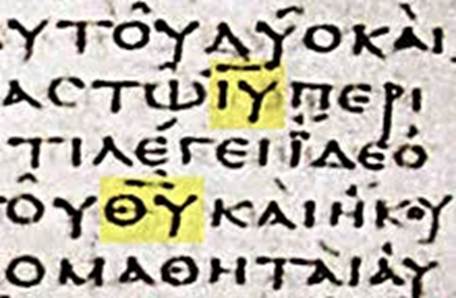
Figure 1. Codex Vaticanus (B), 4th century, John 1. Nomina sacra highlighted: ΙΥ (genitive of Ἰησοῦς) and ΘΥ (genitive of θεός).
Figure 2 shows a fragment of Papyrus 111 from the third century, where the genitive of Ἰησοῦς, IHY, appears. Again, the figure does not bear the argument by itself. It adds texture. It makes visible on the page the same reverence that the prose already requires us to consider.
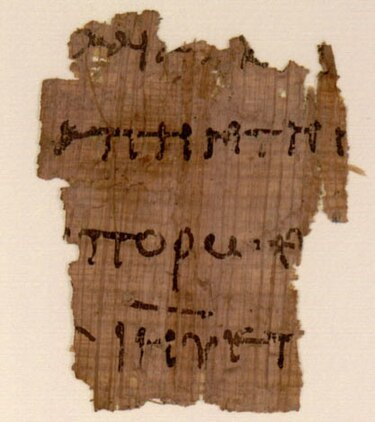
Figure 2. Papyrus 111 (3rd century). The genitive nomina sacra of Ἰησοῦς (IHY) is visible at the bottom line.1
The staurogram adds another layer. Early papyri sometimes embed a τ–ρ ligature inside forms of σταυρός and σταυρόω. The sign visually evokes the crucified figure. It does not decide which κύριος a line has in view, and it should not be made to do more than it can do. But it shows that devotion to the crucified κύριος was inscribed into the textual culture of the early Church. The cross entered the scriptorium.
This is why the figure material belongs in the essay. It is not controlling evidence. It is not the foundation. It is a visual witness to the same world of devotion, copying, prayer, and confession in which κύριος Ἰησοῦς was already sacred speech.
Authorial Voices: One Rule Set, Many Contexts
Applied across the canon, the same rule set yields a polyphonic yet coherent picture. Matthew sets the cadence with parabolic κύριοι and the seismic Psalm 110. Mark frames the paradox of David’s son and Lord. Luke’s two volumes chart recognition from infancy titles to apostolic proclamation and prayer ἐπὶ τῷ ὀνόματι Ἰησοῦ. John’s drama moves from κύριε as sir to κύριος and θεός confessed. Paul’s letters normalize the language of ὁ κύριος ἡμῶν Ἰησοῦς Χριστός and press it into the space of Israel’s monotheism. Hebrews, the catholic epistles, and Revelation reinforce the pattern in their registers.
Luke-Acts as a Narrative Map of Recognition
Luke-Acts gives the development in narrative form. In the infancy narratives, κύριος often names the God of Israel. During Jesus’ ministry, κύριε may function as respectful address. After Easter and Pentecost, the discourse is recalibrated. The apostles preach in the name of Jesus, heal ἐπὶ τῷ ὀνόματι Ἰησοῦ, baptize in his name, suffer for his name, and call others to turn to him. Old Testament idioms for God’s action remain, producing overlap that is not confusion but reverent precision.
Ambiguity That Tells the Truth
Ambiguity is not always a weakness. James 5, Acts 11, and 2 Corinthians 3 show how κύριος can truthfully name God and the exalted Son without collapsing the Father and the Son into one person. The writers are not careless. They are reverent, and they let reverence govern diction where a modern diagram might prefer tidy partitions.
Not every κύριος resolves cleanly into θεός ὁ πατήρ or Ἰησοῦς ὁ κύριος, and that is not a flaw in the sources. It reflects the way earliest believers thought and prayed. When James urges elders to anoint the sick ἐν τῷ ὀνόματι τοῦ κυρίου, readers hear the habitual Christian practice of healing ἐν ὀνόματι Ἰησοῦ and also the biblical conviction that God alone heals. When Acts says ἦν χεὶρ κυρίου μετ’ αὐτῶν and many turned ἐπὶ τὸν κύριον, Luke draws on an Old Testament phrase for God’s power and the fresh Christian habit of naming conversion as turning to Ἰησοῦς. In places like 2 Corinthians 3 Paul deliberately exploits the elasticity of κύριος while rereading Exodus in light of Χριστός and τὸ πνεῦμα. ἡνίκα δ’ ἐὰν ἐπιστρέψῃ πρὸς κύριον, περιαιρεῖται τὸ κάλυμμα once meant turning to YHWH and now means turning to the unveiled glory of God in Χριστός by the work of the Spirit. Such ambiguity is not muddle. It is theological depth.
The same term can name the one God of Israel and also the exalted υἱός who shares his name and work, without collapsing the persons. Again, the writers are not careless. They are reverent, and they let reverence govern all.
Variants That Matter and Why They Do Not Undo the Pattern
Textual variants demand special care. Because crucial places read Ἰησοῦς, others κύριος, and others θεός, each must be analyzed on its own terms. This prevents us from smuggling later theology into earlier manuscripts or letting a single reading carry more weight than the transmission permits. In textual evaluation, internal coherence with immediate context, difficulty that explains alteration, and external attestation together guide judgment. The point is not to produce a dogmatic chain that snaps where a variant appears. The point is to see how the pattern holds across variant paths.
Jude 5 appears as Ἰησοῦς, κύριος, or θεός. Ἰησοῦς yields the most explicit inclusion of the Son in Israel’s saving identity; κύριος sustains a double hearing; θεός recounts God’s act while leaving Jude’s exalted Christological claims intact. On any reading the pattern holds. Visually similar nomina sacra, such as ι̅ς̅ and κ̅ς̅, may help explain how variation arose. The examples above and the note below help place this in the world of early Christian scribal practice.
Jude 5 and the Name Ἰησοῦς in an Exodus Frame
Jude 4 and Jude 5 concentrate the problem. In Jude 4, the false teachers deny τὸν μόνον δεσπότην καὶ κύριον ἡμῶν Ἰησοῦν Χριστόν. The most natural construal takes both δεσπότης and κύριος with Ἰησοῦν Χριστόν. If that is right, Jude does not merely call Jesus an honored teacher. He names him with the language of sovereignty and lordship. In Scripture, δεσπότης can be used of human masters, but it is also a prayer-word for God’s sovereignty. Simeon prays, Δέσποτα, νῦν ἀπολύεις τὸν δοῦλόν σου. The souls beneath the altar cry, Δέσποτα ὁ ἅγιος καὶ ἀληθινός. Peter warns of those who deny τὸν ἀγοράσαντα αὐτοὺς δεσπότην. Jude’s pairing of δεσπότης and κύριος under the name Ἰησοῦς Χριστός therefore sits in a register heavier than ordinary honor.
Then Jude 5 presses the matter further. The verse circulates in three principal forms: Ἰησοῦς λαὸν ἐκ γῆς Αἰγύπτου σώσας, κύριος λαὸν ἐκ γῆς Αἰγύπτου σώσας, and θεός λαὸν ἐκ γῆς Αἰγύπτου σώσας. Modern critical editions generally favor Ἰησοῦς, though the other readings have serious witness. The variant must be handled honestly.
If Ἰησοῦς is original, the theological force is direct. Jude names Jesus as the one who saved a people out of Egypt. That is an act Israel attributes to YHWH. Jesus is not merely compared to a later savior. He is placed in the subject-position of Israel’s saving Lord.
If κύριος is read, the verse remains powerful but more open. “The Lord” can be heard as the God of the Exodus, but in Jude’s immediate context it also resonates with the κύριος just named as Ἰησοῦς Χριστός. This is not a retreat from high Christology. It is precisely the kind of reverent overlap found elsewhere in early Christian usage.
If θεός is read, the verse straightforwardly recounts God’s act in the Exodus. Even then, Jude 4 still speaks of Jesus as δεσπότης and κύριος, and the letter’s final doxological movement is διὰ Ἰησοῦ Χριστοῦ τοῦ κυρίου ἡμῶν. The broader Christological field remains intact.
So the argument does not stand or fall on one variant. The reading Ἰησοῦς gives the strongest single-verse pressure. The reading κύριος preserves a double hearing. The reading θεός leaves Jude’s exalted Christological language undestroyed. On any path, Jude belongs with the witnesses that place Jesus within or near the saving identity of Israel’s God.
Jude in Canonical Conversation and Scribal Dynamics
Jude stands in canonical conversation. Paul says of Israel’s wilderness generation, πάντες ἔπιον γὰρ ἐκ πνευματικῆς ἀκολουθούσης πέτρας, ἡ πέτρα δὲ ἦν ὁ Χριστός. That is not the same sentence as Jude 5, but it occupies the same conceptual neighborhood. The saving and sustaining presence of God with Israel is read through Christ. Hebrews hears the wilderness voice speaking “today” and frames the failure to enter κατάπαυσιν as a warning to the Church. John says Isaiah saw Jesus’ glory and spoke of him. None of these texts is merely interchangeable with the others. Together, they show a pattern: the earliest Christian witnesses can place Christ in the saving scenes and divine speech of Israel’s Scriptures without treating this as a breach of monotheism.
The semantics of δεσπότης in Jude 4 amplify the point. Jude calls the intruders people who deny τὸν μόνον δεσπότην καὶ κύριον ἡμῶν Ἰησοῦν Χριστόν. The most natural construal takes both titles with Ἰησοῦν Χριστόν, so that the one only Sovereign and Lord is Jesus Christ. Elsewhere in the New Testament δεσπότης functions as a form of divine address. Simeon prays Δέσποτα, νῦν ἀπολύεις τὸν δοῦλόν σου in the temple. The souls beneath the altar cry Δέσποτα ὁ ἅγιος καὶ ἀληθινός. Peter warns that false teachers will deny τὸν ἀγοράσαντα αὐτοὺς δεσπότην, which many read of Christ who bought them. Jude’s pairing of δεσπότης and κύριος with the proper name Ἰησοῦς Χριστός therefore sits within a scriptural register where δεσπότης is at home in the mouth of worshipers addressing God. The pairing strengthens the sense that Jude’s discourse about Jesus has entered the field of God’s sovereignty, not merely the field of human honorifics.
Jude also stands at the intersection of Scripture and reception. He cites or alludes to Israel’s Scriptures, to tradition about Michael and Moses, and to Enoch. His readiness to bring extra-biblical Second Temple material into Christian exhortation shows that he is unafraid of bold hermeneutical moves when they serve pastoral clarity. The variant forms of Jude 5 fit that profile. If Ἰησοῦς is original, the boldness is Jude’s own. If κύριος or θεός is original, then a strand of transmission that supplies Ἰησοῦς discloses how Christian readers heard the text in a Church that confessed κύριος Ἰησοῦς as the name to be called upon. Either way, the page of the Christian book is a witness to the community’s hearing of God’s saving identity in Jesus.
Scribal behavior may help explain the variation. The contracted nomina sacra, such as ι̅ς̅ and κ̅ς̅, could be visually or theologically susceptible to alteration. A scribe uncomfortable with Ἰησοῦς as the Exodus agent might substitute κύριος or θεός. Conversely, a scribe steeped in the confession κύριος Ἰησοῦς might make explicit what the context seemed already to imply. We do not need to decide motive with certainty. The effect matters: the transmission itself bears witness to a Christian reading world in which Jesus, Lord, God, Exodus, sovereignty, and salvation were already tightly joined.
Finally, Jude’s Exodus line converses fruitfully with the practice of invoking τὸ ὄνομα κυρίου. Paul’s deployment of Joel’s promise at Romans 10, where calling on the name of the κύριος becomes the confession and invocation of Ἰησοῦς, tells us how earliest believers understood the saving name. If the saving God of the Exodus can be named as Ἰησοῦς, then the Church’s practice of calling upon the name of the κύριος Ἰησοῦς is not a devotional innovation detached from Scripture. It is the lived form of the same theological judgment. The God who brings a people through water and wilderness now does so in and as the crucified and risen one. Jude’s terse sentence thus opens a door into the whole hallway of earliest Christian worship and exegesis.
Apostolic Continuity and Ecclesial Reception
Paul reads the wilderness rock as Christ. Hebrews hears the wilderness voice speaking “today.” John says Isaiah saw Jesus’ glory. Ecclesially, the Latin West long read Iesus in Jude 5 through the Vulgata Clementina, while the Nova Vulgata reads Dominus. Critical editions such as NA28, UBS5, and SBLGNT print or favor Ἰησοῦς. No solemn dogma fixes the variant, but Scripture’s pattern, early patristic usage, and the Church’s textual infrastructure together show the Ἰησοῦς reading to be venerable and canonically at home.
Worship, Name, and Practice
The Church calls upon τὸ ὄνομα τοῦ κυρίου Ἰησοῦ, baptizes into his name, assembles in it, and blesses by it. Joel’s promise about the Name is Christianly fulfilled in the invocation of Jesus. Doxology, prayer, and confession converge so that language about κύριος corresponds to acts of worship offered to the Son, to the glory of the Father.
Where the Honorific-Only Hypothesis Breaks
This is where the honorific-only hypothesis breaks. It can explain polite κύριε. It can explain ordinary reverence. It can explain human masters and social lords. It cannot explain the full pattern: YHWH texts applied to Jesus, prayer to Jesus, saving invocation in his name, creation through him, judgment by him, worship of him, the nomina sacra, the staurogram, ὁ κύριός μου καὶ ὁ θεός μου, Stephen’s Κύριε Ἰησοῦ, Paul’s Isaian confession in Philippians 2, and Revelation’s worship of the ἀρνίον. A king may receive homage. An angel may carry a message. A prophet may speak for God. But no creature may receive divine worship, bear the divine Name in this way, and stand as the one through whom all creatures exist.
Incarnation, Eucharist, and the Divine Mediator
The high Christological claim must be protected from distortion. To say that Christ belongs on the Creator side of the distinction does not mean that his human nature is uncreated. The eternal Son is uncreated. The humanity he assumes is created, temporal, real, and complete. The incarnation is not a creature becoming God by promotion. Nor is it God merely appearing as man. It is the eternal υἱός truly assuming created human nature without ceasing to be who he eternally is.
This is why the Eucharist belongs to the argument, not as a decorative afterthought, but as its sacramental concentration. Christ does not merely institute a religious practice as a creaturely representative of God. The eternal Son, through whom all creatures exist, gives the Church sacramental participation in the one sacrifice he offers through the human nature he assumes. The Eucharist does not create a second sacrifice beside the Cross. It makes sacramentally present the one sacrifice of the incarnate Son. Here the divine mediator saves from the divine side while truly entering the human condition he redeems.
The Creator-creature distinction therefore does not weaken sacramentality. It protects it. If Christ were only a creaturely agent, the Eucharist would be a holy memorial of a creature’s obedience. If Christ were divine without true humanity, the Eucharist would lose the flesh-and-blood realism of the incarnate sacrifice. Catholic confession requires both. The one who gives himself is true God from true God, and the gift he gives is the true body and blood of the incarnate Son.
Trinitarian Consequence
The New Testament’s language of κύριος and δεσπότης does not merely prove that Jesus is important. It forces the question of how the one God can be confessed as Father, Son, and Spirit without division. The Father is not the Son. The Son is not the Father. The Spirit is not an impersonal force. Yet the Son shares the divine Name, work, glory, and worship. The Spirit mediates the confession of Jesus as Lord and gives life in the Church. The result is not a second deity, not a creaturely mediator only, and not a modal mask. It is the grammar of the one God revealed as πατήρ, υἱός, and πνεῦμα ἅγιον.
A final clarification safeguards simplicity. When Scripture says that God is love, love is not a second god. Love is a divine perfection. But when Scripture names the Father, the Son, and the Holy Spirit, it is not multiplying attributes. It is revealing personal distinction within the one simple God. The names are not three divine properties added to a prior essence. Nor is the essence a fourth thing hidden behind them. The Father is God. The Son is God. The Holy Spirit is God. Yet there are not three gods. The persons are distinct by relation and origin, not by divided deity.
Divine simplicity is not cancelled. It is illuminated. The unity of essence is personal and relational without division.
Conclusion
The conclusion is strict, but not brittle. Scripture establishes a Creator-creature distinction. God is the unmade maker, source, Lord, and proper object of divine worship. All else is made, dependent, finite, and not to be worshiped as God. The New Testament places Christ not merely among honored creatures but on the Creator side of that distinction: all things are made through him; divine worship and saving invocation are given to him; the Name, glory, throne, judgment, and saving work of Israel’s God are applied to him. Yet he remains personally distinct from the Father and truly assumes created human nature for us. Therefore Jesus Christ, as Son and Word, is not a creature through whom God merely acts. He is the eternal Son through whom all creatures exist, the incarnate κύριος who saves from the divine side while truly entering the creaturely condition he comes to redeem.
This is not only a grammar for argument. It is a grammar for looking.
Thomas Aquinas writes:
| For it says in Eph (2:8): ‘By grace you are saved through faith.’ But Christ is the author of faith. Therefore, if you wish to be saved you must look to His example. Hence, he says, Looking on Jesus in His sufferings. This was signified by the brazen serpent lifted up as a sign, so that all who looked upon it were cured (Num. 21:8); ‘As Moses lifted up the serpent in the desert, so must the son of man be lifted up: that whosoever believes in him may not perish; but may have life everlasting’ (Jn. 3:14). Therefore, if you wish to be saved, look on the face of your Christ. Thomas Aquinas: Hebrews: English |
This final turn matters. The argument does not end by placing Christ in a category and walking away. It ends by looking upon him. The one through whom all creatures exist is also the crucified one lifted up for the life of the world. The Creator-creature distinction does not make Christ distant. It makes his nearness more astonishing. The Lord who cannot be reduced to a creature assumes creaturely flesh, suffers in it, offers it, gives it sacramentally, and draws the creature into communion with God.
If you would be saved, look upon the face of your Christ, your Lord and your God, as the apostle Thomas did; confess him with words only his Spirit gives, and live the life he alone gives, the life he is. Amen? Amen.
One Lord speaks in many texts. Those texts teach the Church to pray, confess, copy, suffer, and live in his Name.
Note on the Figure Sources
The figure examples for nomina sacra and related manuscript visuals were originally sourced through the Wikipedia article on Nomina sacra and its linked references. That article is useful as a starting point because it gathers accessible examples and points toward the primary manuscript evidence. It should not function as the final scholarly authority in a formal version of this essay, but it is relevant as a gateway to the visual evidence discussed here. For publication or academic submission, the figures should be checked directly against manuscript repositories, critical apparatuses, or specialist studies such as Larry Hurtado’s work on early Christian artifacts.
Bibliography
Bartholomä, Philipp F. “Did Jesus Save the People out of Egypt? A Re-examination of a Textual Problem in Jude 5.” Novum Testamentum 50 (2008): 143-158.
Bauckham, Richard. Jesus and the God of Israel: God Crucified and Other Studies on the New Testament’s Christology of Divine Identity. Grand Rapids: Eerdmans, 2008.
Bauer, Walter, Frederick W. Danker, William F. Arndt, and F. Wilbur Gingrich. A Greek-English Lexicon of the New Testament and Other Early Christian Literature. 3rd ed. Chicago: University of Chicago Press, 2000.
Bede the Venerable. Commentary on the Seven Catholic Epistles. Translated by David Hurst. Kalamazoo: Cistercian, 1985.
Fee, Gordon D. Pauline Christology: An Exegetical-Theological Study. Peabody: Hendrickson, 2007.
Hengel, Martin. The Son of God: The Origin of Christology and the History of Jewish-Hellenistic Religion. Philadelphia: Fortress, 1976.
Hurtado, Larry W. Lord Jesus Christ: Devotion to Jesus in Earliest Christianity. Grand Rapids: Eerdmans, 2003.
Hurtado, Larry W. One God, One Lord: Early Christian Devotion and Ancient Jewish Monotheism. Philadelphia: Fortress, 1988.
Hurtado, Larry W. The Earliest Christian Artifacts: Manuscripts and Christian Origins. Grand Rapids: Eerdmans, 2006.
Martin, Ralph P. Carmen Christi: Philippians 2:5-11 in Recent Interpretation and in the Setting of Early Christian Worship. Grand Rapids: Eerdmans, 1983.
Metzger, Bruce M. A Textual Commentary on the Greek New Testament. 2nd ed. Stuttgart: Deutsche Bibelgesellschaft, 1994.
Midwinter, James. “Who Led the Israelites Out of Egypt? An Examination of Jude 5.” Foundations 75 (2018): 6-18.
Nestle-Aland. Novum Testamentum Graece. 28th ed. Stuttgart: Deutsche Bibelgesellschaft, 2012.
Nova Vulgata: Bibliorum Sacrorum Editio. 2nd typical ed. Vatican City: Libreria Editrice Vaticana, 1986.
Rahlfs-Hanhart, Alfred. Septuaginta: Id est Vetus Testamentum Graece iuxta LXX interpretes. Editio altera. Stuttgart: Deutsche Bibelgesellschaft, 2006.
Roberts, Colin H. Manuscript, Society and Belief in Early Christian Egypt. London: Oxford University Press, 1979.
SBL Greek New Testament. Edited by Michael W. Holmes. Atlanta: Society of Biblical Literature, 2010.
Tov, Emanuel. Textual Criticism of the Hebrew Bible. 3rd ed. Minneapolis: Fortress, 2012.
United Bible Societies. The Greek New Testament. 5th rev. ed. Stuttgart: Deutsche Bibelgesellschaft, 2014.
Vulgata Clementina. Biblia Sacra iuxta Vulgatam Clementinam. Madrid: Biblioteca de Autores Cristianos, 1946.
Wright, N. T. Jesus and the Victory of God. Minneapolis: Fortress, 1996.
Wright, N. T. Paul and the Faithfulness of God. Minneapolis: Fortress, 2013.
- For the Nomina Sacra pics I sourced most of it from Wiki, and just from clicking off of their sources. Don’t hate, the article it is good!: https://en.wikipedia.org/wiki/Nomina_sacra ↩︎