Jesus is Called God in the New Testament
One Lord in Many Texts: How κύριος and δεσπότης Reveal the New Testament’s Claim about Jesus
The New Testament explicitly calls Ἰησοῦς ‘God’ (θεός) in several places, and even more often speaks of him as κύριος in ways that carry the identity, honors, and works of Israel’s God. Alongside κύριος, the title δεσπότης is used of God the Father and, in key passages, of Jesus. However, within the broader Jewish context in which the NT was written, explicit θεός language for Jesus is not the ordinary idiom; the narrative unfolds progressively, and so does the revelation it conveys. What follows explains how this works.
Thesis
The New Testament writers consistently use the titles κύριος and δεσπότης to include Ἰησοῦς within the unique divine identity of Israel’s God while maintaining a real distinction between Ἰησοῦς and the πατήρ. This pattern is not a late embellishment or a sloppy confusion of titles. It emerges from a coherent identity framework. Ἰησοῦς is the same God as the πατήρ by essence yet not the same person by origin, so uniquely divine attributes and names can apply to the υἱός without implying more than one God. Read with disciplined attention to context, the language of Lord and Master discloses that earliest Christian speech about Ἰησοῦς is not merely respectful, it is worshipful and theologically precise.
Method: Reading κύριος and δεσπότης by Rule Rather Than Hunch
Any argument about κύριος must first separate ordinary usage from theological claim. In everyday Greek, κύριος can mean sir, owner, or master. The New Testament embraces this range, which is why readers must classify each instance by context rather than assume a single meaning. The simplest stratum is human address, especially in dialogue and parables, where speakers say κύριε as a polite vocative. A leper who cries κύριε ἐὰν θέλῃς, δύνασαί με καθαρίσαι or a servant who answers a story’s landowner uses social language rather than a creed. At the other end of the spectrum stand passages where Scripture’s YHWH texts, the church’s worship, or divine roles are applied to Ἰησοῦς. Between these poles lie formulaic epistolary titles such as ὁ κύριος ἡμῶν Ἰησοῦς Χριστός and a tranche of verses that remain genuinely ambiguous, often by design.
To keep these layers distinct, it helps to work with a weighted evidence ladder. Old Testament citations or tight allusions in which a YHWH text is brought into the orbit of Ἰησοῦς carry the greatest weight. Explicit prayer, praise, or doxology addressed to Ἰησοῦς carries the same weight, since these are forms of devotion Israel’s Scriptures reserve for God. Narrator usage of ὁ κύριος that unmistakably identifies Ἰησοῦς, especially in post resurrection narration, is a strong indicator. Formulaic titles and attributions of creator or final judge prerogatives add corroboration. Neutral household settings neither help nor hurt, while a clear sir in conversation pushes toward ordinary human address. Scores do not replace judgment, but they discipline it and show why some texts demand a high christological reading while others do not bear that freight.
From the latter follows a simple decision rule. Where the upper cues cluster and Ἰησοῦς is in view, κύριος signals inclusion of Ἰησοῦς in the divine identity. Where ὁ κύριος plainly refers to God with no Christological focus, it means the God of Israel. Where the context is human or parabolic, it stays human. When κύριος functions as a standing title for Ἰησοῦς without an explicit Old Testament transfer or worship setting, it should be read as a settled formula of Christian speech. When cues tie or remain in tension, it is better to preserve ambiguity than to force a decision.
Textual variants demand special care. Because crucial places read Ἰησοῦς, others κύριος, others θεός, each must be analyzed on its own terms. This prevents us from smuggling later theology into earlier manuscripts or letting a single reading carry more weight than the transmission permits. In textual evaluation, internal coherence with immediate context, difficulty that explains alteration, and external attestation together guide judgment. The point is not to produce a dogmatic chain that snaps where a variant appears. The point is to see how the pattern holds across variant paths.
Septuagintal Background: Why κύριος Matters
The intensity of κύριος in early Christian speech depends on its Septuagintal history. In the Greek Scriptures κύριος functions as the standard rendering of the Tetragrammaton, while also naming human lords and masters. The same lexeme therefore carries a double capacity. It can mark polite address and it can bear the Name that is above all names in Israel’s confession. This is precisely the linguistic field in which the New Testament writers work. When they speak of ὁ κύριος ὁ θεὸς ἡμῶν, they inhabit the Shema in Greek. When they ascribe Psalm 110 to the Messiah, they let a YHWH centered text speak about the enthroned υἱός. When the church prays Maranatha and confesses κύριος Ἰησοῦς, it places the risen one in the sphere of Israel’s devotion to κύριος. The polyvalence of κύριος does not create confusion. It provides the bridge across which Israel’s monotheism opens, without tearing, to include the crucified and risen Ἰησοῦς.
Identity Frame: Same God by Essence, Not the Same Person by Origin
The framework underneath the pattern is simple to say and careful to apply. The New Testament speaks of Ἰησοῦς as the same God as the πατήρ by essence while refusing to collapse persons. Personal distinction is traced to origin, so that the υἱός is ἐκ τοῦ πατρός without being the πατήρ. Under that frame, uniquely divine predicates and names can apply to the υἱός without multiplying deity. The grammar of devotion arises from this stance. To honor the υἱός as κύριος is to glorify the πατήρ. To bend the knee to Ἰησοῦς is to participate in the devotion that in Israel’s Scriptures belongs to YHWH, not to set up a rival. The frame is not an abstraction imposed upon texts. It is a compact way to describe how the texts themselves speak when they move between θεός for the Father and κύριος for the Son, then at key moments let κύριος bear the weight of Israel’s God talk for Ἰησοῦς. Devotion to Ἰησοῦς is not the dilution of monotheism but its christological articulation.
Manuscripts on the Table: What the Page Itself Confirms
Material features of early Christian manuscripts corroborate what the texts say in prose. The nomina sacra system contracts θεός, κύριος, Ἰησοῦς, and Χριστός with a supralinear bar. This uniform graphic treatment places the divine name, the title κύριος, and the name Ἰησοῦς in a single class of sacred words. The contraction does not disambiguate each instance, yet it shows that Christian scribes treated the name of Jesus and the title Lord with the same scribal reverence as the divine name.
Figure 1 illustrates this with a sample from Codex Vaticanus (John 1), where the genitive nomina sacra for Ἰησοῦς (ΙΥ) and θεός (ΘΥ) are highlighted. Figure 2 shows a fragment of Papyrus 111 (3rd century), where the genitive of Ἰησοῦς (IHY) appears. These examples make visible on the page the same reverence our argument detects in the prose.
Early papyri also embed the staurogram, a τ–ρ ligature inside forms of σταυρός and σταυρόω that evokes the crucified figure. The staurogram does not tell us which κύριος a line has in view, yet it shows that devotion to the crucified κύριος was inscribed in the text stream from the start. These choices are not marginal. They are a window onto the mind of communities that prayed to Ἰησοῦς and copied his name with the graphic markers reserved for God.
Jude 5 in a strong line of witnesses reads Ἰησοῦς λαὸν ἐκ γῆς Αἰγύπτου σώσας. The subject is explicitly Ἰησοῦς in an action Israel ascribes to YHWH. Even where other witnesses read κύριος or θεός, the surrounding letter still attributes absolute sovereignty to Ἰησοῦς. The page itself therefore supports the thesis.
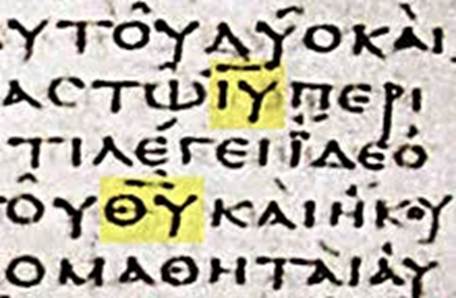
Figure 1. Codex Vaticanus (B), 4th century, John 1. Nomina sacra highlighted: ΙΥ (genitive of Ἰησοῦς) and ΘΥ (genitive of θεός).
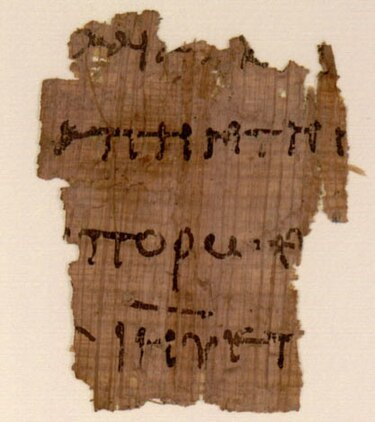
Figure 2. Papyrus 111 (3rd century). The genitive nomina sacra of Ἰησοῦς (IHY) is visible at the bottom line.1
Authorial Voices: One Rule Set, Many Contexts
Applied across the canon, the same rule set yields a polyphonic yet coherent picture. Matthew sets the cadence with parabolic κύριοι and the seismic Psalm 110. Mark frames the paradox of David’s son and Lord. Luke’s two volumes chart recognition from infancy titles to apostolic proclamation and prayer ἐπὶ τῷ ὀνόματι Ἰησοῦ. John’s drama moves from κύριε as sir to κύριος and θεός confessed. Paul’s letters normalize the language of ὁ κύριος ἡμῶν Ἰησοῦς Χριστός and press it into the space of Israel’s monotheism. Hebrews, the catholic epistles, and Revelation reinforce the pattern in their registers.
Luke–Acts as a Narrative Map of Recognition
Luke–Acts offers a chronological cross section of how this language matured in history. In the infancy narratives, κύριος names God. During the ministry, κύριε often means sir. Easter and Pentecost recalibrate the discourse, and the mission normalizes prayer, preaching, and baptism in the name of Jesus. Old Testament idioms for God’s action remain, producing overlap that is not confusion but reverent precision.
Ambiguity That Tells the Truth
James 5, Acts 11, and 2 Corinthians 3 show how κύριος can truthfully name God and the exalted Son without collapse. The writers are not careless. They are reverent, and they let reverence govern diction where a modern diagram might prefer tidy partitions.
Not every κύριος resolves cleanly into θεός ὁ πατήρ or Ἰησοῦς ὁ κύριος, and that is not a flaw in the sources. It reflects the way earliest believers thought and prayed. When James urges elders to anoint the sick ἐν τῷ ὀνόματι τοῦ κυρίου, readers hear the habitual Christian practice of healing ἐν ὀνόματι Ἰησοῦ and also the biblical conviction that God alone heals. When Acts says ἦν χεὶρ κυρίου μετ’ αὐτῶν and many turned ἐπὶ τὸν κύριον, Luke draws on an Old Testament phrase for God’s power and the fresh Christian habit of naming conversion as turning to Ἰησοῦς. In places like 2 Corinthians 3 Paul deliberately exploits the elasticity of κύριος while re reading Exodus in light of Χριστός and τὸ πνεῦμα. ἡνίκα δ’ ἐὰν ἐπιστρέψῃ πρὸς κύριον, περιαιρεῖται τὸ κάλυμμα once meant turning to YHWH and now means turning to the unveiled glory of God in Χριστός by the work of the Spirit. Such ambiguity is not muddle. It is theological depth. The same term can name the one God of Israel and also the exalted υἱός who shares his name and work, without collapsing the persons. The writers are not careless. Again, they are reverent, and they let reverence govern all.
Variants That Matter and Why They Do Not Undo the Pattern
Jude 5 appears as Ἰησοῦς, κύριος, or θεός. Ἰησοῦς yields the most explicit inclusion of the Son in Israel’s saving identity; κύριος sustains a double hearing; θεός recounts God’s act while leaving Jude’s exalted christological claims intact. On any reading the pattern holds—and visually similar nomina sacra (ι̅ς̅ / κ̅ς̅) help explain how the variation arose. See examples of the Nomina Sacra above, and the Wiki page linked below in the footnote.
Jude 5 and the Name Ἰησοῦς in an Exodus Frame
Jude 5 is a pressure point where text, theology, and the model converge. The verse circulates in three principal forms: Ἰησοῦς λαὸν ἐκ γῆς Αἰγύπτου σώσας, κύριος λαὸν ἐκ γῆς Αἰγύπτου σώσας, and θεός λαὸν ἐκ γῆς Αἰγύπτου σώσας. Modern critical editors generally prefer Ἰησοῦς, while acknowledging substantial support for κύριος and some for θεός. Read internally, Ἰησοῦς in verse 5 coheres strikingly with verse 4, where Jude has already named τὸν μόνον δεσπότην καὶ κύριον ἡμῶν Ἰησοῦν Χριστόν as the one whom the intruders deny. The shift from confessional title in verse 4 to narrative subject in verse 5 then yields a tight link. The Ἰησοῦς whom the false teachers deny is the very one who saved a people out of the land of Egypt.
If Ἰησοῦς is original, the theological force is unambiguous. Jude identifies the Son with the agent of the Exodus, an act Israel attributes to YHWH. That is not an isolated flourish. It is the most explicit instance of the pattern our model tracks elsewhere by transfer and allusion. Here, the inclusion of Ἰησοῦς within Israel’s God-identity occurs not by echoing a κύριος text about YHWH but by naming Ἰησοῦς as the actor of YHWH’s saving work. The verse thus stands beside confessions like ὁ κύριός μου καὶ ὁ θεός μου and claims like εἷς κύριος Ἰησοῦς Χριστός as a direct witness that earliest Christian God-talk could speak of Jesus with the subject role of Israel’s Lord.
If κύριος is read, the verse remains theologically weighty but becomes ambiguous in our scheme. In immediate context “the Lord” could be heard as God in the Exodus story or as the κύριος just named in verse 4, Ἰησοῦς. The ambiguity is not a retreat from high Christology. It is the sort of overlap Luke exploits with ὁ λόγος κυρίου and ἡ χείρ κυρίου in Acts. If θεός is read, Jude 5 straightforwardly recounts God’s act in the Exodus, while the letter still ascribes to Ἰησοῦς titles of absolute sovereignty in verse 4 and ends with a doxological orientation διὰ Ἰησοῦ Χριστοῦ τοῦ κυρίου ἡμῶν. In none of the readings does the pattern collapse. Rather, Ἰησοῦς makes the strongest single-verse claim, κύριος preserves a deliberate double hearing, θεός leaves intact Jude’s exalted language for Ἰησοῦς elsewhere.
The point is in Jude 4 δεσπότης and κύριος are together, and that should matter in context of our model study here. Scripture δεσπότης is a prayer‑word for God’s sovereignty. The New Testament extends it to Christ as well. In Jude 4 the most natural reading takes both δεσπότης and κύριος with Ἰησοῦν Χριστόν, matching the identity frame within which the Son bears the Name and shares the sovereignty.
Scribal behavior likely contributes to the variation. A scribe uncomfortable with Ἰησοῦς as the Exodus agent might substitute κύριος or θεός. Conversely, a scribe steeped in confessional usage could replace κύριος with Ἰησοῦς to make explicit what context implies. Our model does not need to adjudicate motive to register effect. On any reading, Jude belongs with the witnesses that either explicitly include Ἰησοῦς in Israel’s saving identity or place him so near to it that the community’s confessional instincts supply the link.
Jude in Canonical Conversation and Scribal Dynamics
The force of Jude 5 grows when set within a wider canonical conversation. Paul says of Israel’s wilderness generation that πάντες ἔπιον γὰρ ἐκ πνευματικῆς ἀκολουθούσης πέτρας, ἡ πέτρα δὲ ἦν ὁ Χριστός. That is not the same sentence as Ἰησοῦς σώσας ἐξ Αἰγύπτου, yet the conceptual neighborhood overlaps. In both cases the saving or sustaining agency attributed to YHWH in Israel’s story is read through the lens of Christ’s presence with his people. Hebrews argues that the voice that spoke in the wilderness continues to address the church today, and that the failure to enter κατάπαυσιν turns on hearing that voice “today.” John adds a different angle when he remarks that Isaiah saw his glory and spoke of him, in a context where the glory in view is that of Ἰησοῦς. None of these texts is simply equivalent to Jude 5, yet together they trace a pattern in which the earliest witnesses can place Christ in the saving scenes of Israel’s Scriptures without anxiety about monotheism.
The semantics of δεσπότης in Jude 4 amplify the point. Jude calls the intruders people who deny τὸν μόνον δεσπότην καὶ κύριον ἡμῶν Ἰησοῦν Χριστόν. The most natural construal takes both titles with Ἰησοῦν Χριστόν, so that the one only Sovereign and Lord is Jesus Christ. Elsewhere in the New Testament δεσπότης functions as a form of divine address. Simeon prays Δέσποτα, νῦν ἀπολύεις τὸν δοῦλόν σου in the temple. The souls beneath the altar cry Δέσποτα ὁ ἅγιος καὶ ἀληθινός. Peter warns that false teachers will deny τὸν ἀγοράσαντα αὐτοὺς δεσπότην, which many read of Christ who bought them. Jude’s pairing of δεσπότης and κύριος with the proper name Ἰησοῦς Χριστός therefore sits within a scriptural register where δεσπότης is at home in the mouth of worshipers addressing God. The pairing strengthens the sense that Jude’s discourse about Jesus has entered the field of God’s sovereignty, not merely the field of human honorifics.
Jude also stands at the intersection of Scripture and reception. He cites or alludes to Israel’s Scriptures, to tradition about Michael and Moses, and to Enoch. His readiness to bring extra-biblical Second Temple material into Christian exhortation shows that he is unafraid of bold hermeneutical moves when they serve pastoral clarity. The variant forms of Jude 5 fit that profile. If Ἰησοῦς is original, the boldness is Jude’s own. If κύριος or θεός is original, then a strand of transmission that supplies Ἰησοῦς discloses how Christian readers heard the text in a church that confessed κύριος Ἰησοῦς as the name to be called upon. Either way, the page of the Christian book is a witness to the community’s hearing of God’s saving identity in Jesus.
Scribal habits shed light on the mechanics. Nomina sacra could encourage harmonization, since Ἰησοῦς and κύριος appear on the page as contracted sacra alike. A scribe might adjust from one sacred contraction to another in the direction of what seemed the clearer confession. The staurogram in early papyri visually associates the crucified with κύριος language in the very lexis of the text, and while that device does not decide Jude 5, it shows that a cross-shaped imagination had already entered the scriptorium. Such features are not determinative in exegesis, yet they restrain minimalist theories that picture a purely honorific κύριος for Jesus in the earliest period. The honor paid to his name, title, and cross in the materiality of the manuscripts coheres with Jude’s christological instincts.
Finally, Jude’s Exodus line converses fruitfully with the practice of invoking τὸ ὄνομα κυρίου. Paul’s deployment of Joel’s promise at Romans 10, where calling on the name of the κύριος becomes the confession and invocation of Ἰησοῦς, tells us how earliest believers understood the saving name. If the saving God of the Exodus can be named as Ἰησοῦς, then the church’s practice of calling upon the name of the κύριος Ἰησοῦς is not a devotional innovation detached from Scripture. It is the lived form of the same theological judgment. The God who brings a people through water and wilderness now does so in and as the crucified and risen one. Jude’s terse sentence thus opens a door into the whole hallway of earliest Christian worship and exegesis.
Apostolic Continuity and Ecclesial Reception
Paul reads the wilderness rock as Christ; Hebrews hears the wilderness voice speaking ‘today’; John says Isaiah saw Jesus’ glory. Ecclesially, the Latin West long read Iesus in Jude 5 (Vulgata Clementina), while the Nova Vulgata reads Dominus. Critical editions (NA28; UBS5; SBLGNT) print or favor Ἰησοῦς. No solemn dogma fixes the variant, but Scripture’s pattern, early patristic usage, and the church’s textual infrastructure together show the Ἰησοῦς reading to be venerable and canonically at home.
Worship, Name, and Practice
The church calls upon τὸ ὄνομα τοῦ κυρίου Ἰησοῦ, baptizes into his name, assembles in it, and blesses by it. Joel’s promise about the Name is Christianly fulfilled in the invocation of Jesus. Doxology, prayer, and confession converge so that language about κύριος corresponds to acts of worship offered to the Son, to the glory of the Father.
Where the Honorific Only Hypothesis Breaks
Minimalist theories cannot explain why earliest scribes marked both Ἰησοῦς and κύριος as nomina sacra, why the staurogram appears so early, why prayers to Ἰησοῦς occur inside texts saturated with Israel’s monotheism, or why YHWH texts are applied to the Son at key points of argument and praise. Thomas’s ὁ κύριός μου καὶ ὁ θεός μου, Stephen’s Κύριε Ἰησοῦ, Paul’s Isaian confession in Philippians 2, and Revelation’s worship of the ἀρνίον each stands where an honorific ‘sir’ cannot go.
Conclusion
This very Jewish mode of expressing their God in revelation is like the hairs at the gate of our mouths before God-talk. The Bible guards how the personal words of Christ are truly said without collapsing God into merely our creaturely measures. Read with disciplined attention to context, the New Testament’s usage of κύριος and δεσπότης is not a drift from Israel’s monotheism but its christological fulfillment and defense. Across narrative, epistle, homily, and apocalypse, the writers speak of θεός most often for the πατήρ and of Ἰησοῦς most often as κύριος, then at decisive points allow κύριος to bear the full weight of YHWH language for the Son. This pattern is not editorial accident. It is grounded in Scripture’s own lexicon, enacted in worship that calls upon τὸ ὄνομα τοῦ κυρίου Ἰησοῦ, and mirrored in the material culture of the early book where Ἰησοῦς, θεός, and κύριος are marked alike as nomina sacra. Jude 5 concentrates the logic. Whether the verse reads Ἰησοῦς, κύριος, or θεός, the letter still places Jesus within God’s saving identity, while Jude 4’s pairing of δεσπότης with κύριος under the name Ἰησοῦς Χριστός shows that sovereignty as well as honor is in view and properly so with the mystery that is God if we’re were to go straight pure essence talk (which is very much not the Jewish style of the time).
The result is a coherent grammar for Christian confession. Devotion to Ἰησοῦς does not add a second deity. It names the one God as the Father who sends and exalts and the Son who shares the Name, prerogatives, and worship, with the Spirit mediating this confession in the church. Textual variants do not undo the pattern. Ambiguity at certain points does not weaken the claim. It records a reverent habit that lets Scripture teach how to speak.
A final theological clarification safeguards this grammar. When Scripture says that God is love, love is not a second god, it is a divine attribute. By contrast, when Scripture names the πατήρ and the υἱός and the πνεῦμα ἅγιον, it is not multiplying attributes but revealing personal modes of origin within the one simple God. Divine simplicity is not cancelled, it is illuminated. The unity of essence is personal and relational without division, and the New Testament’s usage of κύριος and δεσπότης is the linguistic form of that revelation. One Lord speaks in many texts, and those texts teach the church to pray and to live in his name.
They, the normative words for Jesus in the NT that we studied here in relation to the divine nature, reveal Jesus as the one who shares Israel’s God’s very identity, honor, and work, applying κύριος (and at key points δεσπότης) to him in YHWH-laden texts, prayers, and divine prerogatives, while remaining personally distinct from the πατήρ, ὅτι ἐστὶν ὁ υἱός.
Bibliography
Bartholomä, Philipp F. “Did Jesus Save the People out of Egypt? A Re‑examination of a Textual Problem in Jude 5.” Novum Testamentum 50 (2008): 143–158.
Bauckham, Richard. Jesus and the God of Israel: God Crucified and Other Studies on the New Testament’s Christology of Divine Identity. Grand Rapids: Eerdmans, 2008.
Bauer, Walter, Frederick W. Danker, William F. Arndt, and F. Wilbur Gingrich. A Greek‑English Lexicon of the New Testament and Other Early Christian Literature. 3rd ed. Chicago: University of Chicago Press, 2000.
Bede the Venerable. Commentary on the Seven Catholic Epistles. Translated by David Hurst. Kalamazoo: Cistercian, 1985.
Fee, Gordon D. Pauline Christology: An Exegetical‑Theological Study. Peabody: Hendrickson, 2007.
Hengel, Martin. The Son of God: The Origin of Christology and the History of Jewish‑Hellenistic Religion. Philadelphia: Fortress, 1976.
Hurtado, Larry W. Lord Jesus Christ: Devotion to Jesus in Earliest Christianity. Grand Rapids: Eerdmans, 2003.
Hurtado, Larry W. One God, One Lord: Early Christian Devotion and Ancient Jewish Monotheism. Philadelphia: Fortress, 1988.
Hurtado, Larry W. The Earliest Christian Artifacts: Manuscripts and Christian Origins. Grand Rapids: Eerdmans, 2006.
Martin, Ralph P. Carmen Christi: Philippians 2:5–11 in Recent Interpretation and in the Setting of Early Christian Worship. Grand Rapids: Eerdmans, 1983.
Metzger, Bruce M. A Textual Commentary on the Greek New Testament. 2nd ed. Stuttgart: Deutsche Bibelgesellschaft, 1994.
Midwinter, James. “Who Led the Israelites Out of Egypt? An Examination of Jude 5.” Foundations 75 (2018): 6–18.
Nestle‑Aland. Novum Testamentum Graece. 28th ed. Stuttgart: Deutsche Bibelgesellschaft, 2012.
Nova Vulgata: Bibliorum Sacrorum Editio. 2nd typical ed. Vatican City: Libreria Editrice Vaticana, 1986.
Rahlfs‑Hanhart, Alfred. Septuaginta: Id est Vetus Testamentum Graece iuxta LXX interpretes. Editio altera. Stuttgart: Deutsche Bibelgesellschaft, 2006.
Roberts, Colin H. Manuscript, Society and Belief in Early Christian Egypt. London: Oxford University Press, 1979.
SBL Greek New Testament. Edited by Michael W. Holmes. Atlanta: Society of Biblical Literature, 2010.
Tov, Emanuel. Textual Criticism of the Hebrew Bible. 3rd ed. Minneapolis: Fortress, 2012.
United Bible Societies. The Greek New Testament. 5th rev. ed. Stuttgart: Deutsche Bibelgesellschaft, 2014.
Vulgata Clementina. Biblia Sacra iuxta Vulgatam Clementinam. Madrid: Biblioteca de Autores Cristianos, 1946.
Wright, N. T. Jesus and the Victory of God. Minneapolis: Fortress, 1996.
Wright, N. T. Paul and the Faithfulness of God. Minneapolis: Fortress, 2013.
- For the Nomina Sacra pics I sourced most of it from Wiki, and just from clicking off of their sources. Don’t hate, the article it is good!: https://en.wikipedia.org/wiki/Nomina_sacra ↩︎
Thomas Aquinas writes:
| For it says in Eph (2:8): ‘By grace you are saved through faith.’ But Christ is the author of faith. Therefore, if you wish to be saved you must look to His example. Hence, he says, Looking on Jesus in His sufferings. This was signified by the brazen serpent lifted up as a sign, so that all who looked upon it were cured (Num. 21:8); ‘As Moses lifted up the serpent in the desert, so must the son of man be lifted up: that whosoever believes in him may not perish; but may have life everlasting’ (Jn. 3:14). Therefore, if you wish to be saved, look on the face of your Christ. Thomas Aquinas: Hebrews: English |
If you would be saved, look upon the face of your Christ, your Lord and your God, as the apostle Thomas did; confess him with words only his Spirit gives, and live the life he alone gives, the life he is. Amen? Amen.