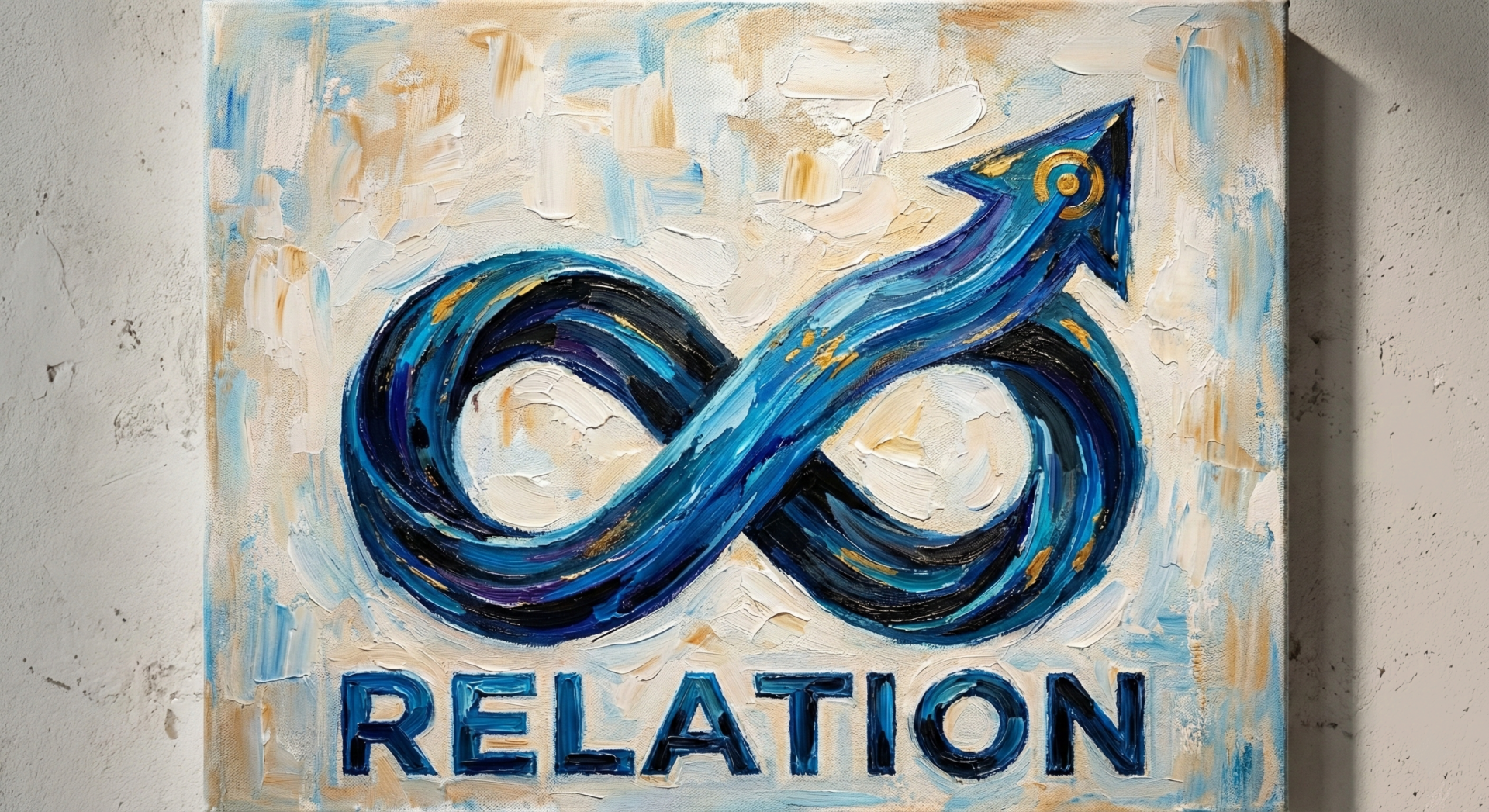
Relation
as Ordered Towardness
Relation = ordered provenance or “from–to” directedness, where the source can institute real terms without being updated by them.
In this framework and idiom, “relation” is described as ordered towardness, the structured way a thing is from, to, with, for, or compared to another, either constitutively (horizon), situationally (inscription), or by rational tracking, with God as the archetype where relation is subsisting act. Aristotle supplies a baseline definition that remains serviceable: “Those things are called relative, which, being either said to be of something else or related to something else, are explained by reference to that other thing.”(1) This places the core point in view: relation is not a mysterious extra object added on top of things, but a structured “to” whose intelligibility depends on reference to another.
The triune, act-relational account affirms that baseline and then clarifies the summit case. In God, relation is not an added feature alongside what God is, as though God were first a substance and only afterward acquired relations. Aquinas states the classical constraint that governs the account: “In God relation and essence do not differ from each other, but are one and the same.”(2) In the present idiom, this means that divine “towardness” is not accidental, not posterior, and not an overlay, but the very life of God as self-gift, with relations of origin naming irreducible personal distinction without dividing the one divine reality.
A Taxonomy That Quells the Creaturely Worry
The point of adding a taxonomy of creaturely relations is not to compete with Aristotle or Aquinas, and it is not to imply that “relation” is unintelligible without this additional layer. The point is to answer a different worry, namely whether the framework gives an ordered, principled account of the many kinds of creaturely relations rather than leaving them as a vague echo. The taxonomy addresses this by making creaturely variegation explicit in the same idiom used to describe the divine archetype. (I guess Thomism, as a competed Aristotelianism does in some sense, but the idiom is tooled for a relational ontology rather than a substance based one.)
Some creaturely relations are constitutive orders, the built-in “to” structures that belong to a nature as such. These include, for example, potency ordered to act, form ordered to matter, means ordered to an end, intellect ordered to the known, will ordered to the good, and the creature’s dependence on the Creator as a real explanatory “from” that is not merely conceptual. In the house terms, this is what “horizon” names: the constitutive order that makes a creature the kind of thing it is and situates its basic directedness.
Other creaturely relations are situational placements, the ordinary relations that can come and go within a stable life and a stable nature, including spatial, economic, legal, and social ties. These include, for example, being employed by an employer, holding an office, being bound by a contract, being obligated by a promise, being married understood as a public covenant, and being a citizen within a political order. In the house terms, this is what “inscription” names: concrete placements and roles within the horizon, often stabilized by norms, institutions, and embodied practices.
Still other relations are rational tracking, relations that arise from how finite knowers compare, classify, and speak. These include, for example, conceptual comparison (such as greater than and equal to), logical ordering (such as genus and species as predicated), and semantic connections in language (such as referential and predicative structures used to track what is true of a thing). In the house terms, these relations are “real” in the sense that they track reality responsibly, while remaining mind-dependent as relations of reason.
When “relation” is stated to be analogical across these tiers, the account avoids forcing every relation into one univocal type, while still keeping relation-talk unified and intelligible. This is also where the framework’s distinctive integration becomes visible. If the aim is (a) a principled account that gives equal explanatory dignity to norm-governed and institution-shaped relations, (b) a unified bridge between relation-talk and identity-tracking in language, and (c) an analogy ladder that stays visibly tethered to the triune archetype, then the taxonomy is doing targeted work. It provides a clear place in the theory where promises, obligations, offices, contracts, and other normatively thick relations are treated neither as mere psychology nor as mere convention, but as genuine creaturely modes of being-toward that can structure a life. It also shows how relational descriptions can be identity-relevant without functioning as “magic words,” because persons and things are tracked through time not only by intrinsic continuities but also by stable patterns of recognition and accountability, including being someone’s spouse, employee, parent, citizen, patient, or guardian, in ways that matter for what is true of them and what is owed to them. Finally, it keeps creaturely towardness ordered back to its source without collapsing Creator and creature, so that dependence, communion, and mission can be read as analogical images of triune giving and receiving, while God remains the unique case in whom relation is subsisting act.
On this basis, the result is best described as continuity rather than novelty for novelty’s sake. Completing an Aristotelian or Thomistic account can accomplish the basic conceptual job of defining relation and distinguishing major kinds. What this framework adds is not a new necessary condition for understanding relation in general, but an explicit integration that is necessary for the specific kind of comprehensive, modern-facing, theology-integrated “this really explains the creaturely world” account being pursued, especially where institutions, norms, and identity-tracking must be treated with full metaphysical seriousness while remaining analogically ordered to the triune archetype.
Clarifying Terms for Readability
“Horizon” means the constitutive order built into a creature as the kind of thing it is, including its directedness to ends and goods and, most fundamentally, its dependence on the Creator. “Inscription” means the concrete placements and roles a creature can occupy within that horizon, including norm-governed and institution-shaped relations that can genuinely structure a life. “Provenance” means origin and sourcedness, the “from whom” and “from what” that anchors explanation and helps fix identity across change. “Analogy ladder” means the ordered way relation-talk applies across God and creatures without treating “relation” as univocal, so creaturely relations can be many and real while remaining creaturely in mode.
About AI Use Here
Going forward AI will be ubiquitous, so if you don’t like my use of it for relational and ordered thought, don’t visit my page. This entry was drafted with the assistance of ChatGPT, and nano banana, including much of the organization of the taxonomy, consultation how to get at the wording of the definitions, and the selection of primary-source excerpts. The quoted passages from Aristotle and Aquinas are presented as verbatim excerpts from the cited translations by AI but you should always check sources (which I may or may not have done). This disclosure is included for transparency to readers who may encounter the text online, even when the text is primarily intended for personal use and informal posting.(3)
Notes
(1) Aristotle, Categories, chap. 7, trans. E. M. Edghill, in The Complete Works of Aristotle, ed. Jonathan Barnes (Princeton: Princeton University Press, 1984).
(2) Thomas Aquinas, Summa Theologiae, I, q. 28, a. 2, trans. Fathers of the English Dominican Province (New York: Benziger Brothers, 1947).
(3) ChatGPT conversation with Robert Dryer, December 13, 2025.
Bibliography
Aristotle. Categories. Translated by E. M. Edghill. In The Complete Works of Aristotle. Edited by Jonathan Barnes. 2 vols. Princeton: Princeton University Press, 1984.
Aquinas, Thomas. Summa Theologiae. I, q. 28, a. 2. Translated by the Fathers of the English Dominican Province. New York: Benziger Brothers, 1947.
ChatGPT conversation with Robert Dryer. December 13, 2025.