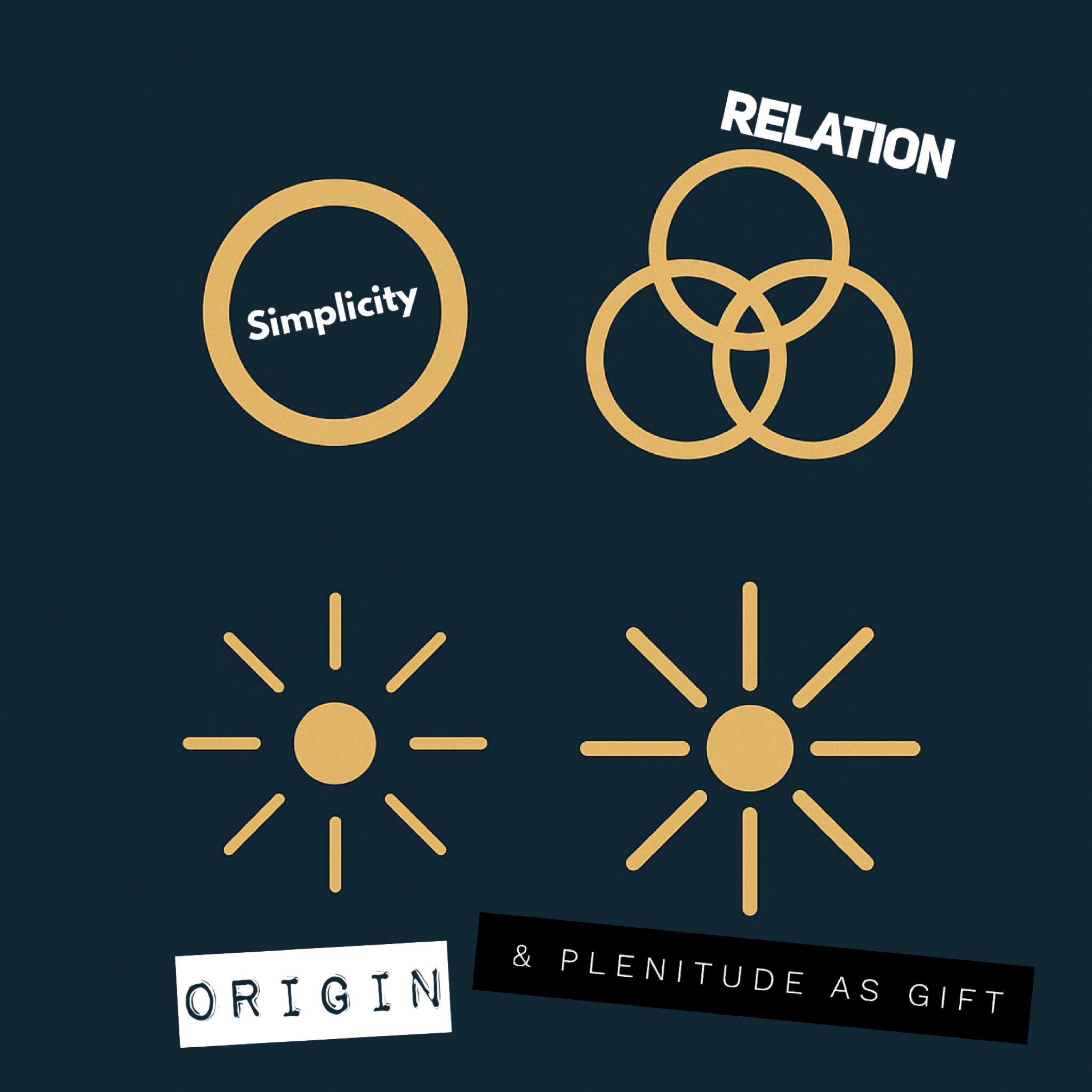
Simplicity, Relation, Origin, and Gift in Theological Reflection
Simplicity, Relation, Origin, and Gift in Theological Reflection: Simplicity and Plentitude In Harmony
In this piece we will explore four core theological principles, Simplicity, Relation, Origin, and Gift, that together form an integrated framework for understanding both the inner life of God and the very structure of reality. The central claim I’ll make here is that these four ideas function both as primitives, irreducible explanatory stops that ground every subsequent theological and metaphysical assertion, and as principles too, that is governing truths that guide our reasoning about God, creation, and humanity’s place in the universe.
First, Divine Simplicity affirms that God is absolutely one and non-composite, pure act of being without any potentiality. Second, Relation explains how real distinctions can exist within the one simple essence without compromising that unity. Third, Origin shows how those distinctions arise from eternal processions within the Godhead. Fourth, Gift reveals how the triune life overflows into creation and draws all things back into communion with their source.
By presenting these four notions together we aim to demonstrate how they clarify the doctrine of the Trinity as well as the nature of creation, providence, grace, and eschatology. Every existing thing participates in God’s self-donative life, and its ultimate purpose is to receive and return the divine gift.
Methodology
Throughout this work we treat Simplicity, Relation, Origin, and Gift as metaphysical primitives, meaning starting points in our theoretical architecture that require no deeper explanation within the system. Any attempt to analyze these concepts further would undermine their function of halting the regress of “Why must God be this way rather than that?” or “How can the divine nature avoid composition?”
At the same time we call them principles because each one names a fundamental truth about divine reality that governs all subsequent reasoning. Simplicity prohibits any division in God. Relation explains genuine distinction without division. Origin accounts for how those distinctions come into being. Gift situates creation within the narrative of divine self-communication.
This dual role guides our exposition. We will first show why each notion must be posited at the primitive level, then demonstrate how it governs our understanding of God and the world.
John Scottus Eriugena’s Insight
Latin Maxim
“Omnia quae sunt, dona sunt; quae non sunt, nihil sunt; omnia ergo dona sunt.”
Translation and Significance
“All things that are, are gifts; things that are not, are nothing; therefore all things are gifts.”
This formula, offered by John Scottus Eriugena in his Periphyseon, carries profound metaphysical weight. It is not a pious metaphor but a declaration about the very mode of being for every created entity. To exist is to receive existence; without reception from an external source, a thing would be nothing at all.
Eriugena’s maxim immediately rules out any notion of a self-subsisting substratum beneath creation. There is no hidden foundation that grants creatures their being; each created thing participates directly in the uncreated Being who is God. Being itself in the realm of creatures is synonymous with receiving and depending, not with self-sufficiency.
This insight has two immediate consequences. First, it establishes Gift as the foundational mode of all creaturely reality. We do not first have relationships or attributes and then give thanks. We first are recipients of a gift. Second, it sets the stage for understanding God’s own being as gift. If every other being is a gift, then only a Being whose very nature is gift can serve as the source of all gifts without being diminished. This leads directly to the primacy of Divine Simplicity: only an utterly undivided act of self-giving can sustain the universal logic that every being is a gift.
Primordial Logic of Gift
To say that every creature exists only by being given existence shifts our metaphysical outlook from Aristotelian self-subsistence to Eriugena’s logic of Gift. Creatures do not possess being as an intrinsic property but as a gratuitous reception. There is no substratum of self-sufficiency beneath the manifold of created reality. Each entity stands or falls on its continuous participation in the uncreated act of being. This participation is not a one-time infusion but an ongoing reception. Every heartbeat, every sunrise, and every motion depends on God’s ceaseless generosity, which is not too far off from the Aristotelian paradigm, really.
The consequence is that dependency is not a blemish but the very hallmark of creaturely reality. Dependency reveals the relational structure of all things. In this sense, to exist is to stand in a network of giving and receiving. Nothing can be abstracted from that network. So, that’s the backdrop, context, and origin of the kind of terms we’re trying to get at.
Divine Self-Donation as Mode of Existence
If creatures are essentially recipients, then the source of their being must be a donor whose very being is donation. Only a Being whose essence is characterized by giving can account for the fact that existence itself is a gift. This is where Divine Simplicity enters as an indispensable explanatory stop. We must deny any composition in God to affirm that the Source can give endlessly without fragmenting or being diminished. God’s very essence must be one simple act of pure being that is identical with an act of pure generosity.
God gives Himself as a gift for no reason at all, simply because He is gift and love.
In this framework, God is not a static monad, or even possible pre-relational monad, hoarding being, but in actuality is an eternal self-donative life. The Trinity—Father, Son, and Spirit—embodies that self-giving. The Father generates the Son. The Father and the Son breathe forth the Spirit. Each procession is an act of self-donation within the divine life. The divine essence is thus gift by nature, not by accident. Every utterance of “God exists” simultaneously affirms that God gives Himself wholly and eternally.
The logic of Gift immediately underwrites a re-visioning of creation. Creation ex nihilo is not a pragmatic solution to an ontological problem in God. Rather it is the overflow of the divine life of generous self-giving. God creates not because He needs anything but because His simple act of being is inherently communicative. To withhold creation would violate the divine nature, for God’s essence is to give.[i]
Once the cosmos exists, it remains dependent on God’s continuous self-donation. Providence is not micromanagement by a distant potentate. It is the sustaining and guiding presence of the uncreated Gift, drawing every creature toward its fulfillment. Sin and evil understood as privations are distortions in the order of giving and receiving. Grace by contrast heals those distortions through the Spirit, who as Donum Increatum pours the first gift of divine life into the hearts of believers.
Finally, the orientation of creation toward God becomes both inevitable and desirable. If existence is gift, then the proper posture for every creature is receptivity and responsive thanksgiving. The cosmos becomes a living liturgy, a grand movement from gift to gratitude to return. Humanity made in the imago Dei learns to stand in the space between gift and response, offering back the very being it has received.[ii]
In these opening sections we have laid the groundwork for a fourfold framework of Christian metaphysics. We began by declaring that all things are gifts following Eriugena’s maxim. We then showed why God’s own being must be a primordial act of self-donation, Divine Simplicity, to account for this universal logic of give and receive. Finally, we drew out the implications for creation’s ongoing dependency and teleology.
Having established Gift as our principle and analogy (and eventually a key primitive in its own right), we are now positioned to introduce the principles in focus in this piece as primitives, Relation and Origin, in order to resolve the puzzles of divine distinction and generation. With Simplicity and Gift secured, Relation will explain how God can be one without being solitary and Origin will reveal how the divine Persons come forth from one another in perfect communion. In the next sections we will show how all four primitives interlock to yield a fully integrated account of Trinity, creation, grace, and eschaton, demonstrating that everything springs from the simple Source of being and returns to Him in an eternal cycle of love.
Primitive I: Simplicity
The moment we reflect on the concept of God, we encounter a fundamental dilemma. Any account that treats God as composite or made of parts undermines divine transcendence. If God were assembled from physical elements or metaphysical components, then God would depend on something prior. To say “What underlies God?” becomes a question that never reaches an end unless we posit a being that requires no underlying cause. Divine Simplicity serves as the indispensable explanatory stop. By affirming that God is absolutely simple, we reject any notion of division in the divine essence and secure both God’s unity and God’s transcendence.
Moreover, without simplicity we face an infinite regress. Every time we identify one component of God—say, an attribute like power or wisdom—we would be forced to ask what constitutes that attribute, and then what lies behind that, and so on without limit. Simplicity halts this regress by declaring that no further analysis of God’s inner constitution is possible or necessary. Once we have affirmed that God is a single undivided act of pure being, any question of what “parts” compose God must cease.
If God were composed, then every divine attribute—power, wisdom, love—would itself demand an underlying explanation, and that explanation would demand another, and so on without end. Only by affirming God as pure act, utterly simple, do we find an explanatory end. After all, what’s a greater end than God? Revelation 22:13; Isaiah 48:12: “Listen to Me, O Jacob, and Israel, whom I called; I am He, I am the First, I am the Last”
Finally, Simplicity protects the coherence of every subsequent theological claim. If God could be divided into multiple metaphysical or logical elements, then the distinctions we draw between Father, Son, and Spirit or between God’s attributes would threaten to fracture the divine nature. Simplicity ensures that each of those distinctions is not a slice of God, but rather a reflection of how one simple essence is encountered in different ways.
God cannot be composed of anything without surrendering His unity, immutability, necessity, and infinitude as composition entails parts, parts imply potentiality, and potentiality entails change and dependency, all of which contradict a being whose essence is identical to His existence and who is pure act (actus purus). Thus, simplicity is not an optional condition but the very metaphysical guarantee that God remains coextensive with all His attributes without division, ensuring that His power, wisdom, and love are not added properties but the one simple divine essence encountered in various respects.
Core Tenets of Divine Simplicity
First, God is non-composite in every respect. There are no physical parts, metaphysical components, or logical constituents that enter into the divine essence. Unlike a human being who has a body and a soul, or a concept that can be broken into constituent ideas, God’s very being knows no division. Such that God knows himself he knows himself perfectly and whole. [iii]
Second, God is pure act, or actus purus. Creatures always exhibit a mixture of actuality and potentiality. A seed is actually a seed but potentially a tree. Every creature requires an external cause to actualize any potential. God, however, possesses no unrealized potential. God is fully and exhaustively actual at every moment. There is no additional perfection that God could gain. God’s reality is the fullness of being itself.[iv]
Third, in God essence and existence are identical.[v] In creatures essence (what a thing is) differs from existence (that a thing is). A rock has essence and must receive existence from another. In God there is no such distinction. God’s very essence is to exist. This is captured in the Latin phrase ipsum esse subsistens —the self-subsistent act of being itself. God does not have existence as an attribute. God is existence.[vi]
Consequences for Divine Attributes
If God is absolutely simple, then all of what we call divine attributes are not separate parts but identical with the one undivided essence. God’s wisdom is not an ingredient added to divine being. God’s power is not a module attached to divine nature. God’s love is not a layer placed on top of divine existence. Each attribute names the same simple reality under different conceptual lenses. Unity is really unity, and to divide it is to undermine it. For example, change introduces undermining it, but immutability does not. Contingency undermines God’s necessity, but being God, he cannot be anything but God. Limitation, means he’s not actually a plenitude and infinitude, which doesn’t make sense when pressed. It seems that it may be literally impossible in God to contradict his perfections if he is unbounded and infinite and a true plentitude:
A helpful analogy is that of a prism and a beam of white light. The prism refracts white light into a spectrum of colors. Yet the colors remain nothing other than the same single ray of white light, perceived differently. In a parallel way, we speak of God’s omniscience, omnipotence, goodness, and justice. These are not four distinct parts of God. They are four conceptual wavelengths in which our mind discerns the richness of the one simple divine essence. The multiplicity of names reflects the limitation of human language and cognition, not a division in God.
Simplicity as Metaphysical Primitive
Divine Simplicity functions as the master grammar for all classical theological discourse. As a metaphysical primitive, it cannot itself be derived from anything deeper. It is the bedrock assumption that underlies every other doctrine. Without it, theological reflection collapses into either tritheism—three separate gods—or modalism—the reduction of three Persons to mere roles of one substance.
By treating Simplicity as our first primitive, we anchor the entire reflection of our 4 principles as not merely principles but also give them a sense of a single irreducible truth: God is one undivided act of pure being. With this secured, we can responsibly introduce Relation as our second primitive to explain real distinction without division, Origin as the third primitive to ground those distinctions in eternal processions, and Gift as the fourth primitive to account for the divine life overflowing into creation. Together these four primitives form the foundational architecture of a coherent Christian ontology in which “all things that are, are gifts,” and yet the Source of all gifts remains the one simple God.
Primitive II: Relation
If God is absolutely simple, yet Christian faith insists on Father, Son, and Holy Spirit, we face an apparent paradox. How can there be real plurality or distinction within one undivided divine essence? Any attempt to locate difference in separate parts or qualities of the divine nature would directly contradict simplicity. The challenge is to account for three distinct Persons without compromising the unity or indivisibility of God. This puzzle demands a fresh category of being—one that can host genuine distinction without introducing composition.
Relation as the Only Category Pointing Beyond Without Composition
Classical metaphysics categorizes being into substance and accidents. Substances stand in themselves; accidents inhere in a substance. Relations, by contrast, inherently point “to another.” A relation does not describe a subject in isolation but always signifies a connection. Crucially, a relation does not add a new part to the subject; it simply expresses how one thing is ordered to another. In God, where no accidents or parts may exist, relation offers the only possible mode of distinction that respects simplicity. By elevating relation to a metaphysical primitive, theology can assert that the divine Persons are real distinctions without splitting the divine essence.
Relational Opposition: Father ↔ Son; Spirit ↔ (Father + Son)
The distinctions among Father, Son, and Holy Spirit emerge solely from their mutual relations. The Father is the unbegotten source; the Son is begotten of the Father; the Spirit proceeds from Father and Son. These are not temporal events but eternal oppositions of origin. The Father’s relation to the Son stands in necessary opposition to the Son’s relation to the Father. Similarly, the Spirit’s procession from both Father and Son stands in opposition to the common principle of active spiration. These opposed relations—paternity and filiation, active and passive spiration—secure three real Persons while avoiding any notion of a fourth or reducing the inner life to mere roles.
Subsistent Relations: Persons Are the Relations
In God, relations do not inhere in a subject; they subsist in personhood. The Father is not a divine substance that has paternity; He is subsistent paternity itself. The Son is not a divine subject that happens to have the property of filiation; He is filiation in person. The Spirit is not a divine subject that bears the attribute of procession; He is procession itself. By identifying the Persons with subsistent relations, theology maintains that each divine Person fully shares the simple essence yet remains distinct by virtue of an irreducible relation of origin. No added quality or component is required. The divine essence remains one and simple even as three identity-conferring relations play out within it.
Conferring Identity Relations
In the life of God each Person is distinguished not by a separate substance or by an added quality but by the very way in which that Person originates from the divine fountain of being. The Father is the unoriginated source, the Son is uniquely begotten of that source, and the Spirit proceeds by the bond of love between them. To call someone a “Person” in this context is to recognize that they bear a singular non-shareable relation of origin within the one undivided divine life. That relation is not an accident but the very key that unlocks their identity. Thus the mystery of the Trinity is sustained: three truly distinct Persons, each defined by their own originary relation, yet together sharing wholly in the one simple divine essence. Shared origin is the one divine substance that all three possess as their revelation or tag; each Person is identified by a distinct relation of origin rather than by any added quality or act of participation. These relations of origin are not accidental attributes but the markers—revelatory tags—that confer personal identity within the one undivided life of God.
The conditions of satisfaction of identity here are not substance essence or property bundling but the precision of originary relations themselves. These singular non-shareable bonds of divine origin alone confer and guarantee each Person’s unique identity within the one undivided life of God. The Father’s unoriginated paternity, the Son’s unique filiation, and the Spirit’s procession are not competing strands within a composite reality but distinct identity-conferring relations radiating from one simple source. In other words, divine simplicity is not undermined by the three Persons but is perfectly expressed in their non-competitive originary bonds. Each relation remains irreducible yet coinhere seamlessly enabling the Father Son and Spirit to be numerically distinct while together manifesting the single uncompounded life of God. In this way divine simplicity is revealed as the Trinity’s own unique life its very structure of originary relations perpetually unveiling the one God in three Persons.
Perichoresis: Dynamic Coinherence of Three Persons
The term perichoresis captures the dynamic mutual indwelling of the three Persons. Because each Person is nothing but a subsistent relation to the other Persons, each wholly contains and is contained by the others. The Father is wholly in the Son and in the Spirit; the Son is wholly in the Father and in the Spirit; the Spirit is wholly in the Father and in the Son. This interpenetration does not blur distinctions but enriches them. Each Person remains distinct by a unique originary relation even as each shares fully in the simple divine essence. Perichoresis thus expresses the living communion of self-donative love at the heart of the Godhead: a perfect unity without fusion, a perfect diversity without division.
Primitive III: Origin (Immanent Processions)
Having established that relation secures real distinction without composition, we must ask what gives those relations their concrete content. If relations are merely formal oppositions, they remain abstract. To avoid an empty nominalism we invoke Origin as a primitive: the eternal, dynamic acts within the Godhead that ground each relation. In other words, subsistent relations require a source of movement or procession that is neither temporal nor external but intrinsic to God’s own life. Without these immanent processions, relation would float as an unexplained category, unable to account for the “how” of paternity, filiation, and spiration.
Generation – Intellectual Procession and the Son as “Word”
The first immanent procession is Generation, understood by analogy with the human act of intellect. In an eternal, perfect act of self-knowledge the Father conceives a Word of Himself. This Word is not a thought or a creation but the Son as the substantial expression of the Father’s essence. Generation thus grounds the relation of paternity and filiation: the Father is Father because He begets the Son, and the Son is Son because He is begotten. This intellectual procession neither adds parts nor implies change in the Father. It simply signifies an eternal act of origin from which the Son’s identity as Verbum—the Word—arises.
Spiration – Volitional Procession and the Spirit as “Love”
The second immanent procession is Spiration, akin to the act of the will. In an eternal, perfect act of mutual love the Father and the Son breathe forth a single Love. This Love is not an emotion but the Holy Spirit as a distinct Person. Spiration grounds the relation of procession—passive spiration in the Spirit and active spiration common to Father and Son. The Spirit is Caritas—the shared Love—united to Father and Son yet distinct by origin. As with Generation, Spiration entails no temporal sequence or alteration of substance; it simply unveils the inner volitional movement that constitutes the Spirit’s identity.
How Processions Yield Real Relations Without Change or Composition
These immanent processions do not introduce composition or change into God. They are not sequential events but eternal acts that always are. Because God is pure act, His processions are inseparable from His essence and do not imply potentiality being actualized. They ground the subsistent relations by providing the “from whom” and the “how” of each Person’s identity. Generation and Spiration thus explain why there are truly three Persons without shattering divine simplicity. Each procession is an irreducible, non-derivative act of being that yields a real relation without dividing or adding any component to the divine nature.
Link to the Economic Trinity
Origin also forges the crucial bridge to the economic Trinity, the missions of Son and Spirit in salvation history. The Son is sent into the world because He is eternally begotten of the Father; the Spirit is poured out because He eternally proceeds as Love. These temporal “missions” mirror the immanent processions. In the Incarnation the eternal Generation takes on flesh; at Pentecost the eternal Spiration is manifested in tongues of fire. Thus Origin ensures that the inner life of God and His outward actions in history cohere: what God eternally is, He freely becomes in time to draw creation into the circle of divine self-giving.
Primitive IV: Gift
The final primitive is Gift, which identifies the Holy Spirit by His personal relation of origin and mission. In Latin theology the Spirit is called Donum Increatum, the Uncreated Gift. This title is not a pious metaphor but a precise designation of His identity. He proceeds from the Father and the Son as the subsistent love binding them together. As Donum Increatum, the Spirit is the fountain of all giving within the Godhead. He is eternally un-owed because His procession issues from the superabundant communion of Father and Son, not from any lack or necessity. By naming the Spirit the Uncreated Gift we make explicit that gratuitous giving is His very personhood.[vii]
In this framework, which we’ll go into detail below later, gift functions as the concrete expression of divine plenitude, identifying the Holy Spirit as the Uncreated Gift whose very procession embodies God’s infinite fullness. In the Catholic tradition, plenitude (Latin plenitudo) signifies God’s absolute, inexhaustible fullness of being and goodness—the wellspring from which all creation flows. By treating Gift as a metaphysical primitive, the text underscores that God’s essence is fundamentally an act of self-donation, making the grammar of giving the foundational pattern for both divine life and creaturely existence. Moreover, Gift accentuates plenitude by showing that the Trinity’s internal processions— the Father’s begetting of the Son and the Spiration of the Holy Spirit—are not mere abstractions but dynamic, overflowing outpourings of God’s simple, undiminished life. This model especially illustrates how every creature exists only by the ongoing reception of the divine gift, situating all existence within an eternal cycle of God’s generosity and the world’s responsive thanksgiving. Let’s recap what Plentitude is, properly however, so it’s clear what this Holy Spirit expression of it is doing in the grammar of Gift.
“Plentitude” from Two Theological Greats
In the Catholic tradition plenitude (Latin plenitudo) designates the absolute fullness or completeness of divine being and goodness—affirmed in Scripture, the Fathers, and the Councils as God’s indivisible wealth of existence and perfection. John Scotus Eriugena and St. Bonaventure each offer vivid metaphors to show how that plenitude operates at the heart of reality.
Eriugena portrays divine plenitude as a super-essential “nothingness” that transcends every creaturely category. He writes that the term “nothing” signifies the ineffable and incomprehensible radiance of divine goodness—unknown to any intellect because it “neither is, nor was, nor will be,” yet “surpasses all” and is therefore properly called “nothing” . He further affirms that “God alone is infinite; everything else is bounded in place and time,” thus showing that this apophatic nothingness is in fact the fountainhead of all finite being .
Bonaventure, by contrast, celebrates that same plenitude as fountain-fullness (fontalis plenitudo): the self-diffusive relations of Father, Son, and Holy Spirit that are not accidental add-ons but the very realization of divine simplicity. He names this “fountain-fullness” the prima ratio entis—the first principle of all being—from which “the immensity of fountain-like creative power shines forth most fully,” and from which the eternal generation of the Son and procession of the Spirit proceed without change .
Together, these models reveal that divine plenitude in Catholic thought is not a static attribute but the infinite, self-originating ground of all that exists—conceived either apophatically as “nothing” or metaphorically as an ever-flowing fountain of life.
3 Insights from Eriugena by way of Duclow
In Donald Duclow’s essay Divine Nothingness and Self-Creation in John Scotus Eriugena (1977), Duclow emphasizes how Eriugena, in his Periphyseon (De divisione naturae), names God’s super-essential radiance “nothing” to reveal an infinite, self-originating plenitude that grounds all being. Below are Eriugena’s own words, in Latin and in smooth English translation, illustrating this vision of divine plenitude as plenitudo rather than privation.
1. Divine Goodness as “Nothing”
Latin (Periphyseon I, 680D–81A)
“Ineffabilem et incomprehensibilem divinae bonitatis inaccessibilemque claritatem omnibus intellectibus, sive humanis sive angelicis, incognitam — superessentialis est enim et supernaturalis — eo nomine significatam crediderim, quae dum per se ipsam cogitatur, neque est, neque erat, neque erit. In nullo enim intelligitur existentium, quia superat omnia…. Dum ergo incomprehibilis intelligitur per excellentiam, nihilum non immerito vociatur.”
AI Translation
“I understand ‘nothing’ to signify the ineffable and incomprehensible radiance of divine goodness—unknown to every intellect, human or angelic—because it is super-essential and supernatural. For when contemplated in itself, it neither is, nor was, nor will be; it can be grasped in no existing thing, since it surpasses all. … And so, precisely because it is incomprehensible in its excellence, it is not improperly called ‘nothing.’”
2. God’s Infinity Beyond All Measure
Latin (Periphyseon I, 482C)
“Solus igitur Deus infinitus est; cetera ubi et quando terminantur, id est loco et tempore.”
AI Translation
“God alone is infinite; everything else is bounded in place and time.”
3. “Nothing” as the Name of Super-Essential Plenitude
Latin (Periphyseon I, 897D)
“Propter superessentialitatem suae naturae nihil dicitur.”
Translation
“It is for the super-essentiality of His nature that He is called ‘nothing.’”
Taken together, we learn from Eriugena, via Duclow that Eriugena teaches that divine plenitude is not an add-on to God’s being but is identical with His very essence, and so ineffably overwhelming that it transcends every category of existence and can only be named “nothing” in the apophatic tradition. In his account, this “nothingness” signifies super-essential abundance rather than privation, echoing Pseudo-Dionysian negative theology. He further affirms that God alone is infinite while everything else is bounded in place and time, thus portraying God’s unbounded nature as the fountainhead from which all created being derives yet remaining itself unconstrained. Together, these passages provide a direct and substantive witness to Eriugena’s vision of divine plenitude as the self-originating ground of all being in the Periphyseon. (source hosted here: https://robertdryer.com/wp-content/uploads/2025/05/duclow-2015-divine-nothingness-and-self-creation-in-john-scotus-eriugena.pdf)
Bonaventure on Plentitude
In his Collationes in Hexaemeron (Reportatio B, caput XI, collatio X, cols. 380–381), Bonaventure asserts that the Father’s eternal begetting of the Son, the Son’s begottenness, and the Spirit’s spiration are not adjuncts to a solitary divine substance but are themselves the self-diffusive relations that constitute God’s simplicity—what he names haec fontalis plenitudo, the prima ratio entis—relation as such, undiminished plenitude and the very foundational principle of all being.” Bonaventure makes this claim succinctly:
“… in qua est plenitudo fontalitalis ad productionem Filii et Spiritus sancti. Haec autem fontalitas quodam modo origo est alterius fontalitatis. Quia enim Pater producit Filium et per Filium et cum Filio producet Spiritum sanctum; ideo Deus Pater per Filium cum Spiritu sancto est principium omnium creatorum….”
AI Translation:
“… in which there is the fountain-fullness toward the production of the Son and of the Holy Spirit. That fountain-fullness, moreover, is in a sense the origin of another fountain-fullness. For since the Father generates the Son and, through the Son and with the Son, brings forth the Holy Spirit, therefore God the Father, by way of the Son with the Holy Spirit, is the principle of all creatures….”
Immediately thereafter he names this very self-diffusive reality:
“Haec fontalis plenitudo, ut vocat, est prima ratio entis, cuius — in contrastu cum creaturis — neque additio neque subtractio licet, sed cuius ipsa infinitas virtutes sine commotione et sine mutatione fluunt, et a quae aeterna generatio Filii et processionis Spiritus procedit in unum modum, quia utriusque verbum et splendor est ‘per omnia Patri aequalis’, et sic Deus simpliciter totus ille cum suis relationibus incommunicabiliter subsistit.”
AI Translation:
“This fountain-fullness, as he calls it, is the first principle of being—unlike creatures, to which neither addition nor subtraction is permitted—but from which its own infinite powers flow forth without stirring or change, and from which the eternal generation of the Son and the procession of the Spirit proceed in the same manner, since the Word and the splendor of each are ‘in all respects equal to the Father,’ and thus God subsists in simplicity, wholly and incommunicably, together with these relations.”
These two passages together demonstrate that for Bonaventure the Father’s begetting, the Son’s begottenness, and the Spirit’s spiration are not external add-ons to a solitary substance but are the very self-diffusive relations—haec fontalis plenitudo, the prima ratio entis—by which divine simplicity is realized and by which all being finds its fountainhead.
What Boneventure argues for principally, I’m expounding here and framing a little more explicitly as something eternal self-donation or Gift. But the basic idea is the same. If anything his treatment of the idea cannot be beat, only revisited. But, it’s helpful to acknowledge him as it’ll put our treatment of the Holy Spirit next in a nice context.
Gift as Personal Identity of the Spirit
The Holy Spirit’s unique personal identity consists in gratuitous self-donation. Whereas the Father is unoriginated source and the Son is begotten Word, the Spirit is the subsistent love that flows between them. This love is not an accident added to their being but is the relational bond that holds the divine Persons in perfect unity. In this sense the Spirit is the first “other” within God, the one who gives and is given. His procession is an eternal act of unmerited generosity. Because He is Gift by nature He becomes the principle and source of all further giving, both within the inner life of God and in the economy of salvation.
Created Gifts Flow from This First Gift
All created gifts proceed from the Uncreated Gift. Existence itself is the first and most universal of created gifts, bestowed by the Spirit’s gratuitous power. In the order of salvation grace and the sacraments are particular expressions of that gift. Baptism, Confirmation, Eucharist and every sacramental rite are channels by which the Spirit communicates created gifts—sanctifying grace, the theological virtues, charisms and fruits—to souls. Because the Spirit’s identity is Gift, His action in the world is never coercive but always invitational. He bestows what He himself eternally is, drawing creatures into participation in divine life. The flow from the Uncreated Gift to created gifts safeguards both God’s initiative and our receptive freedom.
Cosmos as First Created Gift: Ecological and Liturgical Implications
Beyond the realm of grace the entire cosmos is the first created gift offered by God. The Spirit’s creativity brings forth a world of immense beauty, complexity and interdependence. This vision carries profound ecological and liturgical consequences. Ecologically it demands that we treat creation not as raw material to be exploited but as a sacred trust to be received with gratitude and guarded with care. Liturgically it reveals the universe itself as a kind of sacrament, a visible sign of the invisible God. The cycle of seasons, the rhythm of day and night, the renewal of life all echo the Spirit’s generous activity. In cosmic worship the Church joins heaven and earth in giving thanks for the gift of all things, returning creation to its source with praise.
By recognizing the Holy Spirit as the Uncreated Gift, and seeing all reality as His created gifts, we complete the set of four primitives. Simplicity secures the undivided source, Relation explains real distinction, Origin grounds those distinctions in eternal processions and Gift reveals how the inner life of God overflows into creation. Together these primitives form a coherent framework that illuminates both the mystery of the Trinity and the sacramental structure of reality.
The Nature of Reality
Every aspect of the created order stands in radical dependence upon God, who alone is the self-subsistent act of being. Nothing in the cosmos contains within itself the source of its own existence. Each creature, whether an electron or an eagle, exists only by continually receiving its being from the one simple Creator. This contingency safeguards God’s absolute transcendence and ensures that no finite entity can ever become its own ground of reality.
Reality’s Fundamentally Relational Structure
Creation mirrors the Trinitarian life in its very fabric of interdependence. From the subatomic realm to ecosystems, nothing stands alone. Molecules form compounds by mutual contract, cells form tissues by functional ordering, and human persons form societies by bonds of love and communication. Each level of being depends upon countless others in a vast web of dependencies that reflects the relational ontology of the divine Persons.
Creaturely Composition: Potentiality, Gift, Actuality
A hallmark of every created thing is its composition of potentiality and actuality. Potentiality marks the power to receive further being or to become otherwise than one is. Actuality is the realized state of being. In the light of Gift, potentiality is the capacity to be further graced by God and actuality is the fruit of that divine bestowal. Thus every actualized reality stands as a gift received and sustained, never as a brute self-subsistence.
Vestigia Dei: Creation as Sacramental Signs
The natural world bears the traces of its Creator. Mountains, rivers, cells, and seasons all display analogical reflections of divine attributes such as unity, wisdom, power, and beauty. These vestigia Dei function as sacramental signs that point beyond themselves. Just as a priest raises the Eucharist to reveal Christ’s presence, creation lifts our minds to the invisible God. The cosmos thus becomes a universal sacrament inviting wonder, study, and worship.
Teleology: Exitus–Reditus (Gift, Thanksgiving, Return)
The history and destiny of reality follow a dynamic pattern of giving and returning. Creation flows forth from God as an expression of divine generosity. Creatures respond by offering thanksgiving in praise, love, and service. Ultimately the cosmos will return to its origin in a final act of glorification, when every creature acknowledges God’s parenthood and humanity crowns the universal liturgy in the heavenly Jerusalem. In this grand exitus-reditus circuit, reality finds its true meaning as both gift and response.
Conclusion
The principles of Simplicity, Relation, Origin, and Gift form a single, unified framework. Simplicity secures God’s absolute unity and halts any metaphysical regression. Relation then provides the mode by which real distinctions can exist without composition. Origin grounds those distinctions in dynamic, eternal processions. Gift reveals how the undivided divine life overflows into creation and returns in thanksgiving. Together they answer the deepest puzzles of theology and metaphysics: how God’s inner life remains one and how creatures can participate in that life without compromising divine transcendence.
Armed with these four primitives we can now undertake a systematic survey of classical Christian doctrine. In Trinity theology we will see how each divine Person arises in relation and processional origin while remaining one simple essence. In the doctrine of creation we will understand the cosmos as the first created gift that depends on God’s simplicity and bears the traces of divine relation. In the economy of grace we will trace how sacraments and charisms flow from the Spirit as Donum Increatum. Finally in eschatology we will describe how the universe completes its exitus–reditus cycle in the heavenly liturgy of thanksgiving, returning every creature to the one simple Source.
All things that exist are gifts. They flow forth from the one simple Source whose undivided life is relational, processional, and self-donative. By receiving and returning divine gifts we participate in the eternal circuit of love at the heart of reality. In this way theology and ontology converge in the single proclamation that being itself is nothing other than the self-communication of the divine love.
[i] “The more the reduction reduces itself, the more it extends givenness—so much reduction, so much givenness.”
— Jean-Luc Marion, Reduction and Givenness, pp. 203–204.
Here Marion shows that the very act of stripping away all our categories (the “reduction”) only uncovers ever greater surplus of gift: the more we empty ourselves of pretensions to dominate or possess, the more reality overflows to us as gratuitous donation. Albeit, this is a phenomenological key, but the from a transcendental world view this stuff applies across the board.
[ii] “The phenomenon does not show itself because we constitute it; it shows itself insofar as it gives itself.”
— Jean-Luc Marion, Givenness and Hermeneutics, p. 2.
This emphasizes that givenness precedes any act of cognition or taking. Being itself is a gift freely offered, not something we summon into existence by our own concepts.
[iii] “It is impossible that there should be in God any composition of substance and accident, for whatever is compounded has parts, and in God there can be no parts.”
— St. Thomas Aquinas, Summa Theologiae I, q. 3, a. 1 (Reply to Objection 4)
[iv] “We call God ‘pure act’ in that in Him there can be no potentiality; He is the fullness of being itself, lacking nothing and incapable of becoming otherwise.”
— St. Thomas Aquinas, Summa Theologiae I, q. 3, a. 2, ad 2
[v] “The divine essence is existence itself; in God essence and act — that is, and that He is — are absolutely identical.”
— St. Thomas Aquinas, Summa Theologiae I, q. 3, a. 4, ad 1
[vi] “The divine essence is existence itself; in God essence and act — that is, that He is — are absolutely identical.”
— St. Thomas Aquinas, Summa Theologiae I, q. 3, a. 4, ad 1
[vii] “Moreover, a complete theology of the divine self-gift would add to the missions of the Spirit in love and of the Son in the outer word the self-gift of the Father in hope.”
— Bernard Lonergan, What Is the Gift of the Holy Spirit?
lonerganresource.com
Lonergan points out that the Father’s self-giving in hope completes the inner economy of Trinity: each Person eternally donates Himself—intellectually, volitionally, and in hope—revealing that divine simplicity must be understood as an undivided act of self-donation.