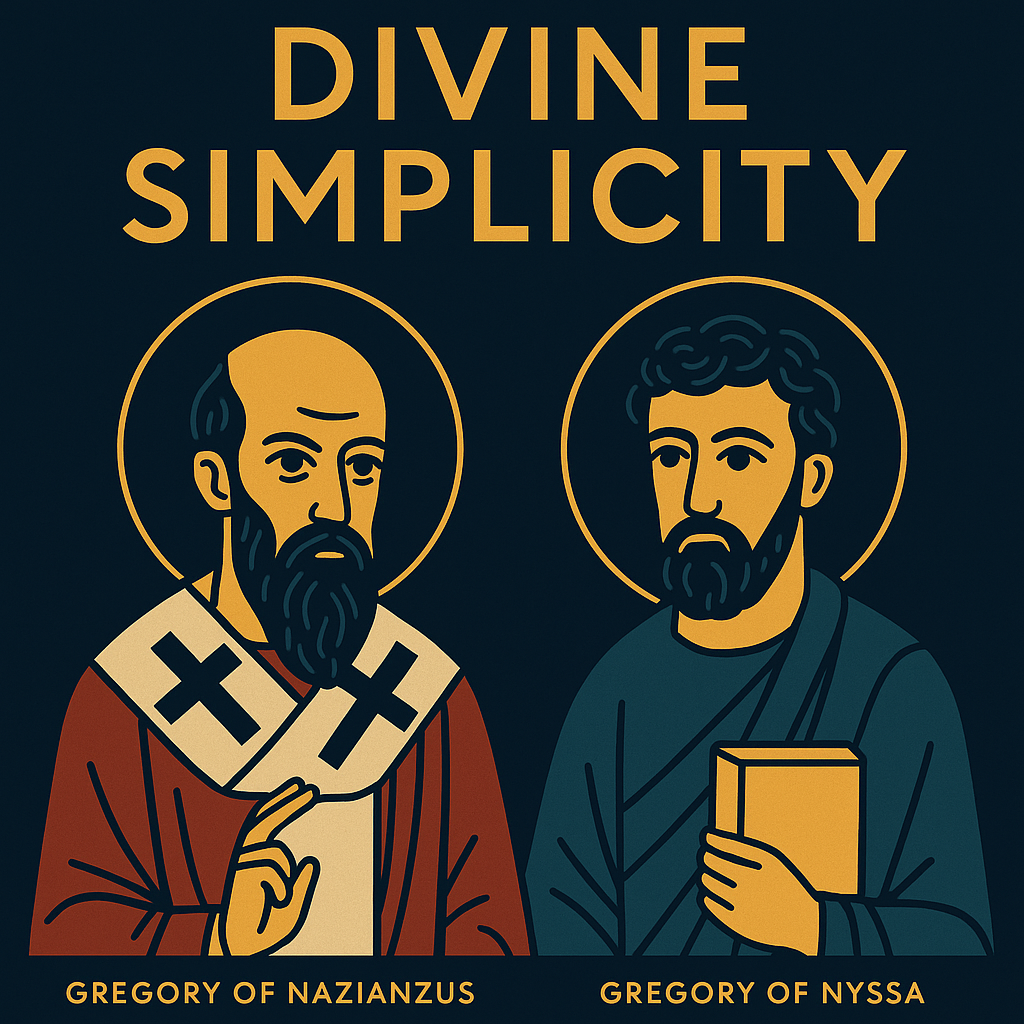
The Cappadocian Achievement:
Divine Simplicity, Semantic Grammar, and the Persons of the Trinity
Modern summaries sometimes make the Eunomian conflict sound like a dispute over whether God is simple, but that framing misses a shared premise: late fourth-century writers across partisan lines, Eunomius included, commonly affirm divine simplicity (Radde-Gallwitz 2019, 452–53). What it obscures is what the pro-Nicene authors themselves treat as decisive. Gregory of Nyssa and Gregory of Nazianzus can grant, without concession, the shared instinct that the divine life is simple, and then press the real point of fracture: Eunomius makes simplicity do work it cannot do by converting it into a rule of definitional transparency. On his construal, simplicity guarantees that the divine essence is conceptually exhaustible, nameable without remainder, and therefore capturable by a single proper term; and once “unbegotten” is installed as that essence-signifying name, the Son’s “begottenness” is forced to signal a different essence and the homoousion dissolves. The Cappadocian diagnosis is that this outcome does not follow from simplicity as such. It follows only because simplicity has been fused to an ambitious theory of naming, definition, and knowability, and because “unbegotten” has been promoted from a negative or relational marker into a purported definition of what God is. On their account, a divine person is an irreducible hypostasis of the one undivided Godhead, distinguished only by relational origin, the fromness and taxis that differentiate without ranking, and held together by the communion of the single divine life and inseparable operation.
Seen from within the late Arian problem-space, Eunomius is not merely speculating. He is attempting to stabilize doctrine by the kind of definitional precision that, to him, seems required by monotheism and by the simplicity of God. The threat, as the Cappadocians see it, is that this “precision” is a trap. It does not clarify the faith; it redefines the terms of confession so that the Son is excluded by definition. In other words, the crisis is simultaneously metaphysical, semantic, and ecclesial: how to confess the homoousion without collapsing into tritheism or modalism, and how to speak of Father, Son, and Spirit using the revealed names without turning God into an object of definition and comprehension.
The historical pressure point: the crisis of naming and knowledge
Eunomius and the Anomoeans press the Church at the level of language. If “God” names a simple essence, and if true knowledge is knowledge by definition, then the Church ought to be able to say what that essence is with one decisive term. Eunomius’s proposal is as stark as it is rhetorically powerful: God’s essence is “unbegotten” (agennētos). If unbegottenness names the divine substance, then the Son, being begotten, cannot share that substance. The Nicene confession becomes, on this telling, confused speech that tries to call two unlike essences by the same divine name.
The Cappadocian fathers see immediately that the danger is not only metaphysical. Eunomius is re-engineering the semantics of God-talk so that the grammar of Christian confession is displaced. The revealed names Father, Son, and Spirit are treated as secondary or derivative, while “Unbegotten” becomes the one proper name that defines God. That move severs the relational logic built into the name Father, and it aims to stabilize monotheism by turning God into a definable monad.
But pro-Nicene theology must also answer a second pressure point. Even if Eunomius can be blocked, the confession “one ousia, three hypostases” is exposed to a standing objection: if Peter, James, and John share one human nature and are three men, why are Father, Son, and Spirit not three Gods? Nyssa stages this problem directly in To Ablabius and admits its difficulty for ordinary reasoning. The Church needs a disciplined way of using “nature” and “person” language that avoids both tritheism and modalism, and avoids positing a fourth thing “behind” Father, Son, and Spirit as though the divine essence were a separable substrate.
The Cappadocian achievement is therefore not a single move but a grammar, a rule-governed pattern of speech that ties together (1) divine simplicity as non-composition and non-measuredness, (2) epistemic humility about the incomprehensibility of ousia, (3) the classification of divine names, especially relation-names, and (4) the ousia/hypostasis distinction, governed by inseparable operations and origin-relations.
Eunomius’s full inferential chain: why “simplicity therefore unbegottenness” is a caricature
If the pro-Nicene rebuttal is to have force, Eunomius must be reconstructed in his own intended logic, not reduced to a slogan. The heart of his argument is an inferential chain in which the controversial work is done in the middle, at the level of semantics and epistemology.
Eunomius begins with what sounds like a classical premise: God is absolutely simple, uncaused, indivisible, and fully self-identical. He is “before all things,” dependent on nothing, having no parts or internal diversity. Up to this point, he can appear to be the strict defender of monotheistic piety.
The hinge arrives with the next step: therefore God’s essence can be perfectly expressed by one proper term, because real knowledge is knowledge by definition. If God is simple, Eunomius argues, then true knowledge cannot be a patchwork of partial concepts. It must be unitary, and it must reach the essence. In the language of the reconstruction you provided, Eunomius assumes the epistemological priority of definition and converts simplicity into definability.
To secure this, Eunomius attacks “names from epinoia,” names that arise from human conceptual reflection. Such names, he says, exist “in name alone” and vanish like breath. They do not touch God’s being. But a proper essence-name would convey, in effect, “that he is what he is.” This is the semantic program: there is one right name, and it transparently reveals the essence.
Only now does “unbegotten” enter as the candidate for that essence-name. Eunomius famously writes, “what follows from this is the Unbegotten, or rather, that He is unbegotten essence” (Apol. 7). The crucial feature of this claim is that “unbegotten” is not treated as a privation or a relational marker, but as the very content of the divine ousia. Eunomius doubles down: “God…both was and is unbegotten…not by way of privation…‘the Unbegotten’ must be unbegotten essence” (Apol. 8).
From here the polemical payoff becomes “inevitable” by Eunomius’s own rules. If unbegottenness just is the divine essence, then whatever lacks unbegottenness is not God. The Son is begotten, therefore he cannot be consubstantial, and “begottenness” becomes the essence-definition of the Son as a different kind of being.
The point to feel is this: Eunomius’s conclusion depends on the semantic and epistemic middle steps, not on simplicity alone. His argument works because simplicity is treated as an epistemic license: the simple God must be definition-ready, and the right name must be essence-transparent. Once that is granted, “unbegotten” can be nominated as the essence-name, and the homoousion can be denied as a matter of definitional consistency.
The Cappadocian refusal: simplicity does not authorize definitional transparency
Nyssa and Nazianzus do not respond by saying, “God is not simple.” They respond by re-locating the force of simplicity. Simplicity is a boundary notion: God is not composite, not measurable, not in a genus, and not subject to creaturely definition. It does not follow that the divine essence is conceptually exhaustible or definable by one term. In fact, for them, the Creator creature distinction is nowhere more dangerously breached than in claims about comprehension. If a human mind can possess a formula that captures the divine ousia, then the line between divine and creaturely knowing is erased.
This is why Basil’s intervention is so important as prolegomenon. In Letter 234, Basil rejects the thought that if God is simple, every predicate or name must collapse into the same meaning or be identical with the essence. If justice, wisdom, providence, power, and majesty are “all the essence,” then either the words become empty synonyms or one ends up multiplying “essences.” Basil’s point is not that God is composite. It is that human concepts approach God from many angles, and linguistic plurality is not metaphysical composition. Simplicity in God means that the perfections are united in God beyond our grasp, not that our speech can reduce God to one definition.
Nyssa presses the same diagnosis with sharper polemical clarity: Eunomius “fastens on the name Ungenerate, and that alone,” precisely because, in its ordinary meaning, it would not give him the control he wants. If “unbegotten” were taken as a privation, it would negate origin without telling what God is, and Eunomius’s heresy “would have collapsed.” So Eunomius must “revolutionize the conception” of the term, inflating it into a positive essence-definition.
Nazianzus attacks the same hinge by forcing the classification question: what kind of word is this? In Oration 29, he stages the trap: “Father” must be either an essence-name or an action-name. Gregory refuses both and insists it is a relation-name. Once that is seen, the entire Eunomian posture is destabilized. If even “Father,” a primary revealed name, is not an essence-definition, then “unbegotten” cannot claim to be the one essence-transparent term. The Cappadocian refusal is grammatical and epistemic: simplicity polices what can be claimed in God-talk, and it forbids turning God into an object of definition.
Nyssa’s strategy: separating what God is from how God exists, and reclassifying agennētos
Nyssa’s core move is to separate three questions that Eunomius conflates: what God is (ousia), how God exists as Father, Son, and Spirit (mode of existence, tropos hyparxeos), and what words can legitimately signify. Where Eunomius tries to make one term do all three jobs at once, Nyssa insists that origin-terms can mark hypostatic distinction without defining the essence.
This appears with particular force in Nyssa’s treatment of causality and provenance. When he speaks of one as “cause” and another as “from the cause,” he insists that this language does not denote nature but “the difference in manner of existence.” The distinction is not between divine and non-divine essences. It is between hypostatic modes: the Father exists as unbegotten source, the Son exists as begotten of that source, and the Spirit proceeds in a distinct manner that still preserves the one nature.
This is why Nyssa calls it absurd to make “not being begotten” the definition of the divine essence. “Unbegotten” is intelligible only as a relative and negative marker. It tells us how the Father is not related, not what the divine ousia is. Nyssa’s homely analogy makes the point unforgettable: if you ask a farmer whether a tree was planted or grew wild and he answers “unplanted,” you learn a mode of origin, not whether the tree is oak or olive. Likewise, to know the Father is “unbegotten” tells you that he is without cause, but “what He is we do not hear in that phrase.”
This blocks Eunomius at the precise place where his logic needed “unbegotten” to be essence-transparent. If agennētos is not an essence-name, it cannot function as the criterion for divinity that excludes the Son. It becomes what it always should have been: a personal distinction indicating provenance, compatible with consubstantiality.
Nyssa then turns the knife by showing that the only distinctions available within a strictly simple divine nature must be relational distinctions of origin, not essential differentiations. He can therefore say, in effect: we “deny the difference of nature,” but confess difference “in respect of cause and that which is caused,” by which alone one person is distinguished from another. That is not a retreat from simplicity; it is precisely simplicity deployed as a governor of what distinctions can and cannot be posited.
Nazianzus’s strategy: the grammatical classification of divine names and the correlative logic of Father and Son
Nazianzus presses the same governing principle through a more explicitly grammatical register. Where Nyssa tends to foreground the metaphysical and epistemic boundary between essence and mode of existence, Nazianzus foregrounds the semantics of naming and the disciplined syntax of confession.
His key move is to refuse the Eunomian classification scheme. Eunomius treats “unbegotten” as the one proper name that captures God’s being. Nazianzus forces the prior question: what kind of word is “Father,” and what kind of word is “unbegotten”? When he insists that “Father” is neither an essence-name nor an action-name but a relation-name, he is not playing a verbal game. He is locating where revelation situates the Church’s speech.
This has immediate doctrinal consequences. “Father” is correlative. One cannot meaningfully say “Father” without implying “Son.” That is why Basil can press the point that Scripture teaches us to name God as Father, Son, and Spirit, not as “Unbegotten, Begotten, and Proceeding” in isolation, and why baptism is in the name of the Father rather than in the name of the Unbegotten. “Father” includes the relational context that Eunomius’s isolated essence-name is designed to erase.
Nazianzus also guards against a predictable misunderstanding of origin-language. To call the Father “cause” does not place him “before” the Son as though eternal generation introduced time or hierarchy. His famous image is that cause and effect can be simultaneous, as with the sun and its radiance, so that “from” need not mean “after.” The point is not to downgrade causality into metaphor, but to firewall it from creaturely temporality and from rank-ordering. Origin language is about provenance, not inferiority.
In Nazianzus, then, the Cappadocian refusal becomes a rule of speech: the revealed names do not function as essence-definitions but as relation-names that secure communion and real distinction together. The decisive dispute is therefore semantic and epistemic: what does simplicity permit us to claim about naming, and what does it forbid?
“One what and three whos” logic: person-language as the constructive complement to the anti-Eunomian refusal
The semantic critique alone is not enough. The Church must also be able to say positively what kind of unity and what kind of distinction it is confessing. This is where the Cappadocian stabilization of ousia and hypostasis becomes inseparable from the simplicity-and-naming debate.
The pro-Nicene task is delicate. On the one hand, the confession of three hypostases risks sounding like three Gods, given the familiar analogy of three men. Nyssa voices the objection, acknowledges the force of common usage, and calls the dilemma “very difficult.” On the other hand, collapsing hypostases risks modalism. And behind both dangers sits a third: speaking of “Godhead” as a generic substrate behind the three, as though there were a fourth thing in addition to Father, Son, and Spirit.
The Cappadocian grammar answers by controlling the terms. “Nature” (ousia) refers to the one divine essence, common and indivisible. “Hypostasis” refers to each distinct person, incommunicable and irreducible. The unity is not a universal shared by three separate instances, as human nature is “instanced” in separated individuals. In God, the one infinite nature is fully present in each person and not divided among them. Nazianzus warns against imagining a “chorus of three gods,” because the Godhead is “undivided in separate persons” in a way creation cannot mimic.
Nyssa can therefore say that the divine ousia is “an absolutely indivisible unit,” “inseparable even though it appears in plurality.” This is where simplicity returns as a positive constraint. If God is simple, the unity of nature cannot be a composite assemblage, and the hypostatic distinctions cannot be differences in essence. They must be relational distinctions of origin that do not divide the one act and power of God.
This is why To Ablabius becomes so important. Nyssa’s solution is not merely conceptual but also operational: God is one because the divine operation is one. The Father, Son, and Spirit do not act as three independent agents whose works merely coordinate. Their action is inseparable and singular in motion, power, and will. This operational unity expresses the unity of nature and blocks the “three Gods” inference that would follow if the divine hypostases were treated as parallel instances under a genus.
In this light, the anti-Eunomian semantics and the person-language achievement are one integrated accomplishment. Eunomius tries to secure monotheism by definitional reduction: one essence, one transparent definition, one essence-name, and thus one divine hypostasis. The Cappadocians secure monotheism by grammatical discipline: one ousia fully present in three hypostases, distinguished only by origin-relations, confessed through correlative relation-names, with inseparable operations as the external display of an undivided life.
Why modern readers misread the dispute, and how the Cappadocians pre-empt the mistake
Modern misreadings tend to reenact the Eunomian move unconsciously, because they import assumptions about language and definition that feel natural in post-Enlightenment settings.
First, there is the assumption that simplicity implies conceptual clarity, as though a simple reality must be definition-ready. Eunomius exploits exactly this intuition and treats it as theological obviousness. Nyssa and Nazianzus block it by insisting that simplicity intensifies, rather than dissolves, the Creator creature difference in knowability. The simple God is not the most easily definable being. He is beyond creaturely measures and therefore beyond comprehension of ousia.
Second, there is the assumption that “cause” implies temporal priority or inferiority. The Cappadocians firewall the term by treating “from” as provenance without “after,” so that origin-talk marks hypostatic distinction without rank.
Third, there is a tendency to treat words as direct labels for essences, so that to name is to define. Eunomius’s program depends on that. Basil, Nyssa, and Nazianzus insist instead on a classification of divine names. Some names are relational (Father, Son), some are negative (unbegotten), many are drawn from operations and from our conceptual approach to God, and none grant definitional capture of the divine ousia.
When we bracket the modern assumption that simplicity implies definition-ready clarity, an assumption that already appears in embryonic form in the fourth-century dispute, the Cappadocian strategy comes into sharp focus. The question is not whether God is simple. The question is what divine simplicity licenses in our speech about God. The debate is what simplicity authorizes in God-talk. Eunomius (in effect) turns simplicity into a rule of definition: simple means definable by one essence-sign. Nyssa and Nazianzus insist that simple means not composite and beyond creaturely measures, and therefore not available to exhaustive conceptual capture. That refusal is what allows them to preserve divine simplicity while refusing the exclusion of the Son.
What doctrinal work is accomplished, and what is blocked
The integrated Cappadocian grammar accomplishes several things at once.
It blocks Eunomius’s definitional reduction of God to unbegottenness by reclassifying agennētos as negative or relational, signifying a mode of existence rather than the content of ousia.
It blocks the collapse of Fatherhood into a property by insisting that Father is a relation-name whose correlative logic entails Son, and that revelation gives relation-names as the disciplined syntax of confession rather than essence-definitions.
It secures the homoousion by denying that unbegottenness functions as an essence-differentiator. Once “unbegotten” is no longer the essence-name, begottenness can no longer imply a different essence, and the Son’s distinction can be located where it belongs: in origin, not in nature.
It preserves real distinction without dividing operation or nature by pairing the ousia/hypostasis distinction with inseparable operations and with origin-relations that do not introduce composition or partition.
And it preserves divine simplicity while refusing a theory of exhaustive comprehension, precisely by turning simplicity into a regulative principle that polices what may be said, rather than into an epistemic key that unlocks the divine essence for definition.
Conclusion: the culminating simplicity-and-naming question in Cappadocian syntax
At the end of the controversy, the question is not “is God simple?” Everyone at the level of slogans can say yes. The question is what simplicity permits us to claim about essence-naming and relational markers, and therefore what kind of knowing is possible in God-talk without collapsing the Creator creature difference.
Nyssa-ending syntax
Given the simplicity, and incomprehensibility (which he shares with Nazianzus) of the one divine nature, by what rule can we say that terms like unbegotten and begotten signify not the essence but a mode of existence, so that origin-difference distinguishes hypostases without making the divine nature definable, composite, or divided?
Nazianzus-ending syntax
If Father and Son are correlative relation-names rather than essence-names, what must be true of divine simplicity and divine naming such that unbegottenness cannot function as a defining name of the essence, and such that the grammar of relation secures the homoousion without turning God into an object of definition or comprehension?
Bibliography
Ayres, Lewis. 2004. Nicaea and Its Legacy: An Approach to Fourth-Century Trinitarian Theology. Oxford: Oxford University Press.
Basil of Caesarea. 1895. Letters. Translated by Blomfield Jackson. In Nicene and Post-Nicene Fathers, Second Series, vol. 8, edited by Philip Schaff and Henry Wace. Buffalo, NY: Christian Literature Publishing Co.
Basil of Caesarea. 2011. Against Eunomius. Translated by Mark DelCogliano and Andrew Radde-Gallwitz. Washington, DC: Catholic University of America Press.
Eunomius of Cyzicus. 1987. The Extant Works. Translated by Richard Paul Vaggione. Oxford: Clarendon Press.
Gregory of Nazianzus. 1894. Select Orations. In Nicene and Post-Nicene Fathers, Second Series, vol. 7, edited by Philip Schaff and Henry Wace. Buffalo, NY: Christian Literature Publishing Co.
Gregory of Nazianzus. 2002. On God and Christ: The Five Theological Orations and Two Letters to Cledonius. Translated by Frederick Williams and Lionel Wickham. Crestwood, NY: St. Vladimir’s Seminary Press.
Gregory of Nyssa. 1893. Against Eunomius. In Nicene and Post-Nicene Fathers, Second Series, vol. 5, edited by Philip Schaff and Henry Wace. Buffalo, NY: Christian Literature Publishing Co.
Gregory of Nyssa. 1954. “To Ablabius: That We Should Not Think of Saying That There Are Three Gods.” Translated by Cyril C. Richardson. In Christology of the Later Fathers, edited by Edward R. Hardy, 256–67. Louisville: Westminster John Knox Press.
Radde-Gallwitz, Andrew. 2009. Basil of Caesarea, Gregory of Nyssa, and the Transformation of Divine Simplicity. Oxford: Oxford University Press.
Radde-Gallwitz, Andrew. 2019. “Gregory of Nyssa and Divine Simplicity: A Conceptualist Reading.” Modern Theology 35 (3): 452–466. https://doi.org/10.1111/moth.12504.
Turcescu, Lucian. 2005. Gregory of Nyssa and the Concept of Divine Persons. Oxford: Oxford University Press.
https://www.newadvent.org/fathers/310228.htm#:~:text=XI.%20Now%2C%20why,all%20its%20greatness.