Who Started The Catholic Church?
Historical Verification of the Succession (Jesus to St. Peter to Leo XIV)?
Who started the Catholic Church? Jesus. When some people ask this, they don’t want the proper answer, which is really just one word. They want to know if something like Papal succession is reasonably there or not, historically, since we’re talking about 2,000 years of history. Below is a deep dive into the Papal Succession List, whi lists all of the people who followed in line, to and from Peter and the church he started from Jesus. That list is also the last end note of this piece if you want to see it. Luckily for us we live in an era of the internet where we can just ask ChatGPT to organize and research the list and get back to us the truth of the matter. Enjoy:
- Matthew 16:18–19
“You are Peter… I will give you the keys of the kingdom… whatever you bind on earth shall be bound in heaven.”
Glue: Jesus gives Peter a distinct authority (“keys,” binding/loosing) that Catholics read as foundational for the Petrine office. - Luke 22:31–32
“Simon, Simon… I have prayed for you that your faith may not fail. And when you have turned again, strengthen your brethren.”
Glue: Jesus ties Peter’s role to a promise of sustaining grace and a duty to confirm the others. - 2 Timothy 2:2
“What you have heard from me… entrust to faithful men who will be able to teach others also.”
Glue: This is the cleanest “succession” verse: a deliberate chain of transmission across generations (Paul → Timothy → faithful men → others). - John 16:13
“When the Spirit of truth comes, he will guide you into all the truth…”
Glue: This supplies the “power and grace through the process” piece: the Church’s handing-on isn’t mere human bureaucracy, but a Spirit-governed continuation of apostolic teaching.
Origins of the Papal Succession List
The list of popes beginning with Saint Peter is deeply rooted in early Christian history and documentation. As per the Church’s tradition, Jesus designated Simon Peter as the first Bishop of Rome, making him the first pope[1]. Early Church writers confirm the line of succession from Peter onward – for example, St. Irenaeus around 180 AD enumerated the bishops of Rome from Peter through Eleutherius (Pope c.174–189) to defend the Church’s apostolic continuity[2]. Likewise, a 4th-century catalog known as the Liberian Catalogue (compiled 354 AD) lists the popes from Peter up to Pope Liberius (reigned 352–366), with dates and notes for each[3]. These ancient sources show that early Christians carefully preserved the sequence of Roman bishops, solidifying the historical core of the papal succession list.
Crucially, early lists sometimes had minor discrepancies that were corrected by later historians. One example is the 3rd Pope: various sources gave his name as “Cletus” or “Anacletus.” It was unclear if these referred to the same man or two different popes. Modern scholarship and the official Vatican list treat Cletus/Anacletus as one person (Saint Anacletus, also called Cletus) who succeeded Linus and preceded Clement I[4]. (Older medieval catalogs had mistakenly split him into two entries, but this duplication was later recognized as a copyist’s error[4].) Aside from such minor name variants, the overall chronological list from St. Peter onward is well attested. Each Pope is generally considered the legitimate Bishop of Rome of his time, in unbroken succession. This continuous lineage is a cornerstone of Catholic tradition – visually symbolized in places like the Basilica of St. Paul Outside-the-Walls in Rome, where portraits of every pope from Peter to today line the walls in order[5][6].
Canonical List vs. Antipopes and Numbering Anomalies
The Catholic Church’s official list of popes deliberately excludes antipopes (rival claimants not accepted as legitimate) and makes a few adjustments for historical anomalies. The enumerated list provided (Peter through Leo XIV) was described as “excluding antipopes,” which aligns with the Vatican’s approach. Below, we verify key points about contested papal claims and numbering quirks to show the list corresponds with reality:
- Pope-elect Stephen (752): After Pope Zachary died in 752, a priest Stephen was elected his successor. However, Stephen died just days after election and before being consecrated. At the time, a man only became Pope upon consecration; thus Stephen was never officially pope – only a pope-elect. For centuries, some lists still counted this Stephen and even called him Stephen II, causing later Stephens to increment their numbers[7][8]. The Catholic Church corrected this in 1961 by removing the unconsecrated Stephen from the papal roster[8]. In the modern official list, the Stephen who reigned 752–757 is now “Stephen II” (instead of III) since the aborted 752 papacy is excluded[8]. The provided list already reflects this fix – it does not count the ill-fated Pope-elect Stephen as “Stephen II.”
- Antipopes (illegitimate claimants): Throughout history, periods of schism produced rival claimants to the papal office. The official succession ignores those who lacked canonical legitimacy or lasting acceptance. For example, in 903 AD a figure named Christopher seized the papal throne, but he is now regarded as an antipope; thus, he is omitted from official lists[9]. The provided list rightly jumps from Leo V (903) to Sergius III (904) with no “Pope Christopher,” mirroring the Church’s view that Christopher was not a true pope[9]. Similarly, Boniface VII – a rogue who twice occupied Rome in the 970s and 980s – is excluded as an antipope in modern reckoning. Notably, however, his ordinal number “VII” was never reused by a legitimate Pope Boniface; thus the next real Boniface in 1294 took the name Boniface VIII, implicitly acknowledging the historical episode of the antipope Boniface VII[10].
- The case of Benedict IX: Pope Benedict IX (1032–1048) is unique for reigning three separate times. He was pope as a young man, then resigned (and even sold the papacy), only to reclaim the office twice amid the upheavals of the mid-11th century. Chronologically, Benedict IX held the pontificate in 1032–1044, again in 1045, and yet again in 1047–1048[11][12]. Each interval ended with a different successor or rival assuming the papal throne. Comprehensive lists of popes therefore list Benedict IX’s name three times to mark each distinct papal term[13][14]. (He is the same person, but each term is a separate historical papacy.) The provided succession list partially reflects this by listing “Benedict IX” twice; however, it missed his brief third tenure (1047–1048), which should be included for accuracy[14]. In official chronology, Benedict IX’s third term is counted, and he is followed by Pope Damasus II in 1048 as the next pope[14]. Accounting for this, the numbering of subsequent popes shifts by +1. (In other words, Pope Francis is properly the 266th pope, and Leo XIV the 267th, once Benedict IX’s three reigns are fully counted[15][16].)
- Other numbering quirks: Over two millennia, a few papal names have odd numbering due to mistaken history. For instance, there is no Pope John XX. This gap arose because John XIV (983–984) was long mistakenly counted twice (some medieval catalogs thought there was an extra John between XIV and XV)[17]. By the time the mistake was discovered, a 13th-century pope innocently took the regnal name John XXI, assuming XX had been used[17]. The numbering was never corrected, so the sequence jumps from John XIX to John XXI, with John XX absent. Likewise, there are no Popes Martin II or III; what happened is that two 9th-century popes named Marinus were erroneously listed in some sources as “Martinus” (Martin II and III), so when a real Pope Martin came along in 1281, he styled himself Martin IV[18]. The official list today retains these quirks – no John XX, no Martin II/III – because those numbers were historically bypassed. Another minor example: Pope Felix III (483–492) is sometimes called Felix II in older texts because the second “Felix” was actually an antipope (355 AD). Modern references usually label the legitimate Felixes according to true sequence (Felix I, III, IV…), skipping the antipope’s numeral[19]. All these nuances have been standardized in the current Annuario Pontificio (the official Vatican yearbook), ensuring that the numbering in the provided list aligns with the Church’s recognized count.
- Included contested popes: A few popes whose legitimacy was once debated are included in the official lineup. For example, Pope Leo VIII (963–965) and Pope Benedict V (964) were rival claimants during a crisis – at one point Leo VIII was an imperial appointee and Benedict V was elected by Romans. Ultimately, both appear in the papal succession (Leo VIII followed by Benedict V) since Leo’s status as pope was later acknowledged after Benedict V acquiesced and was deposed[20][21]. Another is Sylvester III (1045): he was installed while Benedict IX was forced out. Although later deposed and sometimes called an antipope, Sylvester III is counted as an official pope of 1045 in most modern lists[13]. On the other hand, Benedict X (1058), who was elected in a disputed conclave, is excluded as an antipope today; the Church recognizes Nicholas II (1059) as the next legitimate pope after Stephen IX, numbering Nicholas as Pope 155 (not 156) to skip Benedict X[22][23]. These decisions explain why older historical catalogs might differ slightly, but the list given here adheres to the corrected official roster.
Modern Papacy and Current Pope
The continuity of the papal line has carried into the present with Pope Leo XIV, the current Bishop of Rome (as of this writing). He succeeded Pope Francis in 2025. According to news reports, Pope Francis died in April 2025, ending a papacy noted for its reforms and global outreach[24][1]. The conclave that followed elected Cardinal Robert Francis Prevost of Chicago, who took the regnal name Leo XIV. Leo XIV was inaugurated in May 2025 as the 267th pope from St. Peter’s line[16]. He is historically significant as the first American-born pope and the first member of the Augustinian order to become pope[25]. The provided list correctly identifies Leo XIV as the latest pope, though, as noted, he would be the 267th successor of Peter when counted with the most up-to-date enumeration[16].
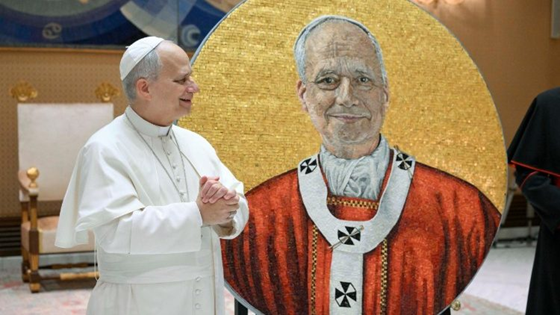
Pope Leo XIV is presented with a newly completed mosaic portrait of himself, destined for display in the Basilica of St. Paul Outside the Walls among the medallions of all previous popes[5][26]. This longstanding tradition highlights the Church’s belief in an unbroken succession from St. Peter to the present.
In summary, the list of popes from Peter through Leo XIV is historically accurate[i] and consistent with the Catholic Church’s official records. All 266 popes up to Francis are accounted for in order[1][15], and Pope Leo XIV now continues the line as the 267th Bishop of Rome[16]. Minor discrepancies in older sources (such as the case of Pope-elect Stephen in 752, or the multiple reigns of Benedict IX) have been resolved in modern lists so that the sequence given here corresponds to the reality documented by historians and the Vatican. Each name in the list has a basis in recorded history, forming a continuous chain linking the present-day Catholic Church to its apostolic beginnings[27][18].
Sources
- Catholic Encyclopedia (1911). “Chronological Lists of Popes.” New Advent. Discusses early papal lists and explains omissions/duplications in numbering[4][28].
- Catholic Encyclopedia (1911). “Chronological Lists of Popes.” (cont’d). Notes on anomalies (e.g. missing John XX, treatment of Stephen of 752, etc.)[29][18].
- Times of India. “From St. Peter to Pope Francis: Full list of popes” (Apr. 21 2025). Provides a numbered list of the 266 popes up to Francis, consistent with Vatican counting[1][15].
- Vatican News. “Biography of Pope Leo XIV, born Robert Francis Prevost.” (May 2025). Confirms Leo XIV as the 267th Pope and gives background on his election[16][25].
- Vatican News. “Pope Leo’s mosaic portrait ready for St. Paul Outside the Walls.” (Jan. 2026). Describes the tradition of installing each pope’s portrait in the basilica’s series, including Leo XIV’s addition[5][26].
- Additional references: Wikipedia’s “List of Popes” (updated 2026) for cross-verification of chronological details and numbering notes[17][18]; Catholic Encyclopedia entries on specific popes (e.g. Felix II/III) for numbering clarifications[19]. These confirm that the succession list given aligns with recognized historical data and corrections.
[1] [9] [14] [15] [21] [23] [24] From St. Peter to Pope Francis: Full list of popes – The Times of India
[2] [3] [4] [20] [27] [28] [29] CATHOLIC ENCYCLOPEDIA: Chronological Lists of Popes
[5] [6] [26] Pope Leo’s mosaic portrait ready for Basilica of St. Paul Outside the Walls – Vatican News
[7] Pope-elect Stephen – Wikipedia
[8] [10] [11] [12] [13] [17] [18] [22] List of popes – Wikipedia
[16] [25] Biography of Pope Leo XIV, born Robert Francis Prevost – Vatican News
[19] CATHOLIC ENCYCLOPEDIA: Pope St. Felix III – New Advent
[i] Yes: Jesus chose Peter, and Peter’s successors are the bishops of Rome (the popes), he wasn’t the only apostle chosen by Jesus to start a church, Paul is another famous example outside the 12, so is novel… But even he helped Peter. That’s for another post tho…
Here’s the full succession list copy and pasted from GPT (official popes, excluding antipopes; current pope is Leo XIV). (Vatican News)
- Peter
- Linus
- Anacletus (Cletus)
- Clement I
- Evaristus
- Alexander I
- Sixtus I
- Telesphorus
- Hyginus
- Pius I
- Anicetus
- Soter
- Eleuterus
- Victor I
- Zephyrinus
- Callixtus I
- Urban I
- Pontian
- Anterus
- Fabian
- Cornelius
- Lucius I
- Stephen I
- Sixtus II
- Dionysius
- Felix I
- Eutychian
- Caius
- Marcellinus
- Marcellus I
- Eusebius
- Miltiades
- Sylvester I
- Mark
- Julius I
- Liberius
- Damasus I
- Siricius
- Anastasius I
- Innocent I
- Zosimus
- Boniface I
- Celestine I
- Sixtus III
- Leo I (the Great)
- Hilary
- Simplicius
- Felix III
- Gelasius I
- Anastasius II
- Symmachus
- Hormisdas
- John I
- Felix IV
- Boniface II
- John II
- Agapetus I
- Silverius
- Vigilius
- Pelagius I
- John III
- Benedict I
- Pelagius II
- Gregory I (the Great)
- Sabinian
- Boniface III
- Boniface IV
- Adeodatus I
- Boniface V
- Honorius I
- Severinus
- John IV
- Theodore I
- Martin I
- Eugene I
- Vitalian
- Adeodatus II
- Donus
- Agatho
- Leo II
- Benedict II
- John V
- Conon
- Sergius I
- John VI
- John VII
- Sisinnius
- Constantine
- Gregory II
- Gregory III
- Zachary
- Stephen II
- Paul I
- Stephen III
- Adrian I
- Leo III
- Stephen IV
- Paschal I
- Eugene II
- Valentine
- Gregory IV
- Sergius II
- Leo IV
- Benedict III
- Nicholas I
- Adrian II
- John VIII
- Marinus I
- Adrian III
- Stephen V
- Formosus
- Boniface VI
- Stephen VI
- Romanus
- Theodore II
- John IX
- Benedict IV
- Leo V
- Sergius III
- Anastasius III
- Lando
- John X
- Leo VI
- Stephen VII
- John XI
- Leo VII
- Stephen VIII
- Marinus II
- Agapetus II
- John XII
- Leo VIII
- Benedict V
- John XIII
- Benedict VI
- Benedict VII
- John XIV
- John XV
- Gregory V
- Sylvester II
- John XVII
- John XVIII
- Sergius IV
- Benedict VIII
- John XIX
- Benedict IX
- Sylvester III
- Benedict IX (again)
- Gregory VI
- Clement II
- Damasus II
- Leo IX
- Victor II
- Stephen IX
- Nicholas II
- Alexander II
- Gregory VII
- Victor III
- Urban II
- Paschal II
- Gelasius II
- Callixtus II
- Honorius II
- Innocent II
- Celestine II
- Lucius II
- Eugene III
- Anastasius IV
- Adrian IV
- Alexander III
- Lucius III
- Urban III
- Gregory VIII
- Clement III
- Celestine III
- Innocent III
- Honorius III
- Gregory IX
- Celestine IV
- Innocent IV
- Alexander IV
- Urban IV
- Clement IV
- Gregory X
- Innocent V
- Adrian V
- John XXI
- Nicholas III
- Martin IV
- Honorius IV
- Nicholas IV
- Celestine V
- Boniface VIII
- Benedict XI
- Clement V
- John XXII
- Benedict XII
- Clement VI
- Innocent VI
- Urban V
- Gregory XI
- Urban VI
- Boniface IX
- Innocent VII
- Gregory XII
- Martin V
- Eugene IV
- Nicholas V
- Callixtus III
- Pius II
- Paul II
- Sixtus IV
- Innocent VIII
- Alexander VI
- Pius III
- Julius II
- Leo X
- Adrian VI
- Clement VII
- Paul III
- Julius III
- Marcellus II
- Paul IV
- Pius IV
- Pius V
- Gregory XIII
- Sixtus V
- Urban VII
- Gregory XIV
- Innocent IX
- Clement VIII
- Leo XI
- Paul V
- Gregory XV
- Urban VIII
- Innocent X
- Alexander VII
- Clement IX
- Clement X
- Innocent XI
- Alexander VIII
- Innocent XII
- Clement XI
- Innocent XIII
- Benedict XIII
- Clement XII
- Benedict XIV
- Clement XIII
- Clement XIV
- Pius VI
- Pius VII
- Leo XII
- Pius VIII
- Gregory XVI
- Pius IX
- Leo XIII
- Pius X
- Benedict XV
- Pius XI
- Pius XII
- John XXIII
- Paul VI
- John Paul I
- John Paul II
- Benedict XVI
- Francis
- Leo XIV (Vatican News)
Note: some older lists used to include “Pope-elect Stephen” (752) as a pope, but he is not counted in the official list today. (ecatholic2000.com) But, we discussed that above.