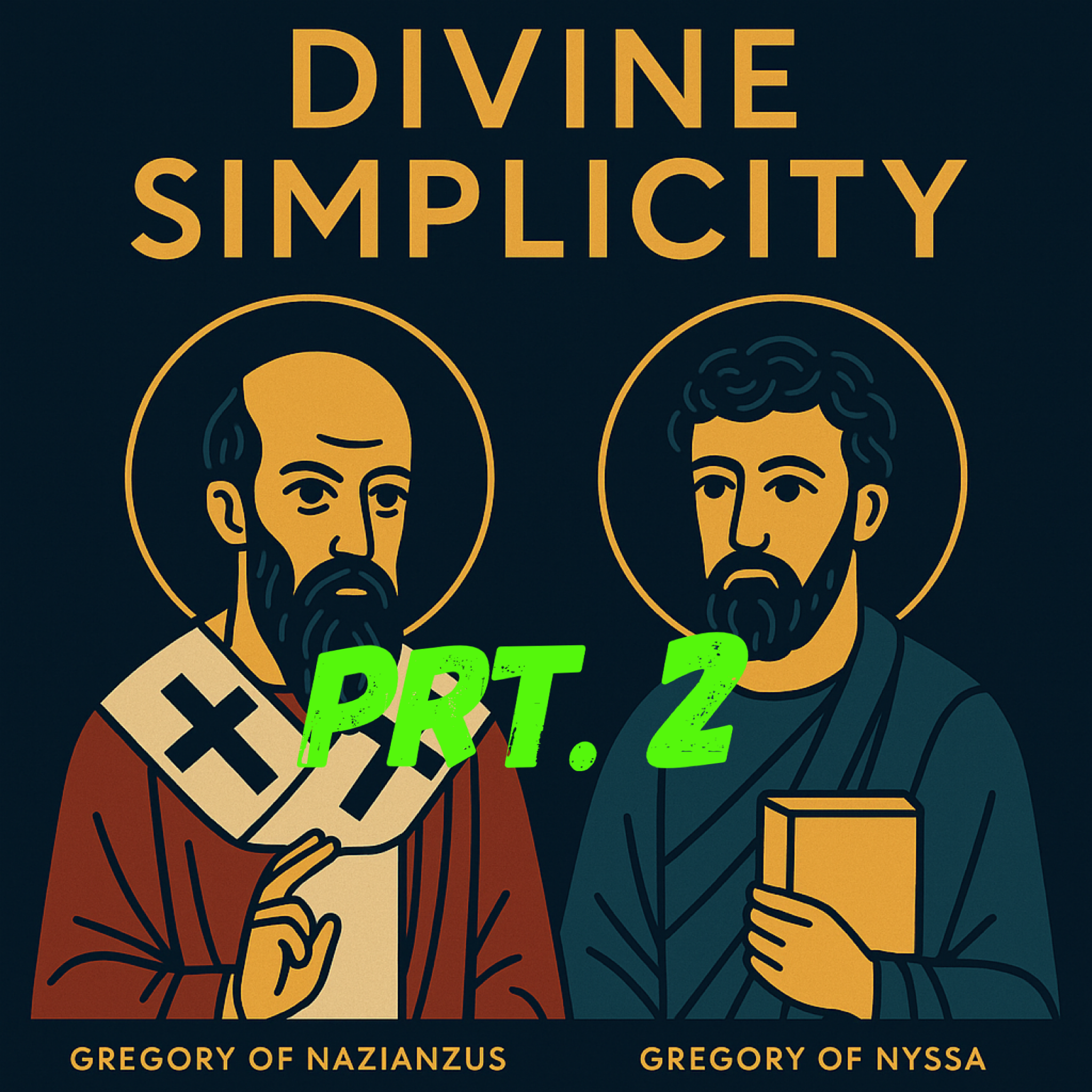
The Cappadocians in Conversation with a Pure-Act Simplicity:
Did the Gregorys have a Platonic Analogue of Actus Purus?
Context
In my previous piece, we explored the Cappadocian Gregorys’ theologies and the idea of simplicity and identity. There we saw that in the classical world, talk about “sameness” in God (divine simplicity) is already a metaphysical claim about what God is like, not just a formal rule, and that modern notions of identity are largely downstream from this theological grammar. We didn’t cover Aquinas in that piece, but he’s helpful here because his essence–existence identity schema is one such claim that can be used to illustrate what we’re doing with the Gregorys: Thomists are saying that in God there isn’t a real inner split between what he is and that he is—no internal parts, no composition there to begin with. After Leibniz, by contrast, identity gets treated much more as a logical tool that simply tells you when two names (x and y) pick out the same thing and lets you substitute one for the other, without committing you to any particular picture of what that “thing” is. You can use that same neutral logical “=” with all kinds of metaphysical views, but the Thomistic God-as-essence-is-existence thesis is a thick ontological stance that goes far beyond what the bare logic itself says. Aquinas, writing long before Leibniz, makes that thick claim about God being utterly simple because he is not operating with a metaphysically neutral “=” at all; he is building the metaphysics of the right referent, one absolutely simple first cause, directly into his account from the start. The Gregorys live in this same conceptual world, so for them too the formal identity Leibniz later articulates is less basic than their prior view of God. In what follows, we continue this reflection and put them in direct conversation with the later, fully developed classical account of simplicity to see the implications. Consider this part 2 of our exploration of the Gregorys and their view on simplicity; if you want to start with part 1, you can find it via the button below, though it’s not necessary for following what we’re doing here.
Gregorys, Divine Simplicity, & Triune IdentityIntroduction
Later scholastic theology often states that whatever is first in the order of explanation must be actus purus, pure act without potency. In Thomistic terms, the First Cause can have no unrealized capacities. God is not composed of essence and existence, is not contained under any genus, and does not have a set of really distinct essential attributes that would require a higher cause of unity. Gregory of Nazianzus and Gregory of Nyssa never say any of this in those words. They do not work with a developed act–potency schema, with an explicit doctrine of essence and esse, or with a technical theory of genera. Their idiom is biblical, polemical, and Platonic.
Nevertheless, taken as a whole, their trinitarian and metaphysical teaching exhibits a striking structural convergence with these later principles. They insist on a strict division between created and uncreated being, on the simplicity and incompositeness of the divine nature, on the unreceived and peculiar way in which being belongs to God, on the impossibility of treating God and creatures as co-instances under a common kind, and on the fact that the many divine names do not correspond to many essences or parts in God. If one later introduces an Aristotelian act–potency framework and asks what sort of reality can occupy the uncreated, first, uncaused place that the Cappadocians describe, the answer is very close to what scholastics will call pure act. So, this piece explores that connection and puts the two traditions in conversation.
The first key nuance is the way the Cappadocians reach these results, which is characteristically apophatic. They do not construct a positive, technical metaphysics of God by laying out axioms in terms of act and potency, genus and species, or essence and existence. Instead, they press God’s transcendence by way of negation: God is not composite, not in time, not circumscribed, not contained within a common measure with creatures, not one being among others. This apophatic habit of speech does not amount to a denial that we can know or say anything true about God, but it does mean that their most important theological moves are refusals of creaturely categories rather than direct metaphysical definitions. This study explores how those apophatic denials, once translated into the later conceptual grammar of act and potency, yield a pattern that closely corresponds to the scholastic notion of pure act.
The question, then, is whether such a move is convertible, or too reconstructive to be fair. It is not claimed here that Gregory of Nyssa and Gregory of Nazianzus secretly held a Thomistic doctrine of actus purus, or that their own self-understanding already included an essence–existence identity thesis, a genus-denial axiom, or a formal rule about every composite needing a cause of unity. What can be shown, however, is that their explicit and repeated commitments line up in a stable pattern that later metaphysics can legitimately formalize. They insist on a strict division between created and uncreated being, consistently associating composition, participation, acquisition, temporal succession, and dissolution with what is caused and posterior, and associating simplicity, uncompoundedness, uncausedness, and peculiar, unreceived being with God as First Cause. They refuse to locate God and creatures under a shared ontological measure, and they explicitly reject any account of divine attributes that would multiply “essences” in God or turn Deity into a compound of perfections. What they say has determinate content and implications for their theology. Once this pattern is in view, translating their apophatic denials into the idiom of act and potency is not an arbitrary reconstruction but a way of stating, in a later conceptual grammar, what their own theology already safeguards at the level of content.
What follows brings together five interlocking lines of Cappadocian teaching and relates each to one later Thomistic maxim. The result is not an attempt to turn Nyssa and Nazianzen into proto-Thomists, but to show how their Platonic and apophatic theology provides a genuine analogue to the idea of pure act at the summit, but from an authentic articulation that is in fact a different idiom. The primary claim here is that the Cappadocian Gregorys and the Thomistic tradition’s view of simplicity can both be right in their reference while differing in idiom, which is precisely why their accounts are analogous rather than identical in form, and the nuances are fascinating and worth laying out.
I. Created and Uncreated: The Frame for a Cappadocian Actus Purus Analogue
The basic frame of Gregory of Nyssa’s metaphysics is the hard division between created and uncreated being. This is not a casual distinction, but the fundamental ontological cut on which his entire doctrine of God and participation turns. In Against Eunomius he describes the situation in simple but programmatic terms: “The ultimate division of all that exists is made by the line between ‘created’ and ‘uncreated’, the one being regarded as the cause of what comes to be, the other as what comes to be.” (Gregory of Nyssa, Against Eunomius). The uncreated is cause, the created is what comes to be from that cause. The uncreated is not one item among many in a wider genus of things that exist. It is what gives being; created things are what receive it. The two sides of the division are not related as coordinate species but as source and participation.[1][1]
Within this framework the uncreated side is characterized by simplicity and the absence of variation. Nyssa says of the divine life that there is “The divine life is such that there is no increase or decrease in quantity or quality in it creating any variation; it is uniform and unchanging.” (Gregory of Nyssa, Against Eunomius). A life that neither increases nor decreases in any respect admits no transition from a lesser to a greater act, no movement from can be to is. Any such change belongs to the created order that comes to be and passes away. At the level of the uncreated, there is no room for real potency that is later actualized.[2]
Nyssa explicitly links this absence of variation to the simplicity of God. What is simple cannot require something “added on” to complete it. In his reply to Eunomius he insists that the divine essence cannot be thought of as a composite that is perfected by further elements. The divine nature, “The Divine nature, whatever it is in its essence, is simple, uniform, and incomposite, and cannot be viewed under any form of complex formation.” (Gregory of Nyssa, Answer to Eunomius’ Second Book).[3] If something “has to be thought of along with something else,” that very need for an “addition” shows that it is no longer simple. Composition indicates dependence; a composite requires a cause that unites its diverse elements. Nyssa’s refusal to treat divine attributes as additions to a more basic core is, in effect, a refusal to put a unifying cause behind God.
Nyssa’s language of diastema (interval) and adiastasia (lack of interval) carries this logic into the register of time. Creation exists in diastema, the extended field of before and after. God, by contrast, is adiastatos, “without interval.” In speaking of the Father and Son he insists that there is “No conception of interval, not even that minute and indivisible one, which, when time is divided into past, present, and future, is conceived indivisibly by itself as the present, as it cannot be considered as a part either of the past or of the future, by reason of its being quite without dimensions and incapable of division, and unobservable, to whichever side it might be added.” which is the present instant (Gregory of Nyssa, Against Eunomius).[4] Temporal succession and with it any process from potency to act belong to what is created, not to the divine life. The uncreated does not grow into what it will be; it simply is what it is, without progression or loss.
Gregory of Nazianzus shares this basic profile, although he presents it in a more rhetorical and doxological way. In his theology of divine generation he insists that when Christians call God Father, Begetter, and Emitter they must strip away all the temporal and bodily associations of those words. The Father’s generation of the Son is “The Father is the Begetter and the Emitter; without passion of course, and without reference to time, and not in a corporeal manner. The Son is the Begotten, and the Holy Ghost the Emission; for I know not how this could be expressed in terms altogether excluding visible things.” (Gregory of Nazianzus, Oration 29).[5] The act of generation is eternal and perfect. If one were to imagine the Father as first possessing merely the capacity to beget and then later exercising it, one would simply be projecting creaturely becoming into God, which Nazianzen explicitly warns against.
An especially programmatic summary occurs in Oration 23, where he speaks of the divine nature as “We may know that the nature of divinity is one and the same, characterized by lack of source, generation, and procession (these correspond to mind, word, and spirit); a nature that is in internal agreement with itself, is ever the same, ever perfect, uncreated, incomprehensible, never self-deficient, nor ever so to be; lives and life, lights and light, goods and good, glories and glory, true and the truth, and Spirit of truth, holies and holiness itself. […] No created or servile thing, nothing which participates or is circumscribed, can attain to its nature, which is both uncreated and sovereign, participated in and infinite.” (Gregory of Nazianzus, Oration 23). The divine nature is without source, without internal conflict, ever the same, ever perfect. In the same passage he immediately contrasts this uncreated and sovereign nature with all “created or servile” realities, which can only “come close” to God “with varying success” and only “as a result of participation” (Gregory of Nazianzus, Oration 23). Becoming and growth in perfection are located entirely on the side of creatures.[6]
Neither Gregory writes treatises on act and potency, and neither states that “whatever is first in the order of explanation must be pure act.” Yet if one overlays an act–potency analysis on their created–uncreated distinction, the result is clear. At the summit stands an uncreated principle that is unchanging, beyond interval, simple and without composition. All becoming, all growth, all realization of capacities is placed on the created, participatory side. In Aristotelian terms this is precisely the denial of potency in the First.
II. Simplicity, Firstness, and Composition
A second Thomistic maxim says that every composite is posterior to its parts and has a cause of unity. For that reason any truly first cause, uncaused and absolutely prior, cannot be composite. Gregory of Nyssa and Gregory of Nazianzus never write this as an axiom. They do not handle composition through a formal analysis of parts and wholes. What they do offer is a stable pattern of judgments in which composition is consistently associated with what is caused, dissoluble, and subordinate, and simplicity with what is first, uncaused, and divine.
Gregory of Nyssa, as already noted, describes the divine nature as “a source of good,” “simple, uniform, incomposite” (Gregory of Nyssa, Against Eunomius). In another dense sentence, in his treatise against the Macedonians, he adds that “We firmly believe that it is simple, uniform, incomposite, because we see in it no complicity or composition of dissimilars, therefore it is that, when once our minds have grasped the idea of Deity, we accept by the implication of that very name the perfection in it of every conceivable thing that befits the Deity. Deity, in fact, exhibits perfection in every line in which the good can be found.” (Gregory of Nyssa, On the Holy Spirit, Against the Followers of Macedonius).[7] The phrase “composition of dissimilars” is crucial. Any unity that depends on the bringing together of different elements is precisely the sort of thing that, for Nyssa, cannot be ascribed to Deity. If there were such a composition, there would have to be something prior that unifies the dissimilars.
Nyssa also associates composition with participation and acquisition, and simplicity with being a source. Speaking again of the uncreated intelligible nature, he emphasizes that it “does not possess the good by acquisition, or participate only in the goodness of some good which lies above it,” but “in its own essence it is good” and “is a source of good” (Gregory of Nyssa, Against Eunomius). Created things “possess the good by acquisition” or participate in a higher good; uncreated nature is good in itself and is the source of the goodness of others. Participation and acquisition imply posteriority; to be a source is to be first. This is the logic that a later metaphysics will recast as “whatever is first cannot be composite, since every composite is posterior to and dependent upon its principles.”
Nyssa’s explicit statements about causality confirm this pattern. In Answer to Eunomius’ Second Book he writes, “From our belief that the universe depends on God, we get an indication that there is no cause whatever of His existence.” (Gregory of Nyssa, Answer to Eunomius’ Second Book).[3] Here, “First Cause of all” and “without cause” are treated as equivalent descriptions. Composite realities, by definition, have their being and unity from something other than themselves, and so are on the side of what is caused. The First is precisely that which is not caused.
Gregory of Nazianzus contributes from a complementary angle. In the Second Theological Oration he observes that “For every compound is a starting point of strife, and strife of separation, and separation of dissolution. But dissolution is altogether foreign to God and to the First Nature. Therefore there can be no separation, that there may be no dissolution, and no strife that there may be no separation, and no composition that there may be no strife.” (Gregory of Nazianzus, Oration 28). An aggregate of elements tends toward conflict and disintegration. He then draws the conclusion, “But dissolution is altogether foreign to God and to the First Nature” (Gregory of Nazianzus, Oration 28). The First Nature cannot be subject to the sort of dissolution that characterizes compounds, because composition, strife, and dissolution hang together as one cluster. In a short application he adds, “no composition that there may be no strife. Thus also there must be no body, that there may be no composition” (Gregory of Nazianzus, Oration 28). Bodiliness and composition belong together; both are excluded from the First Nature.[10]
Nazianzen also associates simplicity with uncausedness in the case of the Word. In Oration 29 he famously says: “He Who is now Man was once the Uncompounded. What He was He continued to be; what He was not He took to Himself. In the beginning He was, uncaused; for what is the Cause of God? But afterwards for a cause He was born.” (Gregory of Nazianzus, Oration 29). The pre-incarnate Word is “the Uncompounded” and “in the beginning … uncaused.” A reality that is “uncaused” cannot be a composite whose unity depends on some prior principle; that would reintroduce a cause behind God. The combination of uncompoundedness and uncausedness in the same subject expresses, in a different idiom, the later idea that the first cause is simple because it is uncaused.[8]
The Cappadocians therefore never state the universal maxim that every composite is posterior and requires a cause of unity. What they do, quite consistently, is reserve composition, participation, acquisition, and dissolution for what is caused and created, and reserve simplicity, uncompoundedness, and uncausedness for God as First Cause. A Thomistic formula that derives simplicity from non-posteriority and uncausedness is best read as a later formalization of this pattern, not as an alien doctrine imposed on silence.
III. Not in a Genus, and No Common Measure with Creatures
A third Thomistic thesis maintains that God is not in a genus. The First Cause cannot be a species under some more general kind. There is therefore no genus “above” God and no neutral scale on which God and creatures are co-instances and co-measured. Gregory of Nyssa and Gregory of Nazianzus never say that “God is not a species in a genus.” That is Aristotelian language that lies outside their habitual vocabulary. Yet the way they conceive the created–uncreated distinction, divine being, and participation amounts to a clear Platonic and apophatic analogue of this claim.
Gregory of Nyssa is particularly explicit in refusing to see God and creatures as sharing a common ontological measure. We have already seen that he divides “all that exists” into created and uncreated, with the uncreated as cause and the created as what comes to be (Gregory of Nyssa, Against Eunomius).[1] That division already resists the idea of a higher common genus. It is not “being” as a genus, with “created” and “uncreated” as species. Rather, it is the division between the One who gives being and the many that receive it.
Nyssa also emphasizes that human language about God does not put God and creatures under a shared concept. He admits that there is “a similarity of names between things human and things divine,” but insists that underneath this sameness lies “a wide difference of meanings” (Gregory of Nyssa, Against Eunomius). The difference in meaning is as wide as the gulf between the Creator and the creation. The same word, such as “good” or “wise,” applied to God and to a creature, does not function as a single genus term. The “marks which distinguish the Maker of all and His works,” he says in another passage, “are separated by a wide interval” (Gregory of Nyssa, Against Eunomius). There is no common field in which the “marks” that characterize divine nature and those that characterize created natures can be measured on one scale.
Nyssa’s description of uncreated intelligible nature reinforces this asymmetry. He writes, “Uncreate intelligible nature is far removed from such distinctions: it does not possess the good by acquisition, or participate only in the goodness of some good which lies above it: in its own essence it is good, and is conceived as such: it is a source of good, it is simple, uniform, incomposite, even by the confession of our adversaries.” (Gregory of Nyssa, Against Eunomius). He adds that this uncreated nature “does not possess the good by acquisition, or participate only in the goodness of some good which lies above it” (Gregory of Nyssa, Against Eunomius). Created realities possess goodness by participation in a higher principle. Uncreated nature is good “in its own essence” and is itself a “source of good.” There is no genus “good” under which both God and creatures stand as co-members, subject to a common rule. Creatures measure up or fall short relative to a good that is above them; God is the very source of that measure.
Gregory of Nazianzus’s account of “being” leads in the same direction. In the Fourth Theological Oration he writes that we are inquiring into “a Nature Whose Being is absolute and not into Being bound up with something else” (Gregory of Nazianzus, Oration 30). He continues, “But Being is in its proper sense peculiar to God, and belongs to Him entirely, and is not limited or cut short by any Before or After, for indeed in Him there is no past or future.” (Gregory of Nazianzus, Oration 30). “Being” in its proper or strict sense is “peculiar to God” and “belongs to Him entirely.” Creatures have a derivative, temporal, conditioned kind of existence, a “being bound up with something else.” God alone is the one whose being is absolute and not received. In such a picture, “being” is not a genus with God as one instance among others. Rather, God is the One to whom being, in the proper sense, belongs; creatures have a participated and conditioned share in that.[9]
Nazianzen’s extended description of the divine nature in Oration 23 further underscores the lack of any common measure between Creator and creature. He says that “the nature of divinity is one and the same, characterized by lack of source, generation, and procession,” and calls it “uncreated, incomprehensible, never self-deficient, nor ever so to be, lives and life, lights and light, goods and good, glories and glory, true and the truth, and Spirit of truth, holies and holiness itself” (Gregory of Nazianzus, Oration 23). He then insists that “no created or servile thing, nothing which participates or is circumscribed can attain to its nature, which is both uncreated and sovereign, participated in and infinite. For some things are remote from it in every respect; others come close to it with varying success and will continue to do so, and this not by nature, but as a result of participation” (Gregory of Nazianzus, Oration 23). Created realities can be “remote” or “come close,” but only “as a result of participation,” never by nature. There is no neutral ontological space in which God and creatures stand as peers.
Even Nazianzen’s anti-composition language points in the same direction. “Every compound is a starting point of strife, and strife of separation, and separation of dissolution,” he observes, and concludes that “dissolution is altogether foreign to God and to the First Nature” (Gregory of Nazianzus, Oration 28). Anything composite is governed by principles of composition and dissolution; the First Nature stands outside that order. A being that is beyond dissolution cannot simply be one case among many in a more general domain of composed entities.[10]
The Cappadocians therefore never write a sentence that looks like “God is not contained in any genus.” What they consistently affirm is an absolute divide between created and uncreated, a way of speaking about being that attributes being in the strict sense to God alone, and a participation structure in which creatures receive their being and perfections from a transcendent source that admits no equal. In content, this amounts to the denial of a genus above God and the denial of any common measure on which God and creatures would be co-instances.
IV. Essence, Existence, and Uncaused Being
Perhaps the most characteristic scholastic formulation about pure act is the thesis that in God there is no real composition of essence and existence. In creatures, what a thing is and that it is are distinct metaphysical principles; in God they are identical. Gregory of Nyssa and Gregory of Nazianzus do not distinguish essence and existence in these terms. They do not argue that in creatures these differ while in God they are one. Yet their language about uncreated nature and peculiar divine being maps naturally onto the structural core of that claim.
Nyssa’s statement about uncreated intelligible nature is central here. As already cited, he writes: “Uncreate intelligible nature is far removed from such distinctions: it does not possess the good by acquisition, or participate only in the goodness of some good which lies above it: in its own essence it is good, and is conceived as such: it is a source of good, it is simple, uniform, incomposite, even by the confession of our adversaries.” (Gregory of Nyssa, Against Eunomius).[11] Uncreated nature is “in its own essence” good and is “a source of good,” not a participant in a higher good. The same nature is “simple, uniform, incomposite.” Goodness is not something added to a bare essence, nor is it something that uncreated nature receives from elsewhere. It is what that essence is in itself. Nyssa does not call this an identity of essence and existence, but the picture is one in which the divine “what” does not look outside itself for its “that.”
In the same polemic Nyssa joins this simplicity to the lack of any cause of God’s existence. Speaking of our belief that the universe depends on God, he says that from this belief “From our belief that the universe depends on God, we get an indication that there is no cause whatever of His existence.” (Gregory of Nyssa, Answer to Eunomius’ Second Book).[3] Divine nature, “whatever it is in its essence,” is “simple, uniform, and incomposite,” and there is “no cause whatever” of its existence. He then generalizes the point in a compact sentence: “He Who is the First Cause of all is Himself without cause” (Gregory of Nyssa, Answer to Eunomius’ Second Book).[3] For Nyssa, to affirm that God is First Cause, without origin, ungenerate, eternal, and without cause is to say the same thing in different words. Any being whose existence is caused is thereby placed on the side of the created; the First Cause is the one whose existence has no cause.
Gregory of Nazianzus approaches the same nexus from the side of being. In Oration 30 he insists that Christians are asking about “a Nature Whose Being is absolute and not … Being bound up with something else” (Gregory of Nazianzus, Oration 30). He immediately adds, “But Being is in its proper sense peculiar to God, and belongs to Him entirely, and is not limited or cut short by any Before or After, for indeed in Him there is no past or future.” (Gregory of Nazianzus, Oration 30). Being in its proper sense “belongs to Him entirely.” Creatures have a limited, temporal, conditioned sort of existence; God alone is the one whose Being is absolute, not “bound up with something else.” Nazianzen does not say, “in God essence is existence,” but he does say that Being, in the strict sense, is proper to God and not received.[9]
Nazianzen’s Christological formula adds an apophatic edge to this picture. In Oration 29 he says of the pre-incarnate Son, “He Who is now Man was once the Uncompounded. What He was He continued to be; what He was not He took to Himself. In the beginning He was, uncaused; for what is the Cause of God? But afterwards for a cause He was born.” (Gregory of Nazianzus, Oration 29).[8] The Word, before taking on flesh, is “the Uncompounded,” and “in the beginning He was, uncaused.” There is no cause of God. A reality that is both uncompounded and uncaused is one whose being is not derived from a prior act and is not composed out of distinct elements.
Neither Gregory, then, formulates a theory of essence and existence and proceeds to say that they are identical in God and distinct in creatures. Their categories are rather uncreated and created, source and participation, simple and composite, without cause and caused. Yet in that language the core content of the later essence–existence thesis appears: God alone has unreceived, peculiar Being; creatures have a caused, participated being. A Thomistic maxim that “in the First, what it is is nothing but that it is” can be read as a more technical mapping of this Cappadocian landscape.
V. Essential Attributes and Divine Simplicity
A further development in scholastic accounts of pure act is the claim that there are no really distinct essential attributes in God. If divine perfections such as wisdom, goodness, and power were each a distinct constituent, one would either have many uncaused eternal realities or a composite Deity that required a cause of unity. Therefore whatever is named essentially in God is identical in reality with the one simple act of being. Gregory of Nyssa and Gregory of Nazianzus do not offer a theory of real, formal, and virtual distinctions among attributes. Yet their explicit teaching about divine simplicity and the status of attributes comes very close to this conclusion.
Gregory of Nazianzus is unusually clear on this point. In Oration 29 he considers whether certain perfections are to be treated as essences in God. He asks: “Are immortality and innocence and immutability also the essence of God? If so God has many essences and not one; or Deity is a compound of these. For He cannot be all these without composition, if they be essences. They do not however assert this, for these qualities are common also to other beings. But God’s Essence is that which belongs to God alone, and is proper to Him” (Gregory of Nazianzus, Oration 29). Nazianzen’s reasoning is straightforward. If immortality, innocence, and immutability were each an “essence” in God, one would have either “many essences and not one” or a Deity that is “a compound of these.” Both options contradict the unity and simplicity of God. He concludes that God’s essence is “that which belongs to God alone, and is proper to Him.” The divine essence is one, and the many perfections we name do not correspond to many essences.
Elsewhere in the same oration he uses an analogy to illustrate that different attributes need not multiply essences. Wisdom and unwisdom, he says, are different in themselves, but both can be attributes of “man, who is the same.” They “mark not a difference of essence, but one external to the essence” (Gregory of Nazianzus, Oration 29). The analogy is imperfect, but the point is that attributive diversity does not necessarily entail diversity of essence. Applied to God, this means that the many perfections we ascribe do not slice the divine essence into metaphysical parts.
Nazianzen’s extended description of the divine nature in Oration 23, already cited, sings the same tune. The “nature of divinity is one and the same,” and at the same time it is called “lives and life, lights and light, goods and good, glories and glory, true and the truth, and Spirit of truth, holies and holiness itself” (Gregory of Nazianzus, Oration 23). He adds that each of these, if contemplated separately, is “God,” because “the mind can divide the indivisible,” but that taken together “their activity and nature are the same” (Gregory of Nazianzus, Oration 23). The perfections are many at the level of naming and contemplation, but the nature is “one and the same” and “indivisible.”[6]
Gregory of Nyssa adopts a similar stance. In his treatise against the Macedonians he writes: “We firmly believe that it is simple, uniform, incomposite, because we see in it no complicity or composition of dissimilars, therefore it is that, when once our minds have grasped the idea of Deity, we accept by the implication of that very name the perfection in it of every conceivable thing that befits the Deity. Deity, in fact, exhibits perfection in every line in which the good can be found.” (Gregory of Nyssa, “On the Holy Spirit, Against the Followers of Macedonius”). Divine nature is “simple, uniform, incomposite,” and admits “no complicity or composition of dissimilars.” At the same time, once the mind grasps “the idea of Deity,” it accepts “by the implication of that very name the perfection in it of every conceivable thing that befits the Deity.” All fitting perfections belong to God, yet they do not do so as separate elements in a composite. They are perfections of a simple, incomposite nature.[7]
In Against Eunomius Nyssa makes the same point with respect to goodness. Uncreated nature “in its own essence is good” and “is a source of good,” and is at the same time “simple, uniform, incomposite” (Gregory of Nyssa, Against Eunomius). Goodness is what the uncreated essence is in itself, not a distinct perfection added on. In another passage he gathers a long list of divine perfections under the heading of the “native dignity” of God: “In our view, the ‘native dignity’ of God consists in godhead itself, wisdom, power, goodness, judgment, justice, strength, mercy, truth, creativeness, domination, invisibility, everlastingness, and every other quality named in the inspired writings to magnify his glory. Each of these is properly and inalienably found in the Son, recognizing difference only in respect of unoriginate and begotten.” (Gregory of Nyssa, Against Eunomius). He then says that every one of these is “properly and inalienably found in the Son,” recognizing difference only in respect of unoriginate and begotten. Many perfections are listed, but they make up one “native dignity.” They are not separate building blocks in God.[12]
Nyssa is also aware that Scripture gives God “names innumerable.” He notes that some of these, such as “imperishable,” “everlasting,” and “immortal,” can be pronounced “absolutely,” and that “Scripture gives God names innumerable. Some of these, such as ‘imperishable,’ ‘everlasting,’ and ‘immortal,’ can be pronounced absolutely, and each contains in itself a complete thought about the Deity.” (Gregory of Nyssa, Against Eunomius). Yet this multiplicity of complete thoughts does not lead him to posit a multiplicity of essences. He has already insisted that the divine nature is simple and incomposite; the many names are ways in which our mind “divides the indivisible.”[13]
At this point it matters that the Cappadocians are not innovating a new grammar of divine names so much as amplifying one already given in Scripture. Israel’s God is addressed under many predicates that each carry the weight of a “complete thought” about who God is, without fragmenting him into many essences. The psalmist can say, “The Lord is my shepherd, I shall not want” (Ps 23:1), and elsewhere, “The Lord is my light and my salvation; whom shall I fear? The Lord is the stronghold of my life; of whom shall I be afraid?” (Ps 27:1). Jesus is confessed as the one who says, “I am the resurrection and the life. Those who believe in me, even though they die, will live” (Jn 11:25), and again, “I am the way, and the truth, and the life. No one comes to the Father except through me” (Jn 14:6). John can write both that “God is light and in him there is no darkness at all” (1 Jn 1:5) and that “Whoever does not love does not know God, for God is love” (1 Jn 4:8). Each line functions as a self-contained, saturated sentence about God, yet none implies that there are many separate “gods of shepherding, light, life, or love.”
The Cappadocians consciously read and preach within that scriptural field. When Nazianzus speaks of the divine nature as “lives and life, lights and light, goods and good, glories and glory, true and the truth, and Spirit of truth, holies and holiness itself,” he is effectively re-voicing this manifold biblical naming in a single doxological sweep. Nyssa’s insistence that titles like “imperishable,” “everlasting,” and “immortal” each express a complete thought about the Deity simply pushes to a conceptual conclusion what the biblical idiom already does in practice: allow multiple, robust predicates of the one Lord without multiplying essences. In that sense, their doctrinal claim that the many divine names “divide the indivisible” is a theological reflection on how Scripture itself already speaks, not a speculative novelty.
The Cappadocians, then, do not say that in God wisdom is identical with goodness is identical with being. They do not develop a more technical account of how attributes differ in our mode of understanding but are one in reality. Yet they explicitly refuse to treat divine perfections as many essences, insist that treating them so would make God composite, affirm that the divine nature is simple and admits no composition of dissimilars, and accept that all fitting perfections belong to God simply in virtue of the one idea of Deity. A Thomistic thesis that there are no really distinct essential attributes in God, and that all such predicates name one simple act of being, is a natural formalization of these commitments.
Conclusion
Gregory of Nyssa and Gregory of Nazianzus never write that “whatever is first in the order of explanation must be pure act.” They never compose treatises on act and potency, do not analyze essence and existence as distinct metaphysical principles, do not speak of God as “not in a genus” in Aristotelian terms, and do not systematically derive divine simplicity from a general maxim about composition and causes of unity. Their concerns are focused instead on safeguarding the biblical confession that Father, Son, and Holy Spirit are one God, on refuting Eunomian and Macedonian subordinationism, and on exalting the divine transcendence in a Platonic and apophatic key.
Yet, when their claims are gathered and viewed together, a coherent picture emerges. They draw an absolute line between created and uncreated being, with the uncreated on the side of source and the created on the side of participation and acquisition. They ascribe to the uncreated nature simplicity and incompositeness, and hold that God’s nature, precisely as divine, is free from increase and decrease and from any temporal measure or interval. They insist that the First Cause is without cause, that there is “no cause whatever” of God’s existence, and that being in its proper sense is peculiar to God and belongs to Him entirely. They deny that divine perfections such as immortality and immutability are many “essences” in God, on pain of making God composite, and they affirm that once one grasps the idea of Deity, one thereby affirms the perfection in God of every fitting good.
If one translates this pattern into the later language of act and potency, the conclusion is that the First on the Cappadocian scheme can have no unrealized capacities that await actualization. All becoming, all acquisition, all composition, all membership under a common genus, and any real distinction among essential perfections characterize created being and not the uncreated God; creatures participate in God and receive these perfections from Him, but God Himself participates in nothing. The uncreated principle is simple, uncaused, beyond genus, and has being in such a way that there is no gap between what it is and that it is. In that sense, the Cappadocians provide a Platonic and apophatic analogue of the later scholastic claim that the First Cause is actus purus.
The Gregorys, thus, are materially committed (by what they actually say) to:
- no potency in God,
- no internal composition in God,
- no genus above God,
- no real plurality of essences or essential attributes in God,
- God’s being as uncaused and non-temporal.
A later Thomistic account of pure act and simplicity is a legitimate formalization of those commitments, not an alien construct slapped on a vacuum. If one attends to what the later tradition actually did—namely, formalize its own theological commitments in an explicitly act–potency language—one can, by analogy, take the Cappadocians’ explicit claims about the uncreated–created divide, divine simplicity, and transcendence, and express them in that conceptual grammar. When one does so, one arrives at something structurally equivalent to the actus purus package, while still remembering that their Platonic and apophatic idiom is irreducible and should not be treated as a 1:1 anticipation of Thomism. In the end, pure act is not a single extra principle the Gregorys are missing; it is the later metaphysical crystallization of a whole pattern that is already present, in less technical form, in their own commitments.
So the point is not that they share an identical conceptual framework, but that both are attempts to receive, in their own idiom, a truthful participation in continuity with the one divine reality that alone can be in view at this level of articulation and expression. What is at stake, then, is not the possibility of a different God, but the risk of a mistaken reference: either our discourse truly refers to the one God, or it does not. The Cappadocian and Thomistic traditions can both be right in their reference while differing in idiom, which is precisely why their accounts are analogous rather than identical in form.
Bibliography
Gregory of Nazianzus. Gregory of Nazianzus: Select Orations. Translated by C. G. Browne and J. E. Swallow. Edited by Philip Schaff and Henry Wace. Vol. 7 of Nicene and Post-Nicene Fathers, 2nd series. New York: Christian Literature, 1894.
Gregory of Nazianzus. Select Orations. Translated by Martha Vinson. Fathers of the Church 107. Washington, DC: Catholic University of America Press, 2003.
Gregory of Nyssa. Gregory of Nyssa: Dogmatic Treatises, etc. Translated by H. A. Wilson. Edited by Philip Schaff and Henry Wace. Vol. 5 of Nicene and Post-Nicene Fathers, 2nd series. New York: Christian Literature, 1893.
Gregory of Nyssa. “On the Holy Spirit, Against the Followers of Macedonius.” In Gregory of Nyssa: Dogmatic Treatises, etc. Vol. 5 of Nicene and Post-Nicene Fathers, 2nd series.
Maspero, Giulio. “The Distinction between Created and Uncreated in Gregory of Nyssa’s Contra Eunomium.” In Gregory of Nyssa: Contra Eunomium II, edited by Lenka Karfíková, Scot Douglass, and Johannes Zachhuber, 93–118. Leiden: Brill, 2007.
Steenbuch, J. Andreas. “How the Eunomian Controversy Changed Gregory of Nyssa’s Doctrine of God.” Verbum Vitae 31 (2017): 333–356.
End Notes
[1] Gregory of Nyssa, Contra Eunomium I.42; cf. VIII, in Nicene and Post-Nicene Fathers, Second Series, vol. 5 (NPNF2 5). “Division of all that exists is made between ‘created’ and ‘uncreated’.”
[2] Gregory of Nyssa, Contra Eunomium II.3 (NPNF2 5). “no increase or decrease in quantity or quality… creating any variation.”
[3] Gregory of Nyssa, Answer to Eunomius’ Second Book II.4 (NPNF2 5). “the Divine nature… is simple, uniform, and incomposite… cannot be viewed under any form of complex formation”; see also the line “there is no cause whatever of His existence.”
[4] Gregory of Nyssa, Contra Eunomium I.42–43 (NPNF2 5). “no conception of interval, not even that minute and indivisible one [the present].”
[5] Gregory of Nazianzus, Oration 29 (Third Theological Oration), §3, in NPNF2 7. generation “without passion,” “without reference to time,” “not in a corporeal manner.”
[6] Gregory of Nazianzus, Oration 23, §11, in Martha Vinson (trans.), Select Orations (CUA Press, Fathers of the Church 107), pp. 136–37. “the nature of divinity is one and the same… ever the same, ever perfect… uncreated… participated in and infinite.”
[7] Gregory of Nyssa, On the Holy Spirit, Against the Followers of Macedonius, in NPNF2 5, p. 316. “no complicity or composition of dissimilars… perfection in it of every conceivable thing that befits the Deity.”
[8] Gregory of Nazianzus, Oration 29, §19, in NPNF2 7. “He Who is now Man was once the Uncompounded… In the beginning He was, uncaused; for what is the Cause of God?”
[9] Gregory of Nazianzus, Oration 30 (Fourth Theological Oration), §18, in NPNF2 7. “Being is in its proper sense peculiar to God… not limited by any Before or After.”
[10] Gregory of Nazianzus, Oration 28 (Second Theological Oration), §9, in NPNF2 7. “Every compound is a starting point of strife… dissolution.”
[11] Gregory of Nyssa, Contra Eunomium I.22 (NPNF2 5:120–21). “in its own essence it is good… a source of good… simple, uniform, incomposite.”
[12] Gregory of Nyssa, Contra Eunomium I.33 (NPNF2 5:114–15). “native dignity… wisdom, power, goodness… each properly and inalienably found in the Son.”
[13] Gregory of Nyssa, Contra Eunomium II (NPNF2 5:263–64). “names innumerable… imperishable, everlasting, immortal… each contains a complete thought about the Deity.”
[1] I use end notes for this paper because it’s easier to format on my website. Sorry footnote fans. So, for the bracketed numbers they’re sources are at the end. There’s not any special noting beyond that to be honest. You’re missing not much.