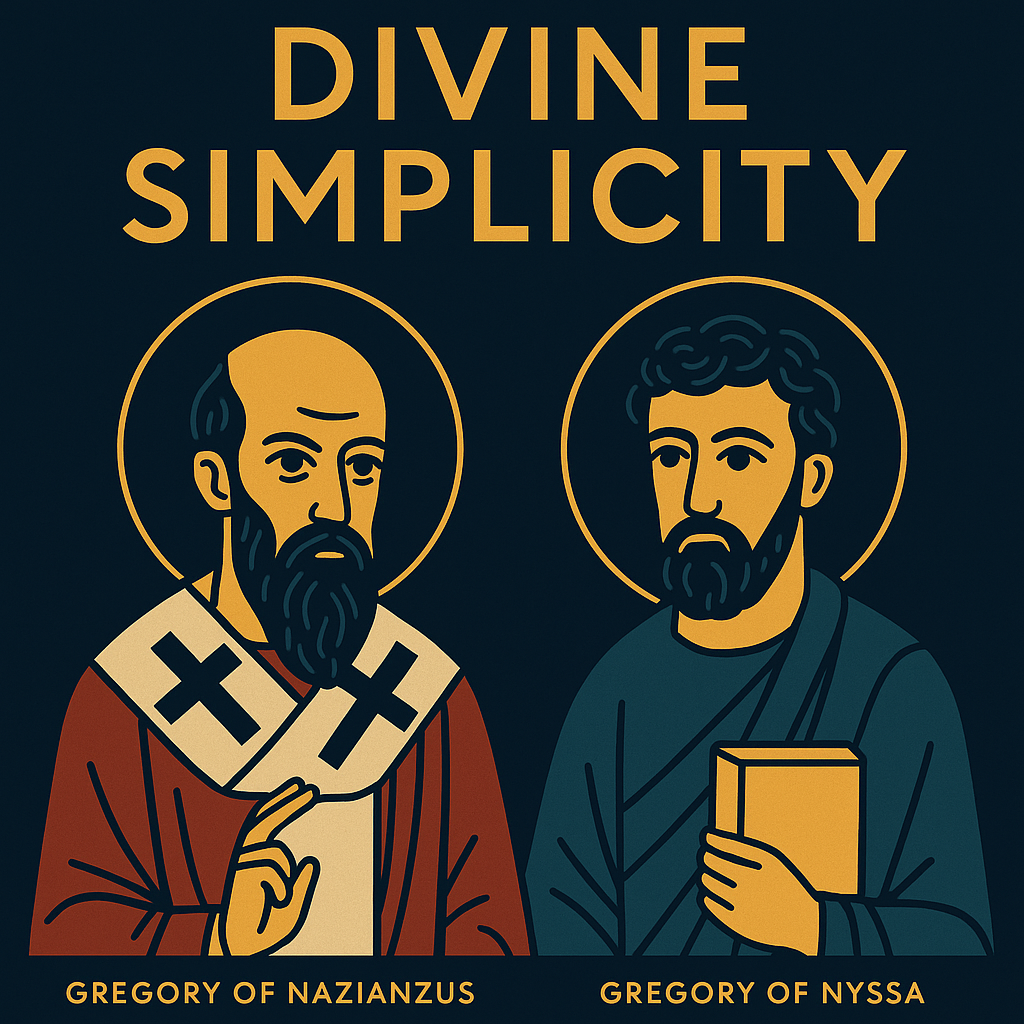
Divine Simplicity and Triune Identity in Gregory of Nazianzus and Gregory of Nyssa
“And since the nature of the Logos is reasonably believed to be simple, and exhibits in itself no duplicity or combination, no one would contemplate the existence of the living Logos as dependent on a mere participation of life, for such a supposition, which is to say that one thing is within another, would not exclude the idea of compositeness; but, since the simplicity has been admitted, we are compelled to think that the Logos has an independent life, and not a mere participation of life.” -Gregory of Nyssa, The Great Catechism, chap. 1, in Gregory of Nyssa: Dogmatic Treatises, Etc., trans. William Moore and Henry Austin Wilson, vol. 5 of A Select Library of the Nicene and Post-Nicene Fathers of the Christian Church, Second Series, ed. Philip Schaff and Henry Wace (New York: Christian Literature Publishing Co., 1892), 650.
“But to make my meaning clearer I will recapitulate. We affirm that each of these terms has its own peculiar meaning, and that the term indivisible cannot be rendered by ungenerate, nor ungenerate by simple; but by simple we understand uncompounded, and by ungenerate we are taught to understand what is without origin. Furthermore we hold that we are bound to believe that the Son of God, being Himself God, is Himself also simple, because God is free from all compositeness; and in like manner in speaking of Him also by the appellation of Son we neither denote simplicity of substance, nor in simplicity do we include the notion of Son, but the term Son we hold to indicate that He is of the substance of the Father, and the term simple we hold to mean what the word bears upon its face. Since, then, the meaning of the term simple in regard to essence is one and the same whether spoken of the Father or of the Son, differing in no degree, while there is a wide difference between generate and ungenerate (the one containing a notion not contained in the other), for this reason we assert that there is no necessity that, the Father being ungenerate, His essence should, because that essence is simple, be defined by the term ungenerate.” -Gregory of Nyssa, Against Eunomius (Answer to Eunomius’ Second Book), in Nicene and Post-Nicene Fathers, Second Series, vol. 5: Gregory of Nyssa: Dogmatic Treatises, Etc., ed. Philip Schaff and Henry Wace (New York: Christian Literature Publishing Co., 1892), 351. Gregory of Nyssa. “Against Eunomius.” In Nicene and Post-Nicene Fathers, Second Series, vol. 5: Gregory of Nyssa: Dogmatic Treatises, Etc., edited by Philip Schaff and Henry Wace. New York: Christian Literature Publishing Co., 1892.
“Try not to trouble yourself over the precise nature of Father, the existence of his only-begotten Son, the glory and the power of the Spirit, the single divinity and splendor in the Three, the indivisible nature as well as confession, glory, and hope of those who truly believe…It is enough for you to have the foundation; leave it to the craftsman to build on it.” -Gregory of Nazianzus, Select Orations, trans. Martha Vinson, The Fathers of the Church 107 (Washington, DC: Catholic University of America Press, 2003), Oration 32.21, 206.
“But to Those who have a simple nature, and whose essence is the same, the term One belongs in its highest sense.” Gregory of Nazianzus, Oration 42, paragraph 15, newadvent.org/fathers/310242.htm
Introduction
The classical Cappadocian settlement is often summarized in the formula “one ousia, three hypostaseis.” Modern readers sometimes hear this as a clever compromise between competing pressures: one God to preserve monotheism, three persons to honor the shape of Christian revelation. Yet Gregory of Nazianzus and Gregory of Nyssa do not treat “one” and “three” as rival data to be negotiated. Their Trinitarian theology begins from divine simplicity, understood as an indivisible, non-numerical unity, and then shows how this simple essence is the single nature of Father, Son, and Holy Spirit. In their hands, identity talk about “one God” is not a primitive logical starting point that is then “applied” to the Trinity. Rather, the sameness of God across the three persons is grounded in one simple divine nature and one undivided operation.
This essay argues that for Nazianzus and Nyssa, divine simplicity is not merely compatible with the Trinity but is the very condition that allows “one God” and “three persons” to name a single reality. Identity is downstream of simplicity in their thought. The one God confessed in Scripture is already and only the triune communion of Father, Son, and Holy Spirit.
Divine Simplicity beyond Number
For the Cappadocians, simplicity is not only a denial of parts but a claim that the divine essence lies beyond any framework in which number properly applies. Gregory of Nyssa, in his treatise On Not Three Gods, states the point with clarity:
“The Father is God: the Son is God: and yet by the same proclamation God is One, because no difference either of nature or of operation is contemplated in the Godhead. For if (according to the idea of those who have been led astray) the nature of the Holy Trinity were diverse, the number would by consequence be extended to a plurality of Gods, being divided according to the diversity of essence in the subjects. But since the Divine, single, and unchanging nature, that it may be one, rejects all diversity in essence, it does not admit in its own case the signification of multitude; but as it is called one nature, so it is called in the singular by all its other names, God, Good, Holy, Saviour, Just, Judge, and every other Divine name conceivable: whether one says that the names refer to nature or to operation, we shall not dispute the point.” (Gregory of Nyssa 1893, On Not Three Gods)
Here divine simplicity is articulated as “the Divine, single, and unchanging nature” that “rejects all diversity in essence” and “does not admit in its own case the signification of multitude.” Number is tied to diversity of nature or operation. Because there is no such diversity in God, the names applied to God are singular. Simplicity therefore fixes unity at a level where counting does not apply.
Gregory of Nazianzus echoes and deepens this logic in the Third Theological Oration. He insists that the Christian confession of “Monarchy” is not a monadic isolation of the Father but a unity of essence and action that is already triune:
“But Monarchy is that which we hold in honour. It is, however, a Monarchy that is not limited to one Person, for it is possible for Unity if at variance with itself to come into a condition of plurality; but one which is made of an equality of Nature and a Union of mind, and an identity of motion, and a convergence of its elements to unity, a thing which is impossible to the created nature, so that though numerically distinct there is no severance of Essence. Therefore Unity having from all eternity arrived by motion at Duality, found its rest in Trinity. This is what we mean by Father and Son and Holy Ghost. The Father is the Begetter and the Emitter; without passion of course, and without reference to time, and not in a corporeal manner. The Son is the Begotten, and the Holy Ghost the Emission; for I know not how this could be expressed in terms altogether excluding visible things.” (Gregory of Nazianzus 1894, Oration 29.2)
The divine “Monarchy” is described as “an equality of Nature and a Union of mind, and an identity of motion, and a convergence of its elements to unity.” The result is that “though numerically distinct there is no severance of Essence.” Divine simplicity is not a thin oneness of count but an intense unity of nature and motion, such that plurality of persons does not generate plurality of essences.
Identity Downstream of Simplicity
These claims about simplicity structure how the Cappadocians speak of sameness and distinction. They do not begin from an abstract logical relation of identity and then apply it to God. Instead, they begin from one ousia and one energeia and allow that ontological unity to explain why “the Father is God; the Son is God; and yet by the same proclamation God is One” (Gregory of Nyssa 1893, On Not Three Gods).
Nazianzus makes the same move repeatedly. In the Fifth Theological Oration he insists:
“Each of these Persons possesses Unity, not less with that which is United to it than with itself, by reason of the identity of Essence and Power; and this is the cause of the Unity of the Trinity. And since It is so honoured and adored in three Persons, and each One of These is Lord and God, as might be expected on the ground of the sameness in nature (for it would be strange if It were adored in two, unless these two were essentially One, or if either of these two were prior to the adoration); therefore the Godhead Which brings all things, even disorder itself, into due arrangement and good order, is Three and yet One.” (Gregory of Nazianzus 1894, Oration 31.16)
He explicitly states that “the identity of Essence and Power” “is the cause of the Unity of the Trinity.” The shared nature and shared operation explain the unity. The “sameness in nature” grounds the fact that each of the three can be called “Lord and God” without multiplying gods. The Cappadocians do not treat equality of predicates as the fundamental fact from which simplicity is inferred. Rather, divine simplicity, as identity of essence and power, is the deeper reality that makes equal predication intelligible. In this sense, identity is downstream of simplicity in their Trinitarian theology.
Nazianzus also makes the relation of sameness and distinction depend on simplicity in Oration 29. Confronting the claim that “Unbegotten” is the very essence of God, he replies:
“It is clear, without saying so, that this line of argument manifestly excludes either the Son or the Father from the Godhead. For if to be Unbegotten is the Essence of God, to be begotten is not that Essence; if the opposite is the case, the Unbegotten is excluded. What argument can contradict this? Choose then whichever blasphemy you prefer, my good inventor of a new theology, if indeed you are anxious at all costs to embrace a blasphemy. In the next place, in what sense do you assert that the Unbegotten and the Begotten are not the same? If you mean that the Uncreated and the created are not the same, I agree with you; for certainly the Unoriginate and the created are not of the same nature. But if you say that He That begot and That which is begotten are not the same, the statement is inaccurate. For it is in fact a necessary truth that they are the same. For the nature of the relation of Father to Child is this, that the offspring is of the same nature with the parent.” (Gregory of Nazianzus 1894, Oration 29.10)
Here “the same” is predicated of Father and Son not because some abstract identity relation is posited and then applied, but because “the nature of the relation of Father to Child” entails sameness of nature. The personal difference between unbegotten and begotten is real, yet this difference does not touch the essence. Simplicity, understood as one unbroken divine nature, grounds the sameness, while relations of origin account for distinction.
Nyssa likewise insists that numerical language belongs properly to persons, not to the simple essence. In On Not Three Gods he writes that human speech may speak of “many men,” but that this is a “customary abuse of language,” since
“their nature is one, at union in itself, and an absolutely indivisible unit, not capable of increase by addition or of diminution by subtraction, but in its essence being and continually remaining one, inseparable even though it appear in plurality, continuous, complete, and not divided with the individuals who participate in it.” (Gregory of Nyssa 1893, On Not Three Gods)
The human analogy is carefully bounded, but the lesson is clear. Nature remains “an absolutely indivisible unit,” and number follows persons, not essence. When the Cappadocians say “one God,” they are not counting an item. They are naming an indivisible nature whose simplicity underlies all predications and identity claims. Their talk of hypostaseis with distinct modes of existence in one ousia is precisely what later Latin theology will encode as “subsistent persons” or “relations that subsist,” but that is a later terminological development. In their own terms, they speak of concrete hypostaseis and a single, simple divine nature.
Some contemporary appropriations of the doctrine of divine simplicity risk pressing the Cappadocian grammar into a shape it does not bear. Divine simplicity is occasionally taken to mean that everything in God, including person and nature, is identical in every real respect, and this maximal identity thesis is then treated both as what the tradition teaches and as untenable. Yet, that is a reconstruction, and for our purposes here it is not simply what Gregory of Nazianzus and Gregory of Nyssa themselves say. Their concern is not to offer a granular analytic account of how every kind of identity must work in God, but to safeguard the confession of one simple, beyond number ousia and one energeia in which Father, Son, and Spirit fully share.
It is crucial to see that, in the classical world, identity is downstream from the ultimate principle of unity, in this case divine simplicity; identity is not primitive enough to stand beside or over against simplicity. There is therefore no hidden logical trap that Gregory of Nazianzus and Gregory of Nyssa unwittingly walked into. They do not speak of a “concrete divine nature” (as moderns sometimes do) as if it were a fourth individual F, with identity claims of the form F = Father, F = Son, F = Spirit; that is later metaphysical vocabulary, not theirs. The problematic extra claim that each divine person is strictly, numerically identical to one concrete divine nature while not identical to each other simply does not arise in their framework, and it is precisely this added layer that generates many modern worries about the Trinity and the transitivity of identity. For the Gregorys, “is God” is an essential predication grounded in one simple ousia and one undivided energeia, not a formal identity claim that treats ousia as a fourth hypostasis. Ousia is real and singular for them, but not another “someone,” and that is exactly why their Trinitarian grammar sidesteps this later logical trap altogether.
Read charitably, their strong talk of simplicity does not collapse God into a bare act of transcendence any more than it reduces him to a mere act of immanence. To equate their insistence on simplicity with a later, ultra-rigid identity thesis, in which person and nature are treated as identical in every respect, would be to mistake their project and, in effect, to construct a conceptual idol that they themselves would have rejected. The Cappadocians display a notable prudence in their use of logical reasoning. They do not derive unity from an independently specified relation of identity and then apply it to God. They begin instead from one simple, indivisible ousia and one undivided energeia and allow that unity to explain why whatever is said of God essentially is said of the three alike. On this basis they can, in effect, be heard as warning us not to redescribe their position as if each person were numerically identical with a fourth concrete divine nature standing over against the three. Such a picture misreads them and, as their own arguments show, quickly breaks the very logical clarity they sought to preserve. The Gregorys ought not to be retrofitted into an ultra-maximal identity thesis about divine simplicity that they never owned; rather, their work should be taken as a reason to trust, rather than to fear, a robust patristic account of divine simplicity that is already ordered to the triune life.
A Later Witness: Gregory Palamas
A later Byzantine development in Gregory Palamas confirms that the premodern pattern is a “view from simplicity,” not a project of logical primitivism. Palamas receives divine simplicity as non-negotiable and makes it central to his defense of the essence–energies distinction. His theology, canonized by a series of Constantinopolitan councils in the fourteenth century, “turns on the ineffable distinction between the incommunicable divine ousia (essence) and the communicable divine energeiai (activities, operations, powers, energies, actualisations, processions, attributes, or ‘glories that pertain to the essence’).” God “remains transcendent and unapproachable in his essence while also communicating and revealing himself (that is to say the essence) to the creation in and through his energy or activity,” most especially in his deifying activity (Plested, “St. Gregory Palamas on the Divine Simplicity,” 509). For Palamas the divine energy is “the property of the Holy Trinity,” mediated by the divine persons but not belonging exclusively to any one of them; it is “God revealed, God ab intra and ad extra.” The distinction between divine essence and divine “actualisations” is, he insists, “not merely notional or conceptual or epistemological but an actual distinction, albeit one which in no way compromises divine simplicity,” to the point that he “will never refer to the distinction as actual without simultaneously insisting that this in no way compromises the unity and simplicity of the godhead” (Plested, 509–10). In On Union and Distinction he explicitly characterizes the essence–energies distinction as “a distinction that unites,” analogous though not identical to the distinction of the three divine persons, and he can say with programmatic force: “in essence and energy there is one deity of God, and not only one but also simple,” so that simplicity “pertains (as it must) both to the essence and energy of God” (Plested, 513; citing On Union and Distinction 22).
From the standpoint of Nazianzus and Nyssa, Palamas functions as a worked example rather than a departure. He refuses to let “divine simplicity” harden into an abstract, flattening identity thesis in which nothing in God can be distinct in any real way; instead he argues that “God remains simple even as he gives himself in his energies,” and that although “the energies may be multiple,” “we do not divide the powers from your nature, knowing your nature to be one and simple and indivisible and the powers to be not only many but, as the Fathers have taught us, beyond number” (Plested, 514). The same God who is seen in deifying light is “the whole of God (in his energy or activity) who yet remains hidden and incomposite (in his essence),” “visible and invisible, known and yet unknown, participated in and yet imparticipable,” such that “God remains one and simple in both essence and energy” (Plested, 518). Palamas condenses this into a deliberately paradoxical but coherent formula: the same God is “divided and undivided, united in distinction and distinct in union, not going out in his processions and ever-moving in his motionlessness, shared out yet unshared even as he is wholly participated in” (Plested, 518). Here again, simplicity fixes unity at the level of essence and energy together, while distinctions, whether of hypostatic relation or of deifying operation, are admitted only in forms that do not divide or add to that simplicity. Palamas thus stands with Gregory of Nazianzus and Gregory of Nyssa as another instance of theology that begins from the simple, triune God given in revelation and in the Church’s experience, and only then articulates what kinds of identity and distinction are permitted, rather than starting from a maximal identity schema and trimming the doctrine of God to fit.
For the Gregorys, transcendence and immanence are two sides of the same reality: the one, simple God is so transcendent that he can be intimately present to all things without competition. So, they are not haunted by the fear “what if we overemphasize transcendence” or “what if we overemphasize immanence” as such. Their articulation rather: do we separate them or collapse them?
- Collapse: you talk about God’s immanence in such a way that he becomes one item in the world.
- Separation: you talk about his transcendence in such a way that he cannot be really present or really act in history.
The Cappadocians feel free to push each pole rhetorically because they are operating within an analogical, apophatic frame. They know that any way we describe God will be “under” one aspect and will leave the other unsaid, and that the harmony is in God, not in our concepts. They keep that harmony by always returning to the one simple nature and the one undivided operation. Here “monarchia” helps their grammar and pushes the conversation forward, because the real issue is not “Have we overemphasized transcendence or immanence?” but “Have we kept them together in one simple God in a way that respects both logic and analogy?” Monarchia is precisely the notion that helps us do this.
Monarchia and Relations of Origin
Within this simple unity, the relations of origin introduce ordered distinction without partition. Nyssa says that “while we confess the invariable character of the nature, we do not deny the difference in respect of cause and of that which is caused, by which alone we apprehend that one Person is distinguished from another, that is, one is the Cause, and another is of the Cause” (Gregory of Nyssa 1893, On Not Three Gods). The difference of “cause and of that which is caused” does not alter the “invariable character of the nature.”
In Against Eunomius he develops the point further:
“Trinity, perfect, distinctions in peculiarities of Persons, Father uncreate, ungenerate, Son only-begotten, Spirit neither, peculiar characteristic. For the uncreate intelligible nature, with regard to the essence itself, affords no apprehensions in regard to its being without cause and beginning, neither does it admit the idea of cause or of beginning as an element in its actual existence, but is conceived solely by the sense of the meanings that these words involve: and He Who is without cause, alone knows the secret of His own nature. For one may be capable of entertaining the idea that some one exists, without knowing the how of this existence, unless he has some knowledge and comprehension of the nature of existent things. But in the case of the supreme Nature the mere fact of being without cause is not observed by way of negation, but is in a sense an actual mode of subsistence peculiar to Himself: for the Son does not merely come from the cause, that by the title of Son he may make an exact confession of the Father’s Nature, but with the existence of the Son is involved also the idea of cause, seeing that it is impossible that that which is believed to exist as the result of cause should not subsist at all. For this reason the term ungenerate sets forth the God over all by way of negation only, that the nature of the Father may be clearly understood, to the end that like may be compared with like through all eternity.” (Gregory of Nyssa 1893, Against Eunomius I.22)
Here Nyssa describes a “Trinity, perfect,” with “distinctions in peculiarities of Persons” such that the Father is “uncreate, ungenerate,” the Son “only-begotten,” and the Spirit has His “peculiar characteristic.” These are distinguishing notes at the level of “mode of subsistence,” not at the level of essence. The divine “uncreate intelligible nature” remains one and without cause. The Father’s “ungenerate” mode, the Son’s being “from the cause,” and the Spirit’s own distinctive mode, together yield ordered relations of origin within the one simple nature.
Nazianzus expresses the same pattern with his famous language of looking either at the Godhead or at the Persons. In Oration 31 he writes:
“But when we look at the Three in Whose image we are formed, and Whom we reverence and worship, and to Whom we refer our salvation, then That which joined us is distinguished again in the three orders of Him Who was the Joiner, or rather of Him Who was the Union, in order that the Persons may be rightly distinguished, and that the Unity may not be confounded into a Sabellian confusion. And when we look at the Godhead, or the First Cause, or the Monarchia, that which we conceive is One; but when we look at the Persons in Whom the Godhead dwells, and at Those Who timelessly and with equal glory have their Being from the First Cause, there are Three Whom we worship.” (Gregory of Nazianzus 1894, Oration 31.14)
When the focus is “the Godhead, or the First Cause, or the Monarchia,” “that which we conceive is One.” When the focus is “the Persons in Whom the Godhead dwells” who “have their Being from the First Cause,” “there are Three Whom we worship.” Divine simplicity, named here as “the Godhead” and “the Monarchia,” is one. Distinction arises from the ordered relations “from the First Cause.” The Father’s Monarchia is not a solitary domination but the personal source from whom the one simple essence is communicated to the Son and the Spirit “timelessly and with equal glory.”
Confessing “One God” as Triune Communion
On this background, the Cappadocian confession of “one God” is already a triune confession. To say “one God” or “the Monarchia” is not to name a bare divine unit. It is to confess “the one simple God, the first cause whose causality in every respect converges into a single principle of unity.” That unity is genuinely simple. As Nazianzus states in another oration, “The Three are One God when contemplated together; Each is God because of the consubstantiality; One God because of the monarchy” (Gregory of Nazianzus 1894, Oration 40.41).
This pattern matches the New Testament’s own way of confessing Christ. Paul insists that “no one speaking by the Spirit of God ever says ‘Let Jesus be cursed!’ and no one can say ‘Jesus is Lord’ except by the Holy Spirit” (1 Cor. 12:3). Peter’s confession, “You are the Messiah, the Son of the living God,” is immediately interpreted by Jesus: “Blessed are you, Simon son of Jonah! For flesh and blood has not revealed this to you, but my Father in heaven” (Matt. 16:16–17). To say “Jesus is Lord” is already to be caught up into the action of Father, Son, and Spirit. The Cappadocians receive this pattern and give it metaphysical articulation.
Nazianzus voices this directly in Oration 23, in Martha Vinson’s translation:
“Our minds and our human condition are such that a knowledge of the relationship and disposition of these members with regard to one another is reserved for the Holy Trinity itself alone and those purified souls to whom the Trinity may make revelation either now or in the future. We, on the other hand, may know that the nature of divinity is one and the same, characterized by lack of source, generation, and procession … each one God, if contemplated separately … the three God, if contemplated collectively, because their activity and nature are the same.” (Gregory of Nazianzus 2003, Oration 23.11)
He affirms that “the nature of divinity is one and the same,” which he characterizes by “lack of source, generation, and procession,” that is, by the interplay of relations of origin. He then states paradoxically that “each one God, if contemplated separately” and “the three God, if contemplated collectively, because their activity and nature are the same.” The unity of nature and activity, which is divine simplicity, explains why “the three” can be called “God” without introducing three gods.
Conclusion
For Gregory of Nazianzus and Gregory of Nyssa, divine simplicity is not a metaphysical obstacle that Trinitarian theology must somehow get around. It is the condition that allows Christian confession to speak truthfully of “one God” and “three persons” without contradiction. Simplicity means that the divine essence is beyond number and indivisible, so that it can be wholly identical in three hypostases. Relations of origin then give ordered personal distinction without adding to or partitioning that simple essence.
They do not offer a general theory of identity and then apply it to God. Instead, they begin from one ousia and one energeia. The sameness of God across Father, Son, and Spirit is not a brute fact but is grounded in the one simple divine nature and one undivided operation. Identity is downstream of simplicity. Their language of hypostaseis with distinct modes of existence in one ousia anticipates what later Latin theology will describe as “subsistent persons” and “subsistent relations,” but their own emphasis remains on the one simple nature and the ordered personal causes. Monarchia names the Father as personal source of this undivided deity, and the Trinity is the concrete, personal way in which that simple unity is God’s own eternal life.1
When we say “one God” in the Cappadocian sense, we are already speaking of the triune communion of Father, Son, and Holy Spirit. “One God” and “three persons” are not two layers glued together. They are two aspects under which the same simple and inexhaustible plenitude of the divine nature is confessed, in the words of Peter, as “the Son of the living God,” and in the Spirit, as “Jesus is Lord.”
Bibliography
Gregory of Nazianzus. 1894. “Theological Orations (Orations 29–31, 40).” In Nicene and Post-Nicene Fathers, Second Series, vol. 7, edited by Philip Schaff and Henry Wace. Reprint, Peabody, MA: Hendrickson, 1994.
Gregory of Nazianzus. 2003. Select Orations. Translated by Martha Vinson. Washington, DC: The Catholic University of America Press.
Gregory of Nyssa. 1893. “On Not Three Gods.” In Nicene and Post-Nicene Fathers, Second Series, vol. 5, edited by Philip Schaff and Henry Wace. Reprint, Peabody, MA: Hendrickson, 1994.
Gregory of Nyssa. 1893. “Against Eunomius.” In Nicene and Post-Nicene Fathers, Second Series, vol. 5, edited by Philip Schaff and Henry Wace. Reprint, Peabody, MA: Hendrickson, 1994.
The Holy Bible. New Revised Standard Version. New York: National Council of Churches, 1989.
Marcus Plested, “St. Gregory Palamas on the Divine Simplicity,” Modern Theology 35, no. 3 (2019): 509–520.
- Analytic Conclusion: All causal explanations in creatures, whether framed in terms of material, formal, efficient, or final causes, are ultimately grounded in the one simple divine essence; within that simple Godhead, at the level of personal relations, the Father is the single personal principle of unity (monarchia), without any division of the essence or exclusion of the Son and the Spirit from the one divine causality. The unifying principle is that the one simple divine essence is precisely what the Father, as monarchia, eternally communicates to the Son and the Spirit, so that simplicity names the undivided “what” that is shared and monarchia names the personal “how” of its sharing, with no priority or competition between them; thus the eternal relations of origin are the very way the one simple essence exists as Father, Son, and Spirit, real relations that really distinguish the hypostases but are not added on top of the essence. In shorthand, we might say the Gregorys have an “act-of-relation-that-is-simple”: the same simple deity is Father-as-cause, Son-as-from-the-cause, and Spirit-as-from-the-cause, and while later developments may not translate this schema directly, the constructive task is to bridge their pattern of thought with subsequent frameworks rather than forcing them into categories they did not use. ↩︎