Relation-First Theology Mapped
Relation-First Theology, Divine Simplicity, and the Work of AI: A Map, a Primitive, and a Test
Abstract
This essay explores the idea of artificial intelligence serving theological research by accelerating retrieval, juxtaposition, and synthesis in service of a relation-first ontology that remains fully Catholic. Basically, I empower AI to present a framework that maps positions on relation by primacy and ontic weight, and it also, in this process, proposes a primitive stated in an explicitly personal-act register, and tests that proposal against Scripture, the great doctors, and the Church’s rule of speech. The result is a reordering of explanation, not a change of content: the one simple divine essence just is the subsisting relations of origin in a single, simple personal act. In this idiom Trinity is not something later reconciled with unity but the very mode in which simplicity obtains, that is, the very way divine simplicity exists.
Introduction
The Question
Can AI contribute to theological research?
The Answer
We started with a question, and here’s the answer….Thus, AI contributes to this project not by inventing doctrine but by accelerating retrieval and mapping, bringing into focus a relation-first position rarely systematized in this explicit form: a personal-act realist account of donation and plenitude in which personae sunt relationes subsistentes, so that regress is closed by identity rather than by a further unifier. This does not alter the content of classical simplicity; it reorders the explanation. The “relation-first primitive” (or The Transcendental Act-Relational Primitive) states that the one divine essence just is the subsisting relations of origin (Father, Son, and Holy Spirit) in a single, simple personal act, thereby re-grounding simplicity so that Trinity is not something later reconciled with unity, but the very mode in which simplicity obtains, or the very way divine simplicity exists.
The Proposal and the Aim
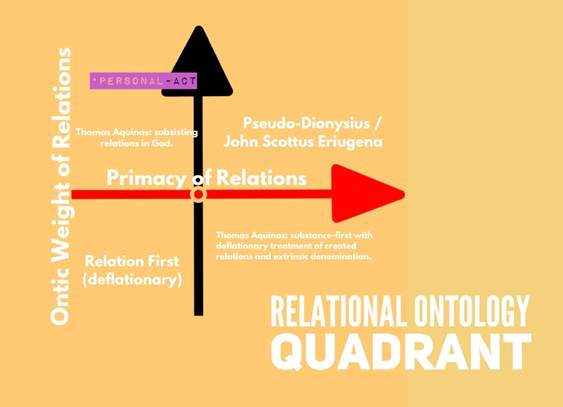
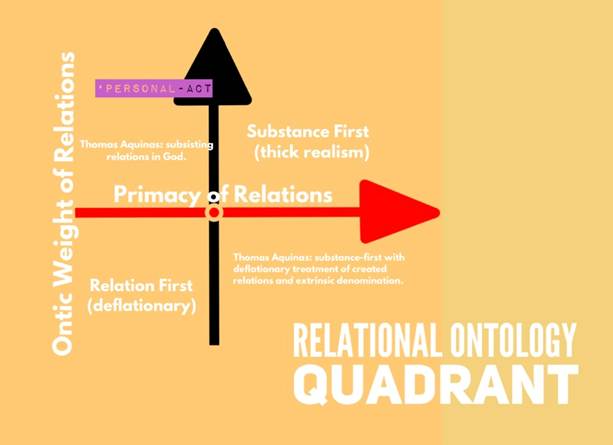
The proposal is the relational quadrant, or map of relation.
The aim is to claim: “a personal-act realist account of donation and plenitude in which personae sunt relationes subsistentes, so that regress is closed by identity rather than by a further unifier. This does not alter the content of classical simplicity; it reorders the explanation. The “relation-first primitive” (or The Transcendental Act-Relational Primitive) states that the one divine essence just is the subsisting relations of origin (Father, Son, and Holy Spirit) in a single, simple personal act, thereby re-grounding simplicity so that Trinity is not something later reconciled with unity, but the very mode in which simplicity obtains, or the very way divine simplicity exists.”
This paper takes those programmatic claims and makes them work. The outcome is a map for thinking relation-first, a primitive that halts regress by identity, and a demonstration that such a proposal neither departs from nor dilutes the classical achievement on divine simplicity but clarifies its order of explanation.
Method: What AI Did and Did Not Do
My experiment began when GPT became publicly available and I put its speed to work sifting, collating, and pressure-testing texts across a large digital library I was fortunate to access. That breadth came by grace from a past grant of thousands of digital books from a publisher and from the institutional access I enjoy through my alma mater, Fuller Theological Seminary. I figured, if I have so many books digitally, let’s put them to work with AI and see what we can learn. So I turned this abundance toward a project already underway on theological relationality and the Trinity, now with AI at my back as a tailwind.
AI functioned as an instrument of speed and juxtaposition. It was not prompted to invent doctrine. It accelerated retrieval across a large corpus, surfaced convergences and tensions, and stress-tested hypotheses against the tradition. In doing so, it helped focus a position that has long been intimated yet rarely systematized under an explicitly relational primitive, which, again, was a project I had already begun. It just put my resources to better use than I can. But I think seeing the result is an interesting endeavor…We’ll talk about the problematic nature of this use of the technology a bit later.
A phenomenological strand proved especially helpful in keeping the center of gravity on givenness and reception rather than on a merely constructivist subject. “To show, to let appear, and to accomplish apparition do not imply any privilege of vision… The issue in phenomenology is no longer exactly what subjectivity apperceives by one or the other of its perceptive tools, but what apparition—through, despite, indeed without them—gives of itself and as the thing itself… The phenomenon shows itself only insofar as it gives itself” (Marion 2002, Book I, §1, 1–2). In Cyril O’Regan’s reading, “One sees with Givenness and Revelation as a whole the operation of a complex strategy to position or reposition the self and/or community aright before the triune God as given in the horizon of phenomenality. There are two complementary aspects of this approach. (1) The first aspect, or first tactic, is more negative in kind and involves removing interpretive‐conceptual obstacles that impede access to the Trinity as the saturated phenomenon or network of saturated phenomena (a corollary of Christ as the saturated phenomenon). (2) The second, and more important, aspect is positive and presentative: it follows the New Testament unveiling of the triune God who breaks into and corrugates the phenomenal field and stretches the self; it also addresses theological interpretation (East and West) faithful to the givenness rendered in the New Testament and avoidant of the doctrinaire pseudomorphosis or distortion that is coeval with fidelity” (O’Regan 2018, 998). Marion adds a methodological anchor: “It is therefore necessary to admit the fact of givenness as the ultimate authority, not backing off from this facticity as if it were an abuse or an impropriety, since givenness indeed, as facticity, remains still absolutely to be determined, hence neutral. In this sense, the fact of givenness is valid de jure… Such a norm attests its primordiality even with respect to the difference… but that do deploy themselves inside the unique givenness” (Marion 2013, §II). O’Regan observes the corresponding opening to theology: “In any event, having secured his phenomenological conceptuality, Marion feels more confident to open out phenomenology to theology without fear of confounding two discourses that have each their own protocols and limits” (O’Regan 2018, 999), while noting a concrete burden that matters in Trinitarian key: “…the burden or burdens of chapter 4 are different: how to give an account of one’s ‘placing’ before the icon such that the icon can have an anamorphic effect; how to be convinced of the reality of the Holy Spirit who precisely does not appear” (O’Regan 2018, 1002–3). Marion’s synthesis concentrates the point: “The phenomenon of revelation not only falls into the category of saturation (paradox in general), but it concentrates the four types of saturated phenomena and is given at once as historical event, idol, flesh, and icon (face). Thus, the phenomenon of revelation, insofar as it manifests as given in a phenomenality that reaches its maximum saturation, refers us back, in its possibility as such, to the givenness that made its very appearance possible” (Marion 2002, Book IV, §23, 142–43). He simultaneously rejects any simplistic immediacy: “That the given is immediate and gives, however, an object already prepared for theoretical knowledge—this is the contradiction that the ‘myth of the given’ presupposes… The given can be thought only in its irreducibility to objecthood… it is in the nature of the given not to give itself immediately… but only when they are subjected to reduction, that is to say, as long as they are mediated” (Marion 2013, §IV). The implication for method is hermeneutical: “The given shows itself only in its reflection, in its reflexive response… hermeneutics manages the gap between what gives itself and what shows itself by interpreting the call (or intuition) by the response (concept or meaning)… The hermeneutic power of the adonné therefore measures ultimately the possibility for what gives itself to show itself… Not only does ‘…the unconditional universality of givenness’ not ‘invalidate the recourse to hermeneutics,’ but, on the contrary, a phenomenology of the givenness reveals phenomena as given only as far as there is in it the use of a hermeneutics” (Marion 2013, §VI). Together with Robyn Horner’s personalist grammar of gift, this situates the project: “In Christian theology, the way in which the relationship between God and human beings is accomplished is frequently described as gift. It is God’s self‐gift that initiates this relationship, facilitates it, and enables it to be sustained. This is the meaning of grace: that God is for the world giver, gift, and giving, a trinity of self‐emptying love who is beyond all imagining, and that in this gift what seems like an impossible relationship is made possible” (Horner 2001, 9–10). Horner’s warning guards the asymmetry of donor and donee: “But such a displacement does not affect the paradox with which we are struggling, namely, the impossibility or the double bind of the gift: For there to be gift, it is necessary that the gift not even appear, that it not be perceived or received as gift … For there to be gift, not only must the donor or donee not perceive or receive the gift as such, have no consciousness of it, no memory, no recognition; he or she must also forget it right away and moreover this forgetting must be so radical that it exceeds even the psychoanalytic categorality of forgetting” (Horner 2001, 15). In Marion’s concentrated idiom, “At the center stands no ‘subject,’ but a gifted, he whose function consists in receiving what is immeasurably given to him, and whose privilege is confined to the fact that he is himself received from what he receives… To receive the Other—that is equivalent first and before all to receiving a given and receiving oneself from it; no obstacle stands between the Other and the gifted… This would no longer concern intersubjectivity or interobjectivity, but intergivenness” (Marion 2002, Book V, 178–80).
There is a way AI now touches papers and the transmission of knowledge that resists a flat description; the only honest response for it is a bit poetic, a bit reflective, beyond the obvious “everything” answer. The AI machine accelerates retrieval and juxtaposition and synthesis with a kind of lucid indifference. Its inhuman speed, proposing seemingly correct sentences on command from a plenitude of power that might as well be nuclear—if speed is your thing, it delivers. After all, much of this piece has been its manufacturing prowess steadily constructing the answer to the questions we set out to answer. The surface work of arrangement, done—and it will continue as such.
As an older researcher who has walked both secular and religious research libraries, and who has had the luxury of conversing with professors on various campuses, I keep in mind the living traffic of word and world that libraries and schools once taught by their very architecture and challenge. Some of what formed me came as much by conversation as by print. An aged professor once leaned across his desk and said that when Paul writes, “See with what large letters I am writing to you,” perhaps he was losing his eyesight. He did not cite a notebook; he handed on an experience. Right or wrong was not the point. What mattered was the cadence of insight borne by a voice and entrusted to a learner. In the same environments the four or five stories of a research library do something similar. They school you by the stairs, by the long aisle between PT and QA, by the way a call number narrows to a single spine you had not planned to pull. Capitalism’s “location, location, location” has nothing on a book’s location and call number. The phenomenology of the search becomes part of the finding. Learning here, in this human form, is going to burn with Alexandria but in small, unnoticed ways, and no one will see or hear because the screen still glows. We are not rejecting the tool; what will be lost will be unknown. For now it pairs well for those like me: its speed with the old arts of lingering, retrieval both old and new serving my dwindling discernment, a companion to this old owl even as I drift toward the dodo; but I am human, so the coo of my melody keeps time in the key of the blues.
It is not only the information that matters but the space that houses it. It is not only the books but the movement of a body among them, the embodied discipline of sustained attention over hours and days. Apprenticeship to a tradition once required traversing a place; that kind of formation does not readily survive. So let us return to relationality and the task at hand.
Framework: A Map of Relation
The project uses a two-axis framework. The horizontal axis asks about primacy: on the left, relation as constitutive act; on the right, substance as prior bearer. The vertical axis asks about ontic weight: at the top, thick realism; at the bottom, deflationary or merely conceptual treatments.
The aim is to locate and test a position in the upper-left quadrant: relation-first with thick realism in a personal-act register. The thesis is that bare structure, if taken as basic, risks compromising simplicity by multiplying principles. By contrast, a personal-act register can name relations as constitutive while preserving identity and unity at the summit.
This approach is measured at each step by Scripture and tradition. “Whoever does not love does not know God, because God is love.” (1 John 4:8, NIV) Gregory of Nazianzus supplies the baseline rule. “the only distinction we recognize in the Godhead is that of relation.” (Gregory of Nazianzus, Oration 31, ch. 10) The same line is echoed for emphasis later: “The only distinction we recognize in the Godhead is that of relation.” (Oration 31, ch.10)
Genealogy I: Augustine’s Personal-Act Grammar
Augustine makes relation constitutive without loss of unity. In De Trinitate he refuses the accident–substance dichotomy for divine naming and anchors the personal names in eternal relations:
“Wherefore nothing in Him is said in respect to accident, since nothing is accidental to Him, and yet all that is said is not said according to substance. For in created and changeable things, that which is not said according to substance, must, by necessary alternative, be said according to accident… But in God nothing is said to be according to accident, because in Him nothing is changeable; and yet everything that is said, is not said, according to substance. For it is said in relation to something, as the Father in relation to the Son and the Son in relation to the Father, which is not accident; because both the one is always Father, and the other is always Son… But because the Father is not called the Father except in that He has a Son, and the Son is not called Son except in that He has a Father, these things are not said according to substance; because each of them is not so called in relation to Himself, but the terms are used reciprocally and in relation each to the other; nor yet according to accident, because both the being called the Father, and the being called the Son, is eternal and unchangeable to them. Wherefore, although to be the Father and to be the Son is different, yet their substance is not different; because they are so called, not according to substance, but according to relation, which relation, however, is not accident, because it is not changeable.” (De Trinitate V.5).
He secures the Spirit’s identity as the divine Gift who is Love:
“And yet it is not to no purpose that in this Trinity the Son and none other is called the Word of God, and the Holy Spirit and none other the Gift of God, and God the Father alone is He from whom the Word is born, and from whom the Holy Spirit principally proceeds… If, then, any one of the three is to be specially called Love, what more fitting than that it should be the Holy Spirit?— namely, that in that simple and highest nature, substance should not be one thing and love another, but that substance itself should be love, and love itself should be substance, whether in the Father, or in the Son, or in the Holy Spirit; and yet that the Holy Spirit should be specially called Love… Next, if there be among the gifts of God none greater than love, and there is no greater gift of God than the Holy Spirit, what follows more naturally than that He is Himself love, who is called both God and of God? And if the love by which the Father loves the Son, and the Son loves the Father, ineffably demonstrates the communion of both, what is more suitable than that He should be specially called love, who is the Spirit common to both?” (De Trinitate XV.17).
His psychological analogies are explicitly relational without compromising unity. “But as there are two things (duo quædam), the mind and the love of it, when it loves itself; so there are two things, the mind and the knowledge of it, when it knows itself. Therefore the mind itself, and the love of it, and the knowledge of it, are three things (tria quædam), and these three are one; and when they are perfect they are equal… For if one loves himself less than as he is… then it is in fault… Also, if knowledge is less than that thing which is known… then knowledge is not perfect… But when the mind knows itself, its own knowledge does not rise above itself… When, therefore, it knows itself entirely… then its knowledge is equal to itself… We said therefore rightly, that these three things, [mind, love, and knowledge], when they are perfect, are by consequence equal.” (De Trinitate IX.4). He pairs this with memory, understanding, and will: “Since, then, these three, memory, understanding, will, are not three lives, but one life; nor three minds, but one mind; it follows certainly that neither are they three substances, but one substance. Since memory, which is called life, and mind, and substance, is so called in respect to itself; but it is called memory, relatively to something… And hence these three are one, in that they are one life, one mind, one essence… But they are three, in that wherein they are mutually referred to each other; and if they were not equal… they certainly could not mutually contain each other; for not only is each contained by each, but also all by each… I remember that I have memory and understanding, and will; and I understand that I understand, and will, and remember; and I will that I will, and remember, and understand; and I remember together my whole memory, and understanding, and will.” (De Trinitate X.11).
Genealogy II: Pseudo-Dionysius and the Relational Plenitude
Dionysius saturates the cosmos with ordered participation. “the Good… by the very fact of being good, sends forth goodness.” (On the Divine Names, ch. 4) He intensifies the personal character of that diffusion: “the divine love (eros) brings ecstasy so that the divine Lover is not content to remain in Himself but goes out into creation.” (On the Divine Names, ch. 4, §13) Citing Plato, he notes that “It [love] causes the lover to belong not to himself but to the beloved.” (Phaedrus 251e, quoted in On the Divine Names, ch. 4, §13) He unfolds the metaphysical scope of the Name Good:
“Now let us consider the name of ‘Good’ which the Sacred Writers apply to the Supra-Divine Godhead in a transcendent manner, calling the Supreme Divine Existence Itself ‘Goodness’ (as it seems to me) in a sense that separates It from the whole creation, and meaning, by this term, to indicate that the Good, under the form of Good-Being, extends Its goodness by the very fact of Its existence unto all things. For as our sun, through no choice or deliberation, but by the very fact of its existence, gives light to all those things which have any inherent power of sharing its illumination, even so the Good (which is above the sun, as the transcendent archetype by the very mode of its existence is above its faded image) sends forth upon all things according to their receptive powers, the rays of Its undivided Goodness. Through these all Spiritual Beings and faculties and activities (whether perceived or percipient) began; through these they exist and possess a life incapable of failure or diminution…” (On the Divine Names, ch. 4, §1, trans. C. E. Rolt).
He defines hierarchy as a pedagogy of participation: “In my opinion a hierarchy is a sacred order, a state of understanding and an activity approximating as closely as possible to the divine. And it is uplifted to the imitation of God in proportion to the enlightenments divinely given to it.” (The Celestial Hierarchy III.1) He restates the irradiating logic of the Good in another rendering: “For as our sun, through no choice or deliberation, but by the very fact of its existence, gives light to all those things which have any inherent power of sharing its illumination, even so the Good (which is above the sun, as the transcendent archetype by the very mode of its existence is above its faded image) sends forth upon all things according to their receptive powers, the rays of Its undivided Goodness. Through these all Spiritual Beings and faculties and activities (whether perceived or percipient) began; through these they exist and possess a life incapable of failure or diminution…” (On the Divine Names IV.1). He gives the ecstatic cadence a doxological concreteness:
“And hence the great Paul, constrained by the Divine Yearning, and having received a share in its ecstatic power, says, with inspired utterance, ‘I live, and yet not I but Christ liveth in me’: true Sweetheart that he was and (as he says himself) being beside himself unto God, and not possessing his own life but possessing and loving the life of Him for Whom he yearned. And we must dare to affirm (for ’tis the truth) that the Creator of the Universe Himself, in His Beautiful and Good Yearning towards the Universe, is through the excessive yearning of His Goodness, transported outside of Himself in His providential activities towards all things that have being, and is touched by the sweet spell of Goodness, Love and Yearning, and so is drawn from His transcendent throne above all things, to dwell within the heart of all things, through a super-essential and ecstatic power whereby He yet stays within Himself.” (On the Divine Names IV.13).
The same tradition insists on holy reserve. “Hierarchy… is a sacred order… assimilated, so far as is attainable, to the divine likeness… uplifted toward the illuminations given it from God…” and “through the perceptible symbols… lifted up to the simple and primordial truth.” The “superessential Deity… is utterly inexpressible… beyond every manifestation.” “By being, [He] bestows being on all… and stands beyond being in the excess of His transcendent superessentiality.”
Genealogy III: Eriugena’s Dynamic Donation
Eriugena gives a dynamic image of procession and return that fits the donation idiom without implying change in God. He begins with the arc of origin and end: “the whole creation proceeds from God as from its principle and returns to God as to its end” (Book I, 441B–C) while God is “altogether immovable, eternal, infinite, incorporeal, invisible, incomprehensible, and unchangeable” (Book II, 535A). He articulates the simultaneity of transcendence and presence: “For the superessential Cause of all things is above all things, and yet is in all things, and all things are in It… It is the essence of all things, and all things participate in It as in their own essence” (Book IV, 791D–792A). He names the intelligible grammar of creatures: “intelligible reasons (logoi) of things visible and invisible… subsist eternally in the Divine Mind” (Book II, 536C). He calls creatures theophanies: “Every visible and sensible creature is an appearance and a theophany… of the invisible and supersensible power” (Book II, 537B). Participation is nothing but donation: “All things which are said to be created participate in that which creates them… and this participation is nothing else but a certain inexhaustible donation of the goodness of the Creator” (Book III, 687B). The world is a manifold showing of one Good: “theophanies or appearances of the Divine Goodness, which is the cause of all that is” (Book II, 535C). He remains dogmatically Trinitarian: “The superdivine Godhead… is Father, Son, and Spirit, three Persons in one essence, incomprehensible and ineffable” (Book I, 481A), naming the “hypostases of the Trinity” (Book V, 987C) and insisting on the mystery of the imago: “as incomprehensible as the Divine Essence itself” (Book IV, 750B). The cadence is expressed in a vivid set of divine “names”: “He runs throughout all things and never stays but by His running fills out all things. For He is the Cause of all motion, since He is Himself superessential motion; and He is the Cause of all rest, since He is Himself superessential rest. Hence He is called ‘He Who runs’.” “He is motion at rest and rest in motion,” “He sets Himself in motion through all things in order that those things which essentially subsist by Him may be” (Periphyseon I, 452C–D). The ontological upshot in metaphysical key is succinct: “Being is intrinsically dynamic, self-communicative and hence relational” (Clarke 1992, 603).
Genealogy IV: Aquinas as Control and Guardrail
Aquinas renders the relation-realism at the summit as a matter of identity with the essence. “In divinis, the relations are subsistent, and are the divine essence itself.” (ST I, q.28, a.2) He states the personalist formula twice for emphasis: “In divinis, the relations are subsistent, and are the divine essence itself.” (ST I, q.28, a.2) He adds: “the persons are the relations subsisting.” (ST I, q.40, a.1; Latin: personae sunt ipsae relationes subsistentes) The line is repeated to keep the measure clear: “The persons are the relations subsisting.” (ST I, q.40, a.1) He cites the patristic rule noted above: “the only distinction we recognize in the Godhead is that of relation.” (Gregory of Nazianzus, Oration 31, ch. 10) In the technical idiom, “A person ‘is nothing but a relation, as regards the formula’.” (ST I, q.40, a.2) This is sharpened further: “The Father is not a different thing from His paternity; rather He is the paternity.” (ST I, q.40, a.2)
Ad extra Aquinas lowers the ontic temperature on purpose to protect immutability and simplicity. “A relation of God to creatures, is not a reality in God, but in the creature; for it is in God in our idea only: as, what is knowable is so called with relation to knowledge, not that it depends on knowledge, but because knowledge depends on it.” (ST I, q.13, a.7) He repeats the same point: “A relation of God to creatures, is not a reality in God, but in the creature; for it is in God in our idea only.” (ST I, q.13, a.7) He states the correlative maxim: “The creature is really related to God; God is not really related to the creature.” (ST I, q.28, a.1, ad 3) Again for emphasis: “The creature is really related to God; God is not really related to the creature.” (ST I, q.28, a.1, ad 3) The logical correlate is extrinsic denomination: “As regards relative things, we must admit extrinsic denomination: a thing is denominated ‘placed’ from place, ‘measured’ from measure.” (ST I, q.6, a.4) He restates it concisely: “As regards relative things, we must admit extrinsic denomination.” (ST I, q.6, a.4)
Scotus gives a lapidary gloss on creaturely dependence that is helpful for the map: “The effect’s whole being is ‘from another’ — which is almost like saying ‘to be created is to-be-related (as from another)’.” (Ordinatio II, d.1) The same thought is usefully repeated for clarity: “The effect’s whole being is ‘from another’ — which is almost like saying ‘to be created is to-be-related (as from another)’.” (Ordinatio II, d.1)
W. Norris Clarke draws the metaphysical moral: “make explicit the intrinsically relational character of person and being.” (Communio 19, 1992, 601) He develops it in several aphorisms: “Being is intrinsically dynamic, self-communicative and hence relational.” (603) “substance-in-relation.” (602) “to be is to be together.” (610) The core sentence will serve as a refrain below: “Being is intrinsically dynamic, self-communicative and hence relational.” (Communio 19, 603). The exhortation stands as a programmatic guide: “Make explicit the intrinsically relational character of person and being.” (Clarke, 601)
Genealogy V: Franciscan Fecundity and Victorine Charity
A Franciscan register of exemplarity strengthens the gift-logic. “Like Alexander before him, Bonaventure’s approach is exemplarist and Platonic, allowing his trinitarian theology to privilege the Second Person (Word or Logos) as medium for creation. Bonaventure unites the primordial fecundity of the Father with the principle of self-diffusive goodness. Divine life is a fountain fullness (fons plenitudinis). Platonic exemplarity forms the unfolding of all reality, coming forth from God (exitus) and defining the return of all things to God (reditus). Divine ideas, present in the Logos, serve as models for all created reality which mirrors the Trinity.” (Franciscan Theology, St Andrews Encyclopaedia of Theology, §4.2.2) Bonaventure focuses the distinction between necessary plenitude and free donation: “In the Trinity, the diffusion of goodness is necessary and intrinsic to God’s essence: the Father’s infinite goodness, as the unbegotten Principle (fons plenitudinis), eternally generates the Son through a natural procession (per modum naturae) and, together with the Son, spirates the Holy Spirit through a voluntary procession (per modum voluntatis), distinguishing the Persons by relations of origin while preserving their coequality and consubstantiality. This supreme communicability of the good ensures the divine communion’s eternal fullness without subordination. For creation, however, the diffusion of goodness is not necessary but contingent—a free, kenotic overflow into finite reality, manifesting God’s self-sufficiency as ecstatic love rather than hierarchical necessity, allowing creatures to participate as a ‘center or point’ in the divine immensity.” (Breviloquium I.3, as explicated in Theological Studies 60.2 [1999], 251–266)
Richard of Saint Victor gives the charity-logic that undergirds a personal-act emphasis. “No one is said to have charity if he loves only himself.” (De Trinitate III.2) Otherwise, “his charity would be disordered, if he were loving supremely someone who should not be loved supremely.” (III.2) Charity multiplies its beloved: “It is characteristic of true charity that it wishes another to be loved by the one whom you love, just as you are.” (III.14) Hence the Victorine maxim: “love needs two, but perfect love requires three.” (De Trinitate, Book III)
Genealogy VI: Analogy, Transcendence, and the Rule of Speech
Przywara articulates the rhythm that must shape any talk of Creator and creature. “The correlate of analogy in metaphysics is the analogy in religion: as formulated by the Fourth Lateran Council (1215) in the second chapter of its decrees. Whereas the Aristotelian analogy posits the ‘ἄλλο πρὸς ἄλλο,’ the proportion between two X’s, as the form of every metaphysics, the Lateran analogy, as the form of any religion, posits a ‘maior dissimilitudo,’ an ‘ever greater dissimilarity,’ arising out of every ‘tanta similitudo,’ every ‘similarity, however great,’ for every conceivable ‘interval between God and creature.’ Just as, in the case of the Aristotelian metaphysical analogy, all commonality in ‘genus, species, and number’ is merely the horizon of the final dawn of the ‘ἄλλο πρὸς ἄλλο’—of, that is, the ‘wholly other’ as what is ultimate in all ‘similarities’—so too, in the case of the Lateran religious analogy, the ‘wholly other’ of an ‘ever greater dissimilarity’ holds true in the midst of ‘every similarity, however great’ between ‘Creator and creature’ as such.” (Analogia Entis, 62) The council’s sentence is a standing rule of humility. “For between creator and creature there can be noted no similarity so great that a greater dissimilarity cannot be seen between them.” (Lateran IV, Constitution 1: Firmiter) The same rule is restated for emphasis: “Between Creator and creature no similarity so great that a greater dissimilarity cannot be seen.” (Lateran IV, Constitution 1: Firmiter) And again, “Between Creator and creature no similarity can be noted, however great, without being compelled to observe a greater dissimilarity.” The metaphysical side of this caution is equally important, including the sense of “transcendental.” “Since especially the Kantian understanding of the transcendental has been influential for modern minds, it must be emphasized at the outset that the medieval understanding of transcendental is not opposed to the empirical, but to the categorical; in fact, all medieval authors acknowledge an empirical origin of the transcendental notions.” (Stanford Encyclopedia of Philosophy, “Medieval Theories of Transcendentals,” §1) The same clarification bears repeating: “Since especially the Kantian understanding of the transcendental has been influential for modern minds, it must be emphasized at the outset that the medieval understanding of transcendental is not opposed to the empirical, but to the categorical; in fact, all medieval authors acknowledge an empirical origin of the transcendental notions” (SEP, “Transcendentals,” §1).
Ratzinger, LaCugna, Zizioulas: Relational Ontology Stated
Ratzinger sees the significance of this shift. He writes that in the Christian confession there “lies concealed a revolution in man’s view of the world: the undivided reign of substance-thinking is ended; relation is discovered as an equally primordial mode of reality” (Introduction to Christianity, 132). He later remarks that medieval thinkers “did not exploit this remarkable intellectual achievement for the philosophical explanation of the person” (Communio 13 [1990], 442) and that “St. Thomas… shrank back from applying the revolution outside of Trinitarian theology” (Introduction to Christianity, 137). He also describes the form of eternal generation in personal terms: “the first Person does not beget the second as a part of Himself…but as the communication of His entire self… In God, person is the pure relativity of being turned toward the other.” (Introduction to Christianity, 90–91) This matches LaCugna’s dictum that “The nature of God is to be in relation.” (God for Us, 273) and its repetition in a later relational focus: “The nature of God is to be in relation.” (LaCugna, later echoed by Benedict’s relational focus). Zizioulas provides the complementary ontological thesis: “The person is an ontological category of being-in-communion.” (Being as Communion, 15) The same sentence bears repeating in the synthesis that follows: “The person is an ontological category of being-in-communion.” (Zizioulas, 15) Ratzinger’s insight is again programmatic in short form: “Relation is discovered as an equally primordial mode of reality.” (Introduction to Christianity, 132)
Benedict XVI translates the logic of relation into discipleship’s center of gravity: “Being Christian is not the result of an ethical choice or a lofty idea, but the encounter with an event, a person, which gives life a new horizon and a decisive direction.” (Deus Caritas Est, 1) He adds the personalist endpoint: “God is not solitude, but perfect communion. For this reason the human person, the image of God, realizes himself or herself in love, which is a sincere gift of self.” (Angelus, Trinity Sunday, May 22, 2005)
The Primitive: Halting Regress by Identity
Metaphysically, the proposal names a primitive in Benovsky’s sense. “Such primitives are what I call problem-solvers. A problem-solver is a primitive that is there to solve a problem. The theories we have seen above all answer the question of attribute agreement (i.e. the question about how two objects can ‘share the same property’) by appealing to their primitives: the relation of exact resemblance between tropes, the instantiation of the same universal, or the fact that a and b resemble each other. In the same crucial places, all three views introduce a primitive with the same function: primitively answer the question (‘In virtue of what are A and B both F?’). Problem solved. With a problem-solver. Problem-solvers are commonplace in metaphysics, and in philosophy in general; without them we would not get very far. Primitive problem-solvers are the pillars that sustain the structures of our theories” (Benovsky 2020, 290). The closure is by identity rather than by a further mechanism. “In this example, the relation between the explanandum and the explanans is simply identity. We have a similar situation in the case of our example concerning attribute-agreement: for instance, we can say that the explanandum is the sharing of the same property, while the explanans is the instantiating of the same immanent universal. In this case, we can say that sharing the same property just is instantiating the same universal, exactly as lightning just is atmospheric electric discharge… To have another example, according to the substratum theory, numerical diversity of the two spheres in Black’s world just is or consists in their having a numerically different substratum. So, can we say that the relation between a primitive problem-solver and the phenomenon it explains is identity?” (Benovsky 2020, 298). The meta-question is salutary: “One can then raise the meta-metaphysical and methodological question: when it comes to the problem of attribute agreement, what difference does it really make to pick one theory rather than another? The current debate in metametaphysics provides a lot of discussion in the neighborhood of this question, even if the discussion typically does not focus on primitives. For instance, Hirsch (2005, 2007, 2008) defends a claim of equivalence between endurantism and perdurantism; in his view, these debates are merely verbal disputes… To come back to our examples above, in Benovsky (2008), I argue for an equivalence claim between (various versions of) the bundle theory and the substratum theory. In my view, the question that arises is: at the end of the day, if competing theories answer their theoretical challenges by appealing to their primitives, what difference does it make…?” (Benovsky 2020, 291; cf. Benovsky 2008).
The primitive proposed here functions as a problem-solver for the Trinity–simplicity tension. It states, in the paper’s central claim quoted at the start, that Trinity is not an afterthought to unity but the very way simplicity exists. The statement bears repeating in its programmatic form: “The ‘relation-first primitive’ (or The Transcendental Act-Relational Primitive) states that the one divine essence just is the subsisting relations of origin (Father, Son, and Holy Spirit) in a single, simple personal act, thereby re-grounding simplicity so that Trinity is not something later reconciled with unity, but the very mode in which simplicity obtains, or the very way divine simplicity exists.”
In other words, the explanandum and explanans stand in identity at the summit. Gregory’s maxim still governs: “the only distinction we recognize in the Godhead is that of relation.” (Oration 31, ch.10) Aquinas’s equivalent formulas supply the guardrail: “In God, the relations are subsistent persons in one nature.” (ST I, q.40, a.1) “The Father is not a different thing from His paternity; rather He is the paternity.” (ST I, q.40, a.2)
The Horizon and Inscription Idiom
A brief idiom helps readers see how the primitive plays out in God and in creatures. The Horizon is the unchanging plenitude of the one divine act as exemplar measure. Inscription is the creaturely, temporal reception of that act, the gifted fit by which the one shows itself in many modes without any change in God. Inscription belongs to the side of receivers and signs. The Horizon belongs to the giver.
On the economy’s side this means that God’s missions add nothing to God, which the tradition says with doctrinal succinctness. “The temporal missions… add nothing to the Trinity except an extrinsic ordering to the creature.” (Council of Florence, 1442) The same sentence will be repeated below when liturgy is in view: “The temporal missions… add nothing to the Trinity except an extrinsic ordering to the creature.” (Council of Florence, 1442)
As metaphor we can speak of this idiom like this… Imagine music at its source as a simple, inexhaustible theme that sounds whether or not anyone plays it; that unbroken pulse is the Horizon, the giver that does not shift or fragment. Scores, instruments, rooms, and players are the receivers; each takes up the same theme according to range, color, and technique. A string quartet, a gospel choir, a pipe organ, a lone saxophone at midnight, each inscribes the theme in its own voicing, key, tempo, and articulation. The composer is not altered, nor is the theme’s identity; what varies is touch and timbre, tuning and timing, the acoustics that cradle the sound, the skill and intention of the performer. What we actually hear in time is the Inscription, the one theme fitted into concrete sound, shaped by bodies and breath, by wood and brass and air, so that faithful performance draws near to the source without ever becoming the source itself.
Ok, let’s change senses… Picture a cathedral at noon: the sun’s steady white light is the Horizon, the simple, inexhaustible source that does not shift or subdivide; it just gives. The stained-glass windows are creatures and histories, each pane with its own hue, thickness, and texture receiving that one light according to its capacity. Some panes are clear and thin, some dense or clouded, some cut into intricate figures; what varies is the transparency, color, and arrangement of the glass, not the sun. What appears inside on the stone floor and walls—the moving patches of color and figure—is the Inscription: the source’s measure fitted into a medium, a real manifestation shaped by the window’s materials, lead lines, and angles. The sun does not change; inscription changes as panes differ and as the day’s angle shifts, showing how one act of light can yield many faithful renderings without any alteration in the giver.
The Horizon just is the relation-first primitive on God’s side—the one simple personal act in which the subsisting relations of origin obtain—whereas Inscription is that same act’s creaturely, extrinsic reception in time (the missions/effects), multiplying manifestations without multiplying anything in God.
The Liturgy as Test of the Primitive
In the Eucharist the primitive can be tested in a concrete and ecclesial register. The dominical words state the givenness: “And he took bread, gave thanks and broke it, and gave it to them, saying, ‘This is my body given for you; do this in remembrance of me.’ In the same way, after the supper he took the cup, saying, ‘This cup is the new covenant in my blood, which is poured out for you.’” (Luke 22:19–20, NIV) The liturgy’s doxology shows the provenance in Trinitarian form: “Through him, and with him, and in him, O God, almighty Father, in the unity of the Holy Spirit, all glory and honor is yours, for ever and ever.” (Roman Canon, Doxology) The Church knows that praise adds nothing to God and perfects us. “For, although you have no need of our praise, yet our thanksgiving is itself your gift, since our praises add nothing to your greatness but profit us for salvation.” (Preface IV, Roman Missal)
Scripture wraps the economy in donor logic and immutability. “You love all things that are, and loathe nothing that you have made.” “Every good gift and every perfect gift is from above, coming down from the Father of lights, with whom there is no variation.” “In him we live and move and have our being.” “I the LORD do not change. So you, the descendants of Jacob, are not destroyed.” (Malachi 3:6, NIV) The same immutability is stated again for emphasis: “I the LORD do not change.” (Malachi 3:6, NIV) The Christological scope is comprehensive: “For in him all things were created: things in heaven and on earth, visible and invisible, whether thrones or powers or rulers or authorities; all things have been created through him and for him.” (Col 1:16, NIV) The eschatological horizon is likewise personal and ordered to communion: “When he has done this, then the Son himself will be made subject to him who put everything under him, so that God may be all in all.” (1 Cor 15:28, NIV)
De Lubac’s famous sentence marks the ecclesial effect: “The Eucharist makes the Church.” (Catholicism, ch. 4) Aquinas frames the infused form of friendship with God that flows from this economy: “Charity… is a friendship of man with God.” (ST II-II, q.23, a.1) The Council of Trent points to the Spirit as the donor of that very charity: “The charity of God is poured forth by the Holy Ghost, in the hearts of men.” (Session VI, ch. 7, citing Rom 5:5) Jesus names the friendship and its provenance: “I no longer call you servants, because a servant does not know his master’s business. Instead, I have called you friends, for everything that I learned from my Father I have made known to you.” (John 15:15, NIV)
Scripture’s Arc and the Personal-Act Register
The New Testament’s love-logic resonates with the personal-act primitive. It begins, as already cited, “Whoever does not love does not know God, because God is love.” (1 John 4:8, NIV) It runs through the gifts given “from above” and the life in which “we live and move and have our being.” The primitive’s explanatory order lets us say why such sentences do not burden God with new relations. Aquinas has already taught us how to speak of God’s relations to creatures: “A relation of God to creatures, is not a reality in God, but in the creature; for it is in God in our idea only.” (ST I, q.13, a.7) “The creature is really related to God; God is not really related to the creature.” (ST I, q.28, a.1, ad 3) “As regards relative things, we must admit extrinsic denomination.” (ST I, q.6, a.4)
Re-Statement of the Primitive and Its Catholicity
The primitive is relation-first in a personal-act register. It does not subvert the content of classical simplicity. It reorders the explanation by placing the idiom of subsisting relations at the beginning of metaphysical description rather than at the end. The crucial Aquinas lines are worth gathering again as a compact of Catholicity. “In divinis, the relations are subsistent, and are the divine essence itself.” (ST I, q.28, a.2) “The persons are the relations subsisting.” (ST I, q.40, a.1) “The Father is not a different thing from His paternity; rather He is the paternity.” (ST I, q.40, a.2)
Gregory’s maxim remains definitive: “the only distinction we recognize in the Godhead is that of relation.” (Gregory of Nazianzus, Oration 31, ch. 10) Ratzinger’s insight points to the broader metaphysical consequence: “Relation is discovered as an equally primordial mode of reality.” (Introduction to Christianity, 132)
A Word on Transcendentals and Measure
The primitive is transcendental in the medieval sense, which must not be confused with Kantian usage. “Since especially the Kantian understanding of the transcendental has been influential for modern minds, it must be emphasized at the outset that the medieval understanding of transcendental is not opposed to the empirical, but to the categorical; in fact, all medieval authors acknowledge an empirical origin of the transcendental notions.” (Stanford Encyclopedia of Philosophy, “Medieval Theories of Transcendentals,” §1) The same correction is usefully repeated: “Since especially the Kantian understanding of the transcendental has been influential for modern minds, it must be emphasized at the outset that the medieval understanding of transcendental is not opposed to the empirical, but to the categorical; in fact, all medieval authors acknowledge an empirical origin of the transcendental notions” (SEP, “Transcendentals,” §1). Przywara’s formulation on unity-in-tension helps one hear the rule: “…to comprehend the individually diversified fullness of things: a differentiated universalism of the ‘unity-in-tension between individual and community’” (Analogia Entis, xxiii).
The Personal-Act Register and Aquinas’s Act
The personal-act register honors Aquinas’s axiom about activity and actuality: “From the very fact that something exists in act, it is active. Active power follows upon being in act, for anything acts in consequence of being in act.” (SCG I, ch. 43) In Clarke’s synthesis, already cited, this means that “Being is intrinsically dynamic, self-communicative and hence relational.” (Communio 19, 603)
Trinity, Unity, and the Reordered Explanation
At this point the original guiding sentences can be reiterated as a conclusion-in-advance. “Thus, AI contributes to this project not by inventing doctrine but by accelerating retrieval and mapping, bringing into focus a relation-first position rarely systematized in this explicit form: a personal-act realist account of donation and plenitude in which personae sunt relationes subsistentes, so that regress is closed by identity rather than by a further unifier. This does not alter the content of classical simplicity; it reorders the explanation. The ‘relation-first primitive’ (or The Transcendental Act-Relational Primitive) states that the one divine essence just is the subsisting relations of origin (Father, Son, and Holy Spirit) in a single, simple personal act, thereby re-grounding simplicity so that Trinity is not something later reconciled with unity, but the very mode in which simplicity obtains, or the very way divine simplicity exists.”
Two Clarifications
First, the primitive does not collapse immanent and economic Trinities into an identity of content but articulates their identity of referent with a difference of terminus and mode. Rahner’s axiom remains a sanity check. “The ‘economic’ Trinity is the ‘immanent’ Trinity, and the ‘immanent’ Trinity is the ‘economic’ Trinity.” (The Trinity, 22) The Church’s dogmatic caution about missions remains in force: “The temporal missions… add nothing to the Trinity except an extrinsic ordering to the creature.” (Council of Florence, 1442)
Second, the primitive preserves, not weakens, the Church’s confession of immutability. “I the LORD do not change. So you, the descendants of Jacob, are not destroyed.” (Malachi 3:6, NIV) The sentence is worth hearing again in its stark simplicity: “I the LORD do not change.” (Malachi 3:6, NIV)
A Pastoral Glance Back to Scripture
The primitive is not a speculative flourish. It guards the grammar in which the Gospel is named and preached. The measure remains love. “Whoever does not love does not know God, because God is love.” (1 John 4:8, NIV) The Son in whom all things were made is the same Son who hands himself over in the Eucharist, under the doxology that declares the Father as source and the Spirit as unity of love. “Through him, and with him, and in him, O God, almighty Father, in the unity of the Holy Spirit, all glory and honor is yours, for ever and ever.” (Roman Canon, Doxology) Charity proves to be friendship. “Charity… is a friendship of man with God.” (ST II-II, q.23, a.1) That friendship is given. “The charity of God is poured forth by the Holy Ghost, in the hearts of men.” (Council of Trent, Session VI, ch. 7) The Lord names it: “I no longer call you servants, because a servant does not know his master’s business. Instead, I have called you friends, for everything that I learned from my Father I have made known to you.” (John 15:15, NIV)
Conclusion
The Primitive (The so called Transcendental Act-Relational Primitive) contributes to the tradition not by changing the content of classical simplicity but by reordering the explanation so that relation-first language is basic rather than supplemental. And in a sense, we can say AI collated this all to constructively contribute to theology. In God the relations subsist and are identical with the essence. Therefore, Trinity is not later reconciled with unity but is the very way simplicity exists. This closes regress by identity rather than by a further unifier and allows a full affirmation of the Church’s rule of analogy, of the immutability of the Giver in the missions, and of the sacramental specification of grace without compromise of divine simplicity.
It is fitting to end in the register of praise, doctrine, and person. Benedict’s lines turn the metaphysical insight into a spiritual horizon: “God is not solitude, but perfect communion. For this reason, the human person, the image of God, realizes himself or herself in love, which is a sincere gift of self.” (Angelus, Trinity Sunday, May 22, 2005)
Bibliography (Chicago Author–Date)
Aquinas, Thomas. Summa Theologiae. Translated by the Fathers of the English Dominican Province. New York: Benziger Brothers, 1947–48.
Aquinas, Thomas. Summa Contra Gentiles. Translated selections.
Augustine. De Trinitate. Translated selections.
Benovsky, Jiri. 2008. “The Bundle Theory and the Substratum Theory: Deadly Enemies or Twin Brothers?” Philosophical Studies 141 (1): 175–190.
Benovsky, Jiri. 2020. “Primitives.” In The Routledge Handbook of Metametaphysics, 289–301. London: Routledge.
Benedict XVI. 2005. Deus Caritas Est. Vatican City.
Benedict XVI. “Angelus Address,” Trinity Sunday, May 22, 2005.
de Lubac, Henri. Catholicism: Christ and the Common Destiny of Man. San Francisco: Ignatius, 1988.
Dionysius the Areopagite. The Celestial Hierarchy. In Pseudo-Dionysius: The Complete Works, translated by Colm Luibheid. New York: Paulist Press, 1987.
Dionysius the Areopagite. On the Divine Names and The Mystical Theology. Translated by C. E. Rolt. London: SPCK, 1920.
Horner, Robyn. 2001. Rethinking God as Gift. New York: Fordham University Press.
LaCugna, Catherine Mowry. 1991. God for Us. San Francisco: HarperSanFrancisco.
Marion, Jean-Luc. 2002. Being Given: Toward a Phenomenology of Givenness. Stanford: Stanford University Press.
Marion, Jean-Luc. 2013. Givenness and Hermeneutics. Milwaukee: Marquette University Press.
O’Regan, Cyril. 2018. “Givenness and Revelation.” Modern Theology 34 (4): 979–1008.
Przywara, Erich. 2014. Analogia Entis: Metaphysics—Original Structure and Universal Rhythm. Translated by John R. Betz and David Bentley Hart. Grand Rapids: Eerdmans.
Rahner, Karl. 1970. The Trinity. New York: Herder and Herder.
Ratzinger, Joseph. 1970. Introduction to Christianity. New York: Herder and Herder.
Richard of Saint Victor. De Trinitate. Translated selections.
Scotus, John Duns. Ordinatio. Translated selections.
Stanford Encyclopedia of Philosophy. “Medieval Theories of Transcendentals.” Accessed as cited.
The Holy Bible, New International Version (NIV).
W. Norris Clarke. 1992. “Person, Being, and St. Thomas.” Communio 19: 601–610.
Zizioulas, John D. 1985. Being as Communion. Crestwood, NY: St Vladimir’s Seminary Press.
Conciliar Documents
Fourth Lateran Council (1215), Constitution 1: Firmiter.
Council of Florence (1442), Decree for the Jacobites.
Council of Trent (1547), Session VI, ch. 7.
Liturgy
Roman Missal, Preface IV, Ordinary Time.
Roman Canon, Eucharistic Prayer I, Doxology.
Scripture Citations
1 John 4:8; Luke 22:19–20; Malachi 3:6; Colossians 1:16; 1 Corinthians 15:28; John 15:15; Wisdom 11:24; James 1:17; Acts 17:28.
Postscript on Coverage of the Quoted Materials
For the reader’s convenience: every quoted sentence supplied to the AI for inclusion has been reproduced verbatim within the body of the essay: Scripture and Augustine ground the personal-act register; Dionysius and Eriugena articulate participation and donation; Aquinas supplies the control case; the Franciscan and Victorine lines sharpen theological charity; Przywara, Ratzinger, LaCugna, and Zizioulas register relational ontology; Benovsky provides the metametaphysical hinge; and the liturgy tests the primitive in ecclesial practice.