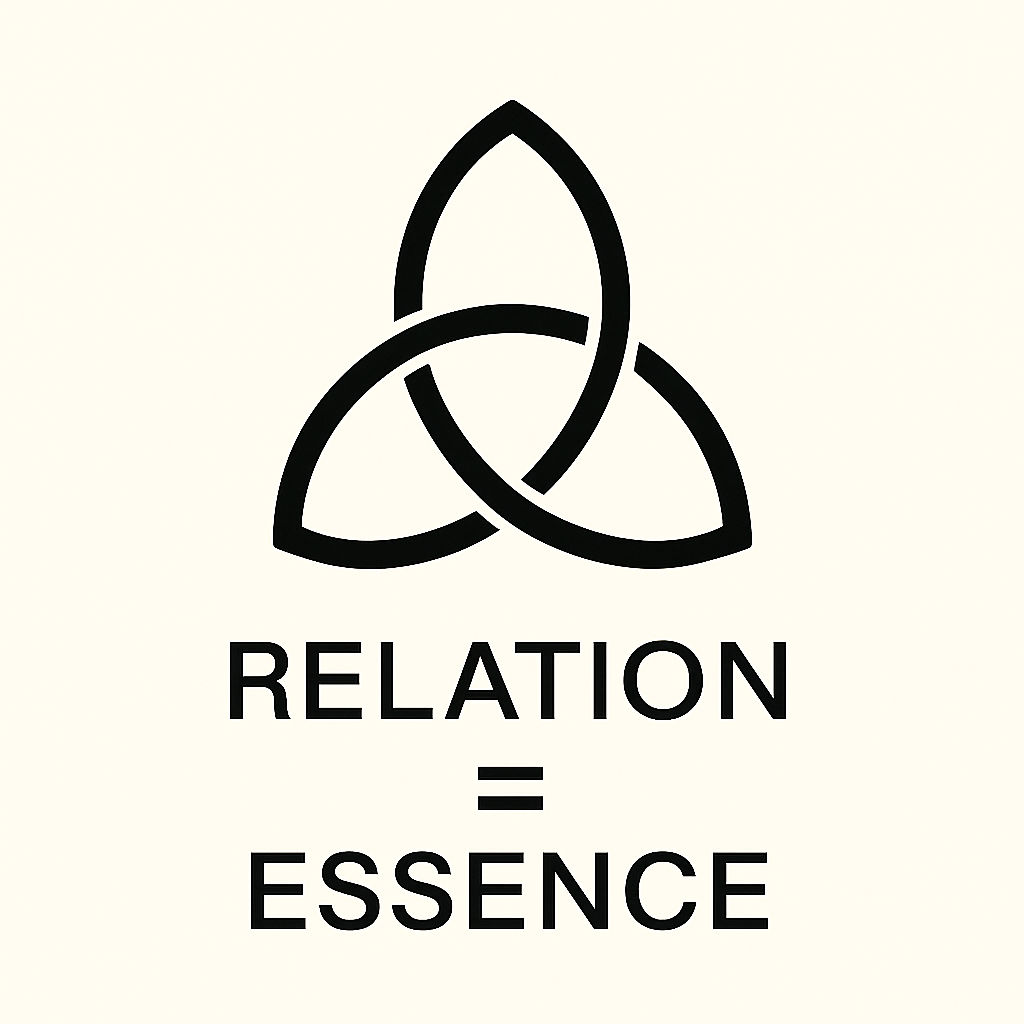
Relational Gift-Ontology
At the heart of my theological experiment is an attempt to frame theology through
relationality as first,
or through the logic of Gift. A relational first ontology claims that the Trinity’s subsistent relations of origin,
Father as unoriginated source, Son as begotten reception and return, and Holy Spirit as proceeding shared communion,
are not added onto a prior “God behind God,” but are the one simple divine actuality itself, confessed as love.
This is not an event in God and not a process of divine becoming. It is a disciplined way of saying that whatever is true of God in se
must be true by non-composition, as the one indivisible act that simply is God, and that all novelty belongs term-side in what is given.
So whether you call this the Principle of Relationality or a Relational Gift Ontology, the idea is straightforward,
even while the discipline is strict. Reality is understood from a single, indivisible act of self-gift, symbolized as
G.
In God, G names the one divine essence as personally subsisting by relations of origin, without partition and without parts.
“Relation” in God is not an added link but the very mode of the one divine reality: from the Father, through the Son, in the Holy Spirit.
In creation, every finite being is a real gift-term, a “this” with its own nature and integrity, whose act of existing is received from God
and sustained by God, and whose history, contingency, and differentiation are instituted effect-side.
My origin-tag language is meant to track that creaturely provenance and continuity across change as a received, finite mode of being,
not as univocal sharing in the divine mode. Under the Catholic analogy of being, the likeness is real and the dissimilarity is ever greater,
so God is not a network and creatures are not merely relations, but creatures are subsistent terms whose relations are founded in what they are and do.
Jean-Luc Marion supplies a phenomenological key: “Love does not give something; it gives itself and gives itself as giving.”¹
In his language the phenomenon never appears as a neutral datum; it arrives under a generosity that exceeds both object and subject.
Theologizing that insight does not tame its excess. It locates its fountainhead and it keeps God from being quietly reduced to a manageable concept.
The triune God is the giver by non-composition, and the creature is the receiver by participation, so that God gives without becoming and the world truly becomes.
For more see:
Introduction to the Principle of Relationality in Catholic Thought – RobertDryer
¹ Jean-Luc Marion, The Erotic Phenomenon, trans. Stephen E. Lewis (Chicago: University of Chicago Press, 2007), 110.